
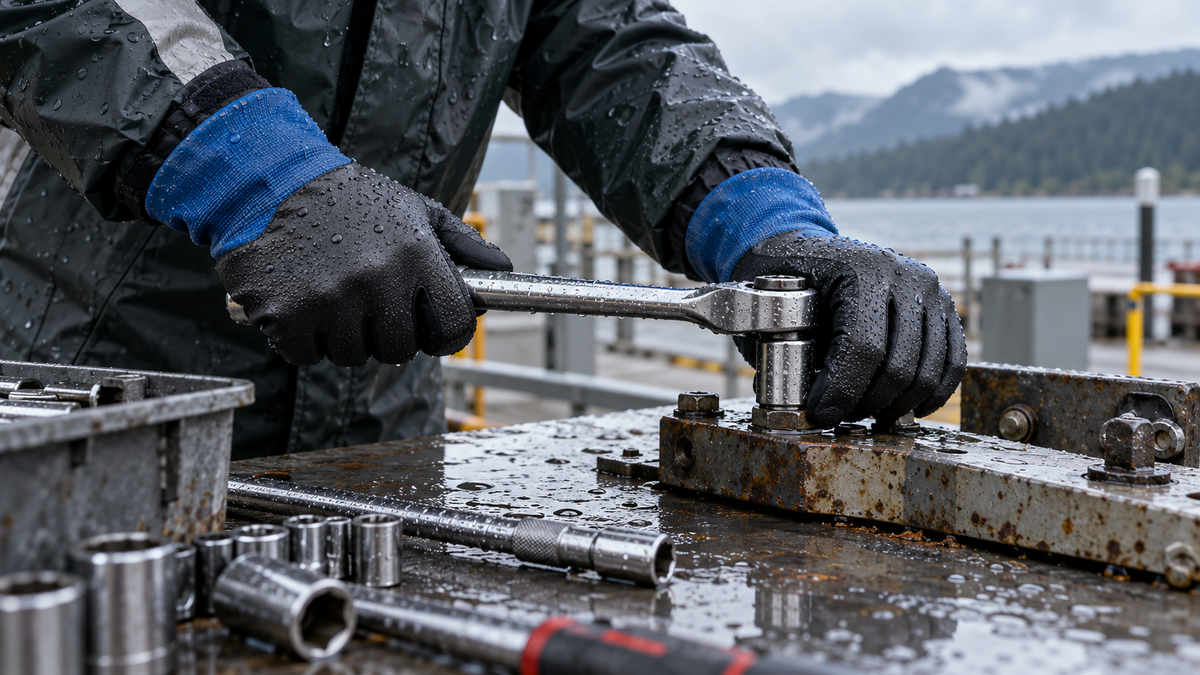
Quick Answer
The best waterproof work glove is the one that keeps water out at the actual point of contact while preserving the grip and finger control the task needs. Check the palm, back, seams, and cuff separately: a water-resistant palm is not necessarily a waterproof glove. Match protection for cuts, chemicals, heat, or machinery hazards before trialing sizes with wet tools and materials.
Who This Guide Is For
This guide is for crews handling rain-soaked equipment, damp materials, washdown tools, or wet outdoor deliveries. It is educational and does not replace a workplace hazard assessment, product instructions, chemical safety data, or applicable OSHA and state requirements.
Find Out Where the Water Enters
A worker can stay dry in a short demonstration and end the shift with wet hands. Water may soak through a fabric back, run over the cuff during overhead work, enter at a seam, or collect inside from sweat. These are different failures and call for different glove designs.
Use the task as your test. Is the worker briefly touching damp cartons, handling rain-wet pipe, or repeatedly reaching into a wet container? How long is contact? Is the water clean, mixed with detergent, or potentially contaminated? If chemical exposure is possible, do not treat a weatherproof coating as chemical protection. OSHA's hand-protection rule requires selection according to task, conditions, duration, and identified hazards.
| Work condition | Feature to inspect | Field test |
|---|---|---|
| Splash or brief damp handling | Palm coating and back-of-hand material | Grip and flex after repeated splashes. |
| Sustained rain or wet contact | Full-shell or membrane design, sealed seams | Wear through a representative work period. |
| Reaching downward into water | Cuff length and overlap with sleeve | Check for water entering when the arm moves. |
| Overhead wet work | Cuff direction and drainage | Check whether runoff enters the glove. |
| Wet oily or soapy surfaces | Surface-specific grip and chemical compatibility | Test the actual material and consult manufacturer data. |
Start with work gloves and narrow by the task, not by a broad “waterproof” search alone. The winter work gloves guide covers insulation; this guide is about wet handling in any season.
Waterproof, Water-Resistant, and Coated Are Not Synonyms
“Water-resistant” usually signals that a material sheds some moisture. “Waterproof” is a stronger claim, but the product description should explain where the barrier is and how the glove is constructed. A coated knit glove may have a dry palm while its exposed knit back absorbs rain. A membrane glove may resist water through the shell but still let it in at the cuff. Ask the supplier for the maker's construction and test information rather than translating a label into a promise about every job.
Grip must be evaluated separately. Water can change the friction between a glove and a smooth handle; oil or soap can change it again. Have workers use the common tool, fastener, package, and control in a supervised trial. A glove that stays dry but slips when turning a wet valve is not a good match. Conversely, an aggressively textured palm may grip well but be too bulky for a small fastener.
Dexterity should be tested after the glove is wet, not only straight from the box. A lining can shift when the wearer removes and re-dons a damp glove. Ask whether fingers still reach the ends, whether the palm twists on a handle, and whether the worker can operate a control without removing the glove. Poor fit is a practical reason protective gloves end up on a bench rather than on hands.
Match the Other Hazard Before Choosing the Weather Feature
The same wet task may include sharp sheet metal, abrasive concrete, cold surfaces, or chemical cleaner. Waterproofing does not establish cut resistance, and thickness does not establish chemical compatibility. OSHA's nonmandatory PPE selection guidance notes that no glove protects against every hazard and advises obtaining manufacturer documentation for anticipated exposures.
For sharp edges, compare the actual cut-rating information and task in the cut-resistant glove guide. For detergents, solvents, or cleaning chemicals, use the product's safety data sheet and the glove maker's chemical-resistance chart for the exact substance and contact duration. A generic “waterproof” listing is not a substitute for those data.
Machinery hazards require a separate assessment. Gloves can create an entanglement risk around rotating parts. Do not solve a wet-grip problem by issuing a glove near unguarded rotating machinery without reviewing the task and procedures.
A Crew Trial That Takes Less Time Than a Bad Bulk Order
- List the wet tasks, contact duration, and any non-water hazards.
- Select two or three glove constructions with documented properties.
- Fit each worker using the exact manufacturer's size chart.
- Test wet grip, fingertip control, and cuff behavior on the real task.
- Repeat after a normal break and re-donning.
- Record which model and size worked, plus cleaning and replacement instructions.
Trial both a light and a sustained-contact scenario when a crew does both. One model may serve loading-dock handoffs; another may be needed for a prolonged washdown. Do not force one glove to cover incompatible tasks simply to simplify purchasing.
Care, Drying, and Replacement
Inspect for worn palms, punctures, split seams, damaged membranes, loose liners, and cuffs that no longer hold their shape. Follow the maker's cleaning and drying instructions; heat or harsh chemicals can damage some coatings and laminates. Replace gloves when damage or persistent leakage means they no longer meet the task. Keep a dry spare pair available where gloves may become saturated. NIOSH notes that wet PPE can irritate skin, and prolonged moisture inside a glove deserves attention rather than being accepted as normal.
Common Mistakes
- Assuming a coated palm makes the entire glove waterproof.
- Testing grip only when gloves and tools are dry.
- Ignoring the direction water flows at the cuff.
- Choosing a thick glove that prevents workers from operating controls.
- Treating weather resistance as proof of chemical resistance.
- Keeping a leaking glove in service because no correct-size replacement is stocked.
Key Takeaways
- Map the route water takes into the glove before comparing products.
- Verify construction and claims on the specific model.
- Test wet grip, fit, and re-donning with actual tools.
- Select separately for cuts, chemicals, temperature, and machinery hazards.
FAQ
Are water-resistant work gloves enough for rain?
They may work for short, light exposure, but not necessarily for sustained contact. Check the whole glove construction and trial it over the task duration.
Are waterproof gloves chemical-resistant?
Not automatically. Chemical selection requires the exact substance, concentration, contact time, and manufacturer compatibility information.
Why do hands feel wet inside a waterproof glove?
Water can enter at a cuff or seam, or moisture can accumulate from sweat. Inspect the glove and the work motion before assuming the shell failed.
When should wet-work gloves be replaced?
Replace them when a puncture, split seam, worn grip, damaged barrier, or other deterioration prevents the selected protection. Follow the model's care and replacement instructions.
Final CTA
Compare work gloves by the wet task and its other hazards. Order a few candidate sizes for a crew trial, then build the winning model and dry replacements into the reorder list.
About Mick Chan: Mick Chan contributes safety supply guidance for eSafetySupplies content, with a focus on practical PPE selection, workplace readiness, and helping teams connect safety requirements to the right supplies. His review perspective is included to keep recommendations grounded in real purchasing and jobsite use.