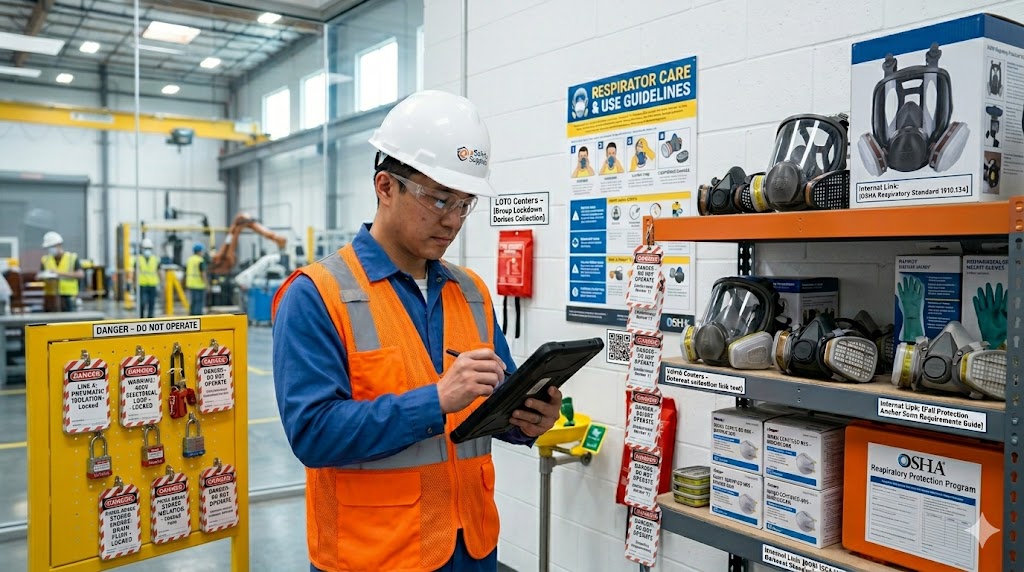
Every year, thousands of industrial workers develop debilitating, long-term lung conditions—ranging from silicosis and asbestosis to occupational asthma—due to breathing air contaminated with harmful dusts, fogs, fumes, mists, gases, smokes, or sprays. Managing respiratory hazards on a packed production floor or busy field site is a massive legal and operational undertaking.
Implementing a general mask policy is not enough. Under OSHA Standard 29 CFR 1910.134 (The Control of Hazardous Energy), facilities are required to implement a formal, written Respiratory Protection Program. This regulation applies whenever exposures exceed an OSHA Permissible Exposure Limit (PEL) or when an employer explicitly mandates respirator use.
This comprehensive guide details the core technical requirements of a compliant respiratory program, outlines the legal selection framework, and provides a step-by-step checklist to protect your workforce and shield your facility from costly regulatory penalties.
What Are the Core Requirements of an OSHA Respiratory Protection Program?
According to the compliance framework established in OSHA Standard 29 CFR 1910.134, an employer must implement a written, site-specific program containing these nine essential elements whenever respirators are required at a job site:
- Hazard Evaluation: Systematic monitoring and assessment of respiratory hazards in the workplace, including a precise identification of airborne contaminants and their exposure concentrations.
- Equipment Selection: Choosing appropriate, NIOSH-certified respirators based on the specific exposure hazards and physical demands of the workspace.
- Medical Evaluations: A mandatory medical screening process conducted by a licensed healthcare professional to ensure employees are physically fit to wear a respirator before fit testing or use.
- Fit Testing: Annual, mandatory fit testing (either qualitative or quantitative) for all tight-fitting facepiece respirators to confirm a proper structural seal.
- Proper Use Protocols: Establishing strict operational procedures for regular use, emergency situations, and the prevention of facepiece seal compromise (such as facial hair restrictions).
- Maintenance and Care: Detailed procedures for cleaning, disinfecting, storing, inspecting, repairing, and discarding respiratory protective equipment.
- Breathing Air Quality: Ensuring that atmospheres supplied by self-contained breathing apparatuses (SCBA) or airline systems meet Grade D breathing air specifications.
- Employee Training: Providing annual, comprehensive training on hazard awareness, proper donning and doffing techniques, equipment limitations, and emergency protocols.
- Program Evaluation: Conducting regular periodic audits and workplace evaluations to ensure the program remains effective and fully compliant with updated codes.
Deep Dive: Breaking Down the Respiratory Compliance Workflow
To keep your operations code-compliant and safely manage airborne hazards, safety coordinators must master the granular, hands-on technical processes that govern equipment selection and fit verification.
Step 1: Technical Respirator Selection & APF Ratings
Selecting the right piece of personal protective equipment (PPE) requires matching the airborne contaminant concentration with the respirator's Assigned Protection Factor (APF). The APF is the workplace level of respiratory protection that a properly functioning respirator or class of respirators is expected to provide to employees.
OSHA breaks down APF values into strict tiers that safety directors must calculate during the engineering control phase:
- APF 10: Half-mask air-purifying respirators (including disposable N95 particulate masks and elastomeric half-masks).
- APF 50: Full-facepiece air-purifying respirators, providing protection up to 50 times the permissible exposure limit.
- APF 25 / 1000: Powered Air-Purifying Respirators (PAPR), depending on whether a loose-fitting hood or a tight-fitting full facepiece is utilized.
- APF 1000 to 10,000: Supplied-air respirators (SAR) or Self-Contained Breathing Apparatuses (SCBA) reserved for immediately dangerous to life or health (IDLH) atmospheres.
To track these requirements cleanly alongside your broader facility safety measures, coordinators often leverage a comprehensive Warehouse Safety PPE Checklist to verify that mask inventories match local safety data sheet (SDS) warnings.
Step 2: The Medical Evaluation Mandate
Before an employee can be fit tested or cleared to wear any tight-fitting respirator on the shop floor, they must undergo a formal medical evaluation. Wearing a respirator places increased physiological strain on a worker, causing increased breathing resistance, dead-air space ventilation, and cardiovascular stress.
Employers must select a physician or other licensed health care professional (PLHCP) to perform the screening using the mandatory medical questionnaire provided in Appendix C of the OSHA standard. This evaluation must be completed before any hands-on equipment testing can legally occur.
Step 3: Qualitative vs. Quantitative Fit Testing
Every worker assigned a tight-fitting respirator must pass an annual fit test to prove that the facepiece forms an airtight seal against their skin. If a respirator leaks, contaminated air will bypass the filters entirely.
OSHA recognizes two distinct technical methods for fit testing:
- Qualitative Fit Test (QLFT): A pass/fail test method that relies on the employee's sensory perception (taste or smell) to detect a specific harmless challenge agent. Common agents include Isoamyl Acetate (banana oil), Saccharin Solution (sweet mist), Bitrex (bitter mist), or Irritant Smoke. This method is legally limited to respirators requiring an APF of 10 (such as standard half-masks or N95s).
- Quantitative Fit Test (QNFT): A data-driven test method that uses specialized instrument probes—such as a PortaCount machine—to numerically measure the exact amount of leakage into the respirator facepiece. This method calculates a specific Fit Factor and is required for high-risk, high-exposure environments requiring full-facepiece coverage (APF 50 environments).
       +-------------------------------------------------------+
       |             OSHA FIT TESTING MATRIX                   |
       +-------------------------------------------------------+
       | Half-Mask / N95 (APF 10)  -> Qualitative Allowed      |
       | Full-Facepiece (APF 50)   -> Quantitative Required    |
       | Facial Hair in Seal Zone  -> AUTOMATIC FAILURE        |
       +-------------------------------------------------------+
Step 4: Cartridge and Filter Change-Out Schedules
A common audit failure is a program that allows workers to use chemical cartridges until they can "smell or taste" the contaminant. OSHA strictly prohibits relying on odor thresholds because many chemicals cannot be smelled until they reach dangerous levels, and some individuals suffer from olfactory fatigue.
Employers must develop a strict, data-backed change-out schedule for gas and vapor cartridges. This schedule must be based on objective data—such as breakthrough times calculated using manufacturer software, average humidity levels, specific airflow rates, and precise contaminant concentration metrics on the job site.
Maintenance, Inspection, and Storage Protocols
An industrial respirator is a precision instrument that must be regularly serviced to maintain its structural integrity. Under 29 CFR 1910.134(h), facilities must enforce a systematic maintenance regimen.
Cleaning and Disinfecting
Respirators issued to a single user must be cleaned and disinfected as often as necessary to keep them sanitary. Equipment shared among multiple workers must be thoroughly cleaned and disinfected before being worn by a different user. The approved protocol requires washing the mask components in warm water with a mild detergent, immersing them in an EPA-approved sanitizing solution, rinsing them completely in clean water, and allowing them to air dry.
Inspection for Deficiencies
Authorized employees must inspect respirators before each use and during regular cleaning. This inspection must include a check of:
- Facepiece flexibility and structural integrity (looking for cracks, tears, or distortion)
- Inhalation and exhalation valves (checking for warping, dust buildup, or torn valve seats)
- Head straps and adjustment buckles (ensuring elasticity is intact)
- All plastic and rubber connections (checking for snug seals and secure threads)
To streamline this verification workflow at your tool crib or safety locker, managers can utilize structured Safety Awareness Handbooks as localized reference materials to guide technicians through physical equipment audits on the floor.
Compliant Storage
When not in use, respirators must be stored to protect them from damage, dust, sunlight, extreme temperatures, excessive moisture, and damaging chemicals. Masks must be packed neatly to prevent facepiece deformation and strap distortion. Stacking heavy gear or unsecured tools directly on top of loose respirators in a toolbox will instantly ruin the face-to-skin seal fit factor.
Respiratory Protection Frequently Asked Questions
Can an employee wear a respirator if they have facial hair?
No. OSHA standard 29 CFR 1910.134(g)(1)(i) explicitly prohibits the use of tight-fitting facepiece respirators by employees who have facial hair that comes between the sealing surface of the facepiece and the face, or that interferes with valve function. Any stubble, beard, mustache, or long sideburns that cross the critical facepiece seal zone will cause an automatic fit-test failure and an immediate job site safety violation. Clean-shaven skin is legally required to ensure an airtight seal.
What are the rules for voluntary respirator use in the workplace?
If an employer allows workers to wear respirators voluntarily in areas where exposure levels are below OSHA limits, the employer must still provide the employee with the specific advisory information contained in Appendix D of 29 CFR 1910.134. Additionally, if the voluntary equipment is an elastomeric mask or a full-face unit, the employer must still implement the medical evaluation and maintenance elements of the written program to ensure the equipment itself does not create a secondary physical hazard for the worker.
How often do OSHA respirator fit tests and medical evaluations need to be completed?
Fit testing must be completed at least once every 12 months (annually), or whenever a worker switches to a different style, model, or size of facepiece. A re-test is also required if the employee experiences significant physical changes that could alter their facial structure, such as major dental work, facial surgery, or significant weight loss or gain. While OSHA does not mandate an automatic annual frequency for medical evaluations, a re-evaluation is triggered if a worker reports respiratory symptoms, a PLHCP determines it is necessary, or the physical work demands significantly increase.
What is the difference between an air-purifying respirator and an atmosphere-supplying respirator?
- Air-Purifying Respirator (APR): Utilizes ambient air from the surrounding work environment and passes it through an engineered filter, cartridge, or canister to remove specific particulates, gases, or vapors before inhalation. These are limited to non-IDLH zones with sufficient oxygen levels.
- Atmosphere-Supplying Respirator: Delivers clean, breathable air to the user from an independent, untainted source completely separate from the local work environment (such as an airline hose connected to a Grade D air compressor or a portable SCBA cylinder tank). These systems are mandatory in oxygen-deficient or highly toxic environments.
Are employers required to pay for all respiratory protective equipment?
Yes. Under federal OSHA mandates, employers are legally required to provide all mandatory personal protective equipment, medical screenings, fit testing sessions, and replacement cartridges at zero cost to the employee. If a facility transitions onto a new production line requiring specialized breathing support, procurement officers should leverage bulk tracking solutions like a dedicated online eSafety Supplies Procurement Account to keep their teams equipped with fresh, compliant inventory without impacting operational margins.
About the Author
Mick Chan is a Senior EHS Compliance Specialist and Safety Content Strategist with over 15 years of boots-on-the-ground experience auditing industrial facilities, logistics hubs, and construction zones across the Western United States. Raised in the San Gabriel Valley, California, Mick holds a Bachelor of Science degree from California State University, Los Angeles (CSULA). He specializes in translating complex federal OSHA codes and National Electrical Codes (NEC) into practical, high-efficiency operational safety programs that shield companies from liability and protect industrial workforces.