
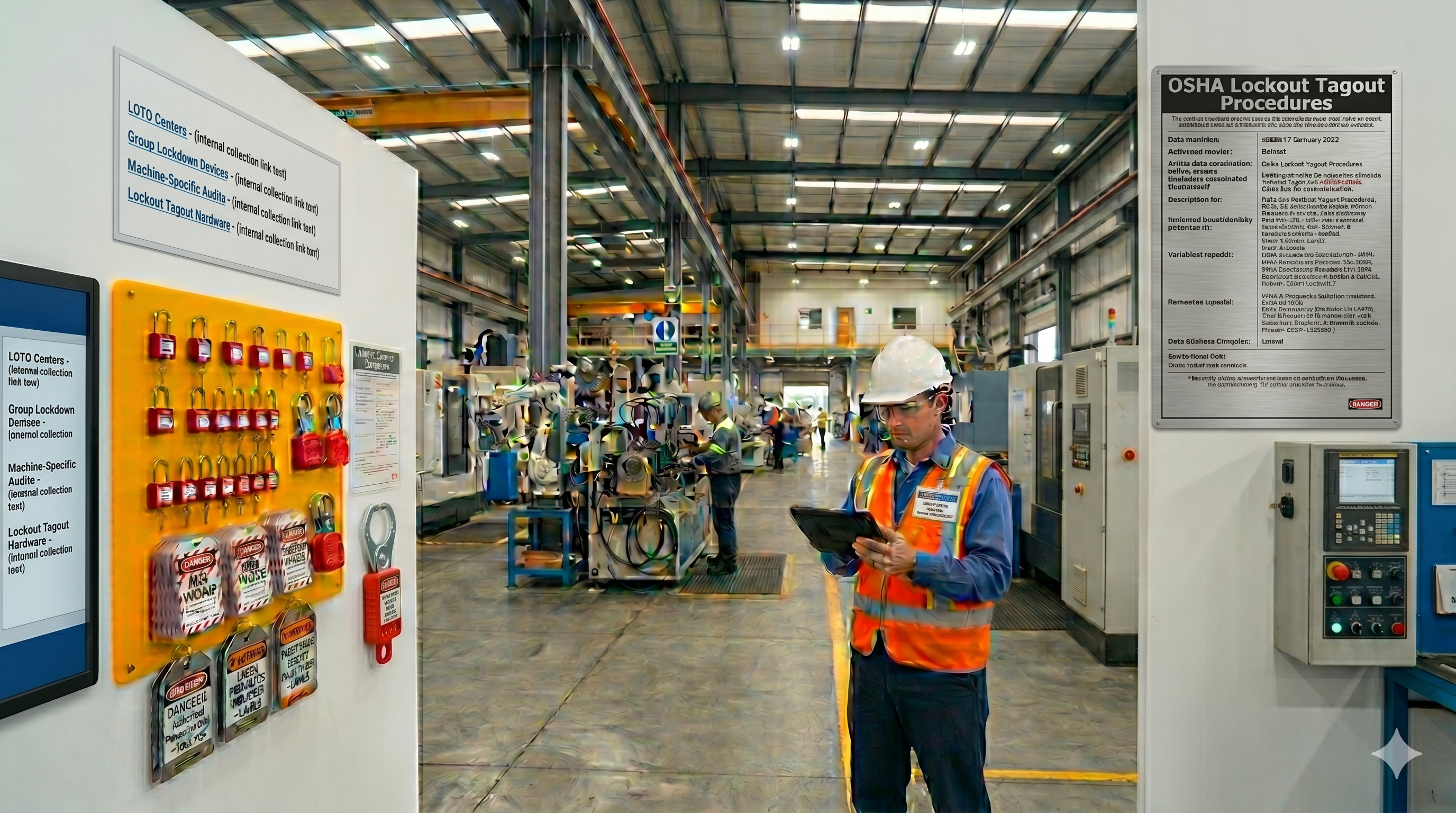
Every year, thousands of industrial workers suffer catastrophic injuries—including electrocutions, amputations, and fractures—due to the unexpected startup of machinery or the uncontrolled release of hazardous energy. Lockout/Tagout (LOTO) violations consistently rank among OSHA’s top ten most frequently cited workplace safety infractions.
However, mastering LOTO is not just about avoiding steep regulatory fines; it is about establishing an ironclad safety culture that ensures every worker returns home safely at the end of their shift. Under OSHA Standard 29 CFR 1910.147 (The Control of Hazardous Energy), facilities are required to implement strict, predictable workflows to completely isolate machinery from its power sources.
This comprehensive guide breaks down the essential six-step lockout tagout procedure, details critical energy dissipation protocols, and outlines how to safely bring equipment back online.
What Are the 6 Steps of Lockout Tagout Procedures?
According to the compliance criteria established in OSHA 1910.147 Appendix A, an effective lockout tagout (LOTO) procedure must follow these six fundamental steps to safely isolate hazardous energy:
- Preparation: The authorized employee identifies all hazardous energy sources (electrical, mechanical, hydraulic, etc.) and locates the machine-specific energy control procedure.
- Shutdown: The machine or equipment is powered down safely in an orderly manner using normal operating controls.
- Isolation: All energy-isolating devices (such as circuit breakers or valves) are activated to cut off power sources from the machinery.
- Lockout/Tagout Application: Assigned individual safety locks and tags are physically affixed to the energy-isolating devices by authorized personnel.
- Stored Energy Dissipation: Any remaining residual energy (such as trapped air, hydraulic pressure, or tension in springs) is safely relieved, bled, or blocked.
- Verification: The technician verifies isolation by testing voltage, checking gauges, or attempting to restart the machine to confirm a complete zero-energy state before beginning maintenance.
Deep Dive: Breaking Down the 6 Steps of LOTO
To achieve absolute compliance and protect your field personnel, authorized employees must fully understand the granular technical mechanics behind each phase of the energy control process.
Step 1: Preparation & Equipment Identification
Before any maintenance occurs, an authorized employee must undergo rigorous preparation. This involves analyzing the target machinery to map out every single energy type powering the unit. Industrial equipment rarely relies on a single electrical plug; systems frequently combine multiple forces, including:
- Electrical circuits (both main power and control voltage)
- Mechanical kinetic energy
- Hydraulic fluid pressure
- Pneumatic compressed air
- Chemical or thermal energy storage
During this stage, the technician must locate and review the specific Energy Control Procedure (ECP) designated for that exact piece of equipment. This document maps out the precise locations of all disconnects, switches, and valves. To ensure your maintenance teams have instantaneous reference guidance on the floor, utilize standardized Lockout Tagout Safety Awareness Handbooks directly at the staging area.
Step 2: Machine Shutdown
With the energy map clearly understood, the machine must be turned off. This must be an orderly shutdown following the manufacturer's parameters and the company's ECP. Stopping production erratically or pulling a main breaker while a machine is under full load can create secondary hazards, such as mechanical binding or electrical arcing. The authorized technician utilizes the normal operating controls (stop buttons, toggles, or digital HMI screens) to bring the machine to a complete rest.
Step 3: Equipment Isolation
Once the machine is turned off via operational controls, it must be physically isolated from its energy source. It is critical to note that turning off a power switch or hitting an emergency stop button does not isolate the machine.
Authorized employees must engage the dedicated energy-isolating devices. This includes physically throwing a main circuit breaker into the "Off" position, turning a blind flange on a pipeline, or closing a main line valve.
Step 4: Application of Lockout/Tagout Devices
With the energy-isolating devices deactivated, physical lockout and tagout hardware must be attached. OSHA mandates a "One Person, One Lock, One Key" philosophy. If three technicians are servicing a machine, three individual locks must be placed on the energy-isolating mechanism using a multi-lock lockout hasp.
- The Lock: A physical lock that holds the isolating device in a safe, de-energized position.
- The Tag: A highly visible warning device securely fastened to the lock that identifies the authorized employee's name, the date, and explicit instructions not to operate the equipment.
LOTO hardware must be completely standardized within your facility by color, shape, or size, and must never be used for anything other than energy control. Centralizing these materials in a heavy-duty, wall-mounted Lock-Out Tag-Out Center guarantees that authorized operators can instantly locate locks, hasps, and tags during unexpected machine downtimes.
       +---------------------------------------------+
       |           TYPICAL LOTO HARDWARE             |
       +---------------------------------------------+
       |  [LOCK] -> Individually keyed, color-coded  |
       |  [HASP] -> Allows multiple worker locks     |
       |  [TAG]  -> "DANGER: Do Not Operate" + Name  |
       +---------------------------------------------+
Step 5: Dissipation of Stored (Residual) Energy
Locking out an electrical disconnect or closing a main valve only stops the active flow of energy. It does nothing to address the trapped, latent force remaining in the downstream system. Under 29 CFR 1910.147(d)(5), all potentially hazardous stored or residual energy must be relieved, disconnected, restrained, and otherwise rendered safe.
Failing to account for residual kinetic energy is one of the leading causes of line-rupture and unexpected cycling injuries during maintenance.
Technical Protocols for Energy Dissipation:
-
Pneumatic and Hydraulic Bleeding: Closing a supply valve leaves high-pressure fluid or air trapped between the valve and the equipment. Authorized employees must safely bleed these lines using designated bleed-off valves or needle valves. Pressure gauges must be monitored until they register a flat zero.
In high-pressure hydraulic setups, a double block and bleed (DBB) system should be utilized where possible to isolate the line completely and provide a continuous drain point to prevent pressure buildup behind the primary lock.
- Mechanical and Gravitational Energy Restraints: If a machine component is elevated, closing a hydraulic line won't stop gravity from pulling it down if a valve fails. Suspended dies, counterweights, or mechanical arms must be physically blocked, pinned, or chained in place using rated safety blocks.
- Thermal and Chemical Flushes: Lines carrying hazardous chemicals or high-temperature steam must be thoroughly flushed, purged, or vented to an atmospheric tank or neutralizing system to protect technicians from chemical spray or thermal burns upon disassembly.
- Electrical Capacitance: Large machinery often utilizes industrial capacitors that store high voltage even after the main breaker is thrown. These must be safely discharged using specialized grounding straps or specified internal discharge circuits before any contact is made.
Step 6: Verification of Isolation (The "Try-Step")
Verification is the most frequently bypassed phase of the lockout tagout process, yet it is arguably the most critical. You are not legally or physically ready to work until you have achieved and confirmed a verified zero-energy state. 29 CFR 1910.147(d)(6) mandates that the authorized employee explicitly verify that isolation and de-energization of the machine or equipment have been accomplished.
This is colloquially known on the floor as the "Try-Step" — you are physically trying to operate the machine under the assumption that your lockout failed.
Zero-Energy Verification Protocol:
- Clear the Danger Zone: Ensure all affected employees, tools, and temporary components are clear of the machine's operational radius before initiating the test.
- Physical Activation (The "Try"): Attempt to cycle the equipment using normal operating controls. Press the primary start buttons, cycle the foot pedals, flip the toggles, and activate any localized human-machine interfaces (HMIs).
-
Redundant Testing for Electrical Loops: For electrical systems, never rely on a visual break alone. A certified digital multimeter (DMM) or a non-contact voltage tester must be used to test phase-to-phase and phase-to-ground legs.
The 3-Point Test Rule: Always verify your voltage tester on a known live source before testing the isolated circuit, test the target isolated circuit, and then immediately re-test the meter against the live source to ensure the meter didn't fail during the process.
- Visual Gauge Inspections: Verify that all inline pressure gauges, digital flow meters, and sight glasses read absolute zero. Ensure mechanical interlocks and physical pins are fully engaged and locked into place.
- Restore Controls to Neutral: Once zero energy is confirmed, you must return all operating controls back to the "Off" or "Neutral" position. Failing to do this creates a critical hazard when the machine is eventually re-energized later.
Step 7: Re-Energization and Release Steps (Bringing Equipment Back Online)
Completing the mechanical maintenance or repair is only half the battle. Bringing a machine back online introduces a fresh set of hazards as the system transitions from a zero-energy state back to full operational power. According to the official OSHA Lockout/Tagout eTool Release Procedures, a strict, sequential protocol must be followed before any lockout or tagout devices are removed and power is restored.
To prevent catastrophic equipment damage or severe injury to personnel during startup, authorized employees must execute the following three-phase release procedure.
1. The Pre-Clearance Inspection
Before a single lock is cut or turned, the physical environment of the machinery must be thoroughly audited.
- Inspect the Work Area: Walk the entire footprint of the equipment. Ensure that all tools, spare parts, shop rags, and maintenance gear have been removed from the machine’s internal mechanisms and operational pathways.
- Re-install Guarding: Ensure that all physical safety guards, access panels, and interlocking brackets that were removed during servicing are fully re-installed, secured, and operational.
- Check Machine Integrity: Verify that all components, lines, and fittings are fully reassembled and closed. For hydraulic and pneumatic systems, ensure all bleed valves closed during Step 5 are shut tight to prevent immediate line spraying upon re-pressurization.
2. Employee Notification and Area Clearing
You must account for every human element in the vicinity before throwing a switch.
- Clear the Danger Zone: Visually confirm that all employees, technicians, and contractors are safely positioned away from the machine's primary moving parts, electrical cabinets, and pressure lines.
- The Affected Employee Mandate: OSHA explicitly requires that all affected employees—those who operate the machine or work in the immediate area—be officially notified that the LOTO devices are being removed and that the equipment is about to be re-energized.
3. Individual Lock Removal Rules
OSHA enforces an incredibly strict philosophy regarding hardware removal: The person who places the lock must be the person who removes the lock. This ensures no one else can inadvertently re-energize a machine while a technician is still hidden inside an inspection hatch. Mobile field technicians should ideally carry an all-inclusive North Lockout/Tagout Toolbox Kit to ensure they have their own dedicated electrical lockouts, breaker locks, and safety tags directly on hand.
- The Individual Lock Rule: Each authorized employee must personally remove their own personal safety lock and tag from the energy-isolating device or group lockout box.
-
Emergency Lock Removal Protocol: If an employee leaves the facility (e.g., shifts change or an emergency occurs) and leaves their lock on a device, the employer may direct the removal of that lock only under specific conditions outlined in 29 CFR 1910.147(e)(3).
The Emergency Removal Steps: The employer must verify that the authorized employee is no longer at the facility, make all reasonable efforts to contact them, and ensure that the employee is fully aware their lock was removed before they return to work on their next shift. This protocol must be documented in writing.
Once all locks are safely cleared, guards are locked down, and notifications are broadcast, the authorized supervisor may safely engage the main power breakers and bring the machinery back into active production.
Lockout Tagout (LOTO) Frequently Asked Questions
Who is allowed to remove a lockout tagout lock?
Under OSHA standard 29 CFR 1910.147, only the authorized employee who applied the lockout lock is permitted to remove it. This ensures no one can accidentally re-energize equipment while the technician is still servicing it. The only exception is the emergency lock removal protocol, which requires an abandoned lock procedure authorized by top facility management after verifying the worker has left the facility.
What is the minor servicing exception for lockout tagout?
The LOTO minor servicing exception allows workers to perform routine, repetitive maintenance tasks without a full lockout tagout if the work takes place during normal production operations. To qualify for this exception under 29 CFR 1910.147(a)(2)(iii)(A), the tasks must be integral to the production process and the employer must provide alternative, effective protection, such as interlocked safety guards, local disconnects, or control switches that offer equivalent protection.
What is the difference between an authorized employee and an affected employee?
- Authorized Employee: A trained worker who physically locks out or tags out machinery to perform servicing or maintenance. They are the only individuals permitted to apply and remove LOTO hardware.
- Affected Employee: A worker whose job requires them to operate the machinery being serviced, or who works in the immediate area where the lockout tagout procedure is being performed. Affected employees do not perform maintenance or apply locks, but they must be notified before a lockout begins and before equipment is re-energized.
Can a zip tie or padlock be used as a lockout device?
No, standard commercial padlocks or everyday zip ties do not meet compliance standards. OSHA mandates that lockout tagout devices must be singularly identified, durable, standardized, and substantial. LOTO padlocks must be distinct from normal security locks (often color-coded) and used only for controlling hazardous energy. Tagout fasteners must be non-reusable, attachable by hand, self-locking, and possess a minimum unlocking strength of 50 pounds (typically requiring a heavy-duty nylon cable tie).
Are written, machine-specific LOTO procedures required for every machine?
Yes. Employers can utilize corporate support materials from the official OSHA Control of Hazardous Energy Program Resources portal to build out compliant frameworks, but they must ultimately develop, document, and utilize separate, written machine-specific Energy Control Procedures (ECPs) for each distinct piece of machinery. A generic corporate LOTO template does not satisfy OSHA audits. If your technicians are interacting with live circuits or specialized apparatuses, ensuring they are outfitted with items from the official eSafety Supplies PPE Collection is also required to maintain concurrent regulatory protection.
About the Author
Mick Chan is a Senior EHS Compliance Specialist and Safety Content Strategist with over 15 years of boots-on-the-ground experience auditing industrial facilities, logistics hubs, and construction zones across the Western United States. Raised in the San Gabriel Valley, California, Mick holds a Bachelor of Science degree from California State University, Los Angeles (CSULA). He specializes in translating complex federal OSHA codes and National Electrical Codes (NEC) into practical, high-efficiency operational safety programs that shield companies from liability and protect industrial workforces.