Quick Answer
N95 and P100 respirators are both particulate respirators, but they are not equal. N95 filters at least 95% of airborne particles and is not resistant to oil, while P100 filters at least 99.97% and is strongly resistant to oil aerosols; the right choice depends on the hazard, exposure level, oil presence, fit, comfort, and your OSHA respiratory protection program.
Who This Guide Is For
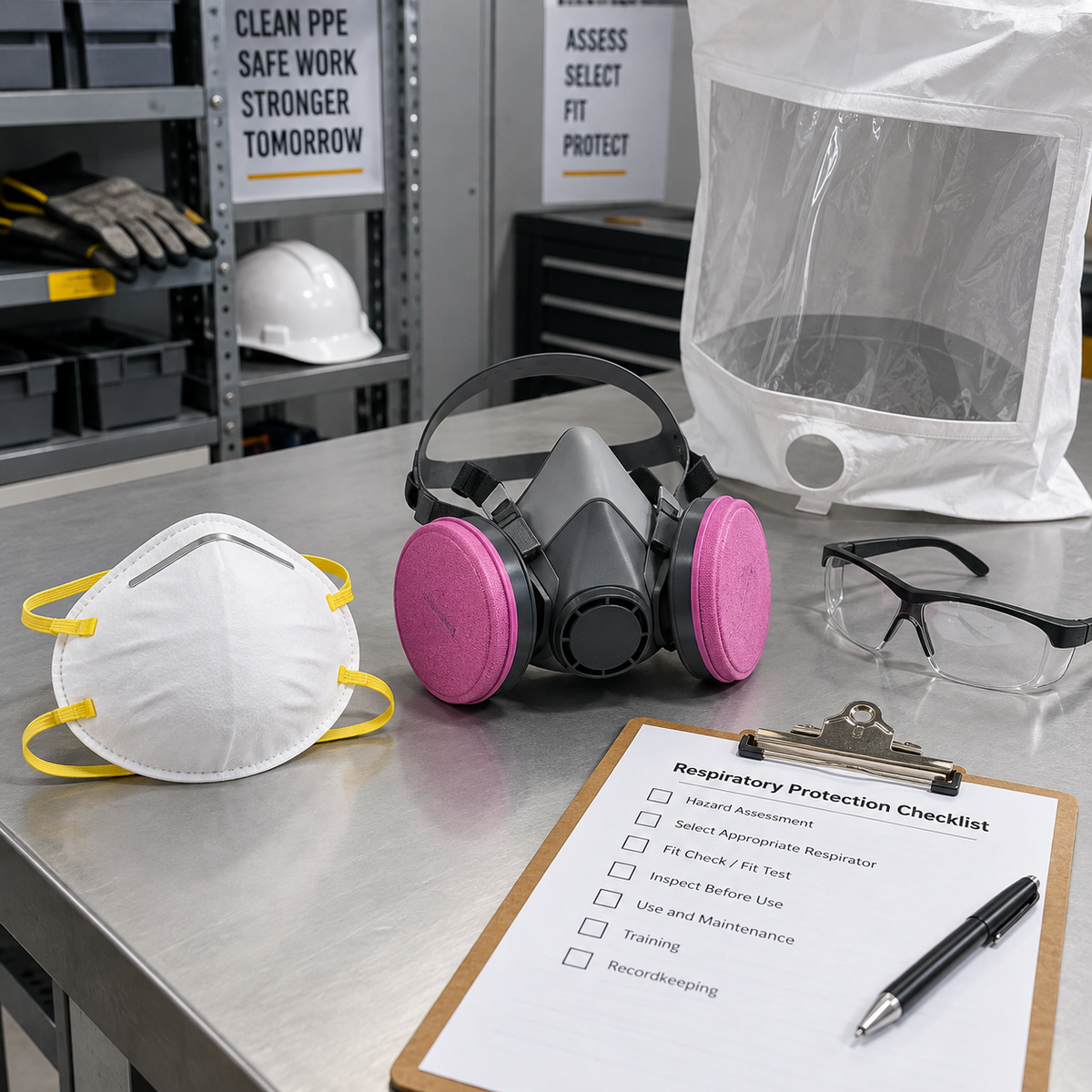
This guide is for workplaces comparing disposable N95 filtering facepiece respirators with reusable half-mask or full-face respirators that use P100 filters.
This article is educational and does not replace legal, regulatory, industrial hygiene, medical, or site-specific safety advice. Always verify requirements against applicable OSHA standards, state plans, local rules, manufacturer instructions, safety data sheets, exposure assessments, and your written respiratory protection program.
Why N95 vs P100 Matters
Respirator selection is not just a product choice. It is a hazard-control decision. The wrong respirator can create a false sense of protection, while an overbuilt option can add breathing resistance, cost, and worker acceptance problems.
NIOSH explains that filtering facepiece respirators filter particles such as dust, mist, and fumes, but they do not protect against gases or vapors. OSHA's respiratory protection standard requires a written program when respirators are necessary to protect employee health, including procedures for selecting respirators, fit testing, training, use, cleaning, storage, and medical evaluations.
In plain language: choose N95 or P100 only after you know what is in the air and whether a particulate respirator is the correct type of protection.
Start With the Hazard, Not the Filter
Before comparing respirators, confirm the exposure:
- Is the hazard a particulate, gas, vapor, oxygen deficiency, or a combination?
- Is there an oil aerosol present?
- Are exposure levels known through monitoring or a competent assessment?
- Is the respirator being used voluntarily or required?
- Will workers need disposable filtering facepieces, elastomeric half masks, full-face respirators, or powered air-purifying respirators?
- Has the employer handled medical evaluation, fit testing, training, and written program duties where required?
PPE is the last line of defense. Engineering controls, substitution, ventilation, wet methods, enclosure, and administrative controls should be evaluated before relying on respirators.
N95 vs P100 Comparison Table
| Decision Point | N95 | P100 |
|---|---|---|
| Minimum particulate filtration efficiency | At least 95% | At least 99.97% |
| Oil aerosol resistance | Not resistant to oil | Strongly resistant to oil |
| Typical form | Disposable filtering facepiece | Reusable respirator filter or cartridge/filter combination |
| Common use case | Dusts, non-oil mists, nuisance particulate controls when appropriate | Higher-efficiency particulate protection, oil aerosol environments, longer reusable programs |
| Fit testing | Required when used as a tight-fitting respirator under OSHA program rules | Required when used as a tight-fitting respirator |
| Gas or vapor protection | No | No, unless combined with the correct gas/vapor cartridge |
| Buying concern | Fit, seal, approval, comfort, strap durability, supply | Filter compatibility, facepiece size, cleaning, storage, replacement schedule |
How NIOSH Filter Classes Work
NIOSH filter classes combine two ideas: filtration efficiency and oil resistance. The numbers 95, 99, and 100 refer to minimum filtration efficiency levels. The letters N, R, and P describe oil aerosol resistance:
- N-series filters are not resistant to oil.
- R-series filters are somewhat resistant to oil.
- P-series filters are strongly resistant to oil.
That is why N95 and P100 are not just different percentages. They are different filter classes. P100 is higher-efficiency and oil resistant, while N95 is lower-efficiency and not oil resistant.
When an N95 May Be Appropriate
An N95 may be appropriate when the hazard is a particulate and the exposure assessment, assigned protection factor, respirator approval, and workplace program support that choice. Common examples may include some dusts, non-oil mists, and certain cleanup or maintenance tasks, depending on the actual exposure.
N95s are often easier to stock and dispose of than reusable respirators. They can be practical when tasks are short, workers do not need chemical cartridges, and contamination control favors disposal.
However, an N95 is not automatically enough just because the hazard is "dust." Silica, welding fumes, wildfire smoke, infectious aerosols, and industrial particulates may require deeper evaluation.
When a P100 May Be Better
A P100 may be a better fit when a higher particulate filtration efficiency is needed, oil aerosols are present, or the workplace already uses reusable elastomeric respirators. P100 filters are common on half-mask and full-face respirators used in industrial maintenance, remediation, manufacturing, and higher-dust tasks.
P100 does not mean "protects against everything." P100 filters are for particulates. If the exposure includes organic vapors, acid gases, ammonia, formaldehyde, or another gas or vapor, workers may need the correct cartridge or combination cartridge/filter selected for that hazard.
Fit Testing and Seal Checks
Both N95 and P100 respirators need a good seal when they are tight-fitting respirators. OSHA's respiratory protection standard includes fit testing requirements before initial use and at least annually for tight-fitting facepieces when respirators are required.
Fit testing is not the same as a user seal check. Fit testing verifies that a specific make, model, style, and size can fit the worker. A seal check is a quick check each time the respirator is put on. Workers need both when tight-fitting respirators are required.
Facial hair that interferes with the seal is a common failure point. So are wrong sizes, damaged straps, poor nosepiece adjustment, incompatible eyewear, and rushing donning during a busy shift.
Buying Checklist
Before ordering N95 or P100 respirators, confirm:
- The hazard is a particulate, not only a gas or vapor.
- The workplace has an exposure basis for the respirator choice.
- The selected model is NIOSH-approved for the intended use.
- The respirator fits the workers who will use it.
- Workers have medical clearance and fit testing where required.
- Replacement filters, cartridges, retainers, and parts are stocked.
- Cleaning and storage supplies are available for reusable respirators.
- Training covers limitations, donning, seal checks, inspection, disposal, and maintenance.
Common Mistakes
- Choosing P100 because it sounds safest without checking breathing resistance, fit, and task duration.
- Using an N95 where oil aerosols are present.
- Assuming P100 filters protect against gases and vapors.
- Buying one respirator size for every worker.
- Forgetting annual fit testing for required tight-fitting respirators.
- Storing reusable respirators dirty or uncovered.
- Failing to replace damaged filters, straps, valves, or facepieces.
- Skipping engineering controls because respirators are available.
Key Takeaways
- N95 and P100 are both particulate filters, but P100 has higher filtration efficiency and oil resistance.
- Neither N95 nor P100 automatically protects against gases or vapors.
- OSHA-required respirator use generally needs a written respiratory protection program, medical evaluation, fit testing, and training.
- Fit and worker acceptance matter as much as filter class.
- The best buying decision starts with the hazard assessment, not the product shelf.
FAQ
Is P100 better than N95?
P100 has higher particulate filtration efficiency and is strongly resistant to oil aerosols. That does not always make it the best choice; the correct respirator depends on the hazard, exposure level, fit, comfort, and program requirements.
Does a P100 respirator protect against chemicals?
P100 filters protect against particulates, not gases or vapors by themselves. Chemical vapor protection requires selecting the correct cartridge or combination cartridge/filter for the specific exposure.
Do N95 respirators need fit testing?
When N95 respirators are required as tight-fitting respirators under an OSHA respiratory protection program, fit testing is required. Voluntary-use situations have different rules, but employers still need to follow applicable OSHA requirements.
Can workers with beards use N95 or P100 respirators?
Tight-fitting respirators need a seal to the face. Facial hair that crosses the sealing surface can prevent a proper seal, so employers need to address this during respirator selection and fit testing.
When should P100 filters be replaced?
Follow manufacturer instructions and the workplace respiratory protection program. Replace filters when damaged, soiled, difficult to breathe through, contaminated, or when the program's change-out or disposal criteria are met.
About Mick Chan
Mick Chan contributes safety supply guidance for eSafetySupplies content, with a focus on practical PPE selection, workplace readiness, and helping teams connect safety requirements to the right supplies. His review perspective is included to keep recommendations grounded in real purchasing and jobsite use.
Final CTA
Build your respirator order around the hazard, fit, and replacement plan. Compare respiratory protection, safety eyewear, and related PPE so each task has the right respirator type, filter class, and support supplies.