
Quick Answer
Respirator cartridge color codes help identify the type of contaminant a cartridge is designed for, such as organic vapor, acid gas, ammonia, formaldehyde, mercury vapor, or particulates. The color is only a starting point. Choose cartridges from a documented hazard assessment, exposure information, NIOSH approval markings, OSHA respiratory protection program requirements, and the respirator manufacturer's compatibility instructions.
Who This Guide Is For
This guide is for safety managers, facility managers, maintenance supervisors, paint and coating teams, janitorial leaders, lab support teams, and buyers responsible for reusable respirators and replacement cartridges. It is educational and does not replace OSHA requirements, NIOSH approval information, industrial hygiene evaluation, safety data sheets, manufacturer instructions, medical evaluation, fit testing, or a written respiratory protection program.
Why Respirator Cartridge Color Codes Matter
Reusable respirators are not one-size-fits-all. The facepiece, cartridge, filter, prefilter, retainer, and change schedule must match the hazard. A cartridge marked for one hazard may not protect against another, and cartridges can become saturated before they look dirty.
Color codes make cartridge families easier to recognize, but they should not be used as the only selection method. The same work area can include vapors, gases, particulates, nuisance odors, poor warning properties, oxygen deficiency, or immediately dangerous conditions that require a different approach.
Before buying cartridges, identify the airborne contaminant, concentration, exposure duration, respirator model, assigned protection factor needs, and whether the environment is suitable for an air-purifying respirator.
Start With the Hazard, Not the Cartridge
OSHA's respiratory protection standard requires a written respiratory protection program when respirators are necessary to protect employee health or when the employer requires respirator use. For required use, the program includes selection procedures, medical evaluations, fit testing for tight-fitting respirators, use procedures, maintenance, training, and program evaluation.
For cartridge selection, document:
- The chemical, dust, mist, fume, vapor, gas, or biological aerosol of concern.
- The SDS or industrial hygiene data used to identify the hazard.
- Whether oxygen levels and contaminant levels are known.
- Whether the cartridge is approved for the contaminant and respirator model.
- Whether the contaminant has poor warning properties.
- The cartridge change schedule and who maintains it.
- Storage method after use so cartridges are not left exposed.
If the hazard is unknown, oxygen-deficient, or immediately dangerous to life or health, do not treat color-coded cartridges as the solution. Escalate to a qualified safety professional and the appropriate respiratory protection program decision.
Common Respirator Cartridge Color Codes
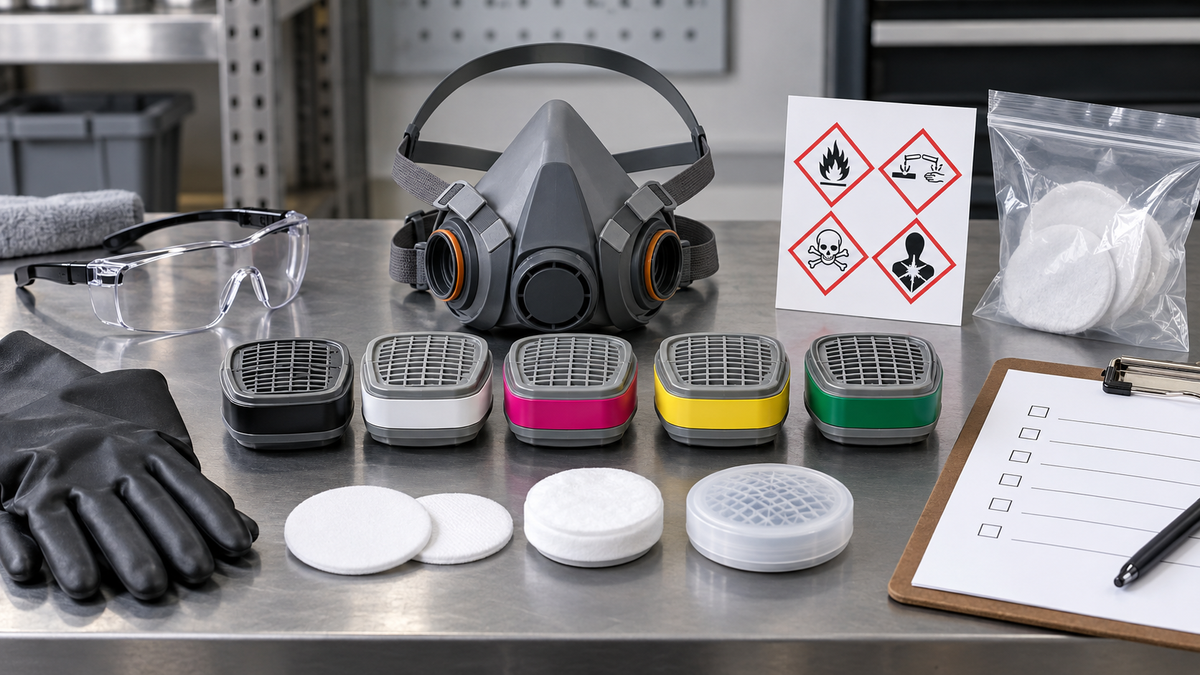
Manufacturers use color labels to indicate contaminant families. Always confirm the exact cartridge label and instructions because combination cartridges may use more than one color.
| Cartridge Color Family | Common Meaning | What To Verify |
|---|---|---|
| Black | Organic vapor | Chemical identity, concentration, breakthrough risk, and change schedule. |
| White | Acid gas | Specific acid gases listed by the manufacturer and cartridge limitations. |
| Green | Ammonia or methylamine | Whether the cartridge covers the actual amine/ammonia hazard. |
| Olive or multi-color | Multi-gas or combination cartridge | Exact list of gases/vapors covered and particulate filter rating if included. |
| Magenta | P100 particulate filter | Particulate hazard, oil resistance needs, filter loading, and respirator fit. |
| Yellow | Organic vapor plus acid gas on many labels | Exact cartridge designation and all contaminants covered. |
Color coding helps workers avoid obvious mix-ups, but the printed approval and cartridge designation are more important than the color alone.
Respirator Cartridge Selection Checklist
- Identify the airborne hazard from SDS, sampling, process knowledge, or qualified review.
- Confirm the work area is not oxygen-deficient or immediately dangerous to life or health.
- Select the respirator type and cartridge/filter using OSHA program requirements and manufacturer guidance.
- Verify NIOSH approval markings and facepiece compatibility.
- Confirm whether the task needs vapor/gas cartridges, particulate filters, or a combination.
- Set a cartridge change schedule before the work starts.
- Train workers to inspect the facepiece, valves, straps, cartridges, and seal area.
- Store cartridges in sealed bags or containers according to manufacturer instructions.
- Replace cartridges that are damaged, expired, saturated, misused, or past the change schedule.
- Keep backup cartridges and filters available by department and respirator model.
Product Category Match Table
| Respiratory Need | ESS Category | What To Verify |
|---|---|---|
| Reusable respirator programs | Respiratory protection | Facepiece style, size, fit-test needs, NIOSH approval, and cartridge compatibility. |
| Organic vapor, acid gas, or multi-gas tasks | Respiratory protection | Cartridge designation, contaminant coverage, change schedule, and storage. |
| Dust, mist, or particulate tasks | Respiratory protection | N95, P95, P100, oil resistance, filter loading, and assigned protection needs. |
| Splash or eye exposure during chemical work | Safety glasses | Whether goggles or face shields are needed in addition to glasses. |
| Chemical handling with respirators | Chemical-resistant gloves | SDS glove recommendation, breakthrough data, cuff length, and dexterity. |
Use-Case Recommendations
For painting, coating, and solvent tasks, start with the SDS and exposure assessment. Organic vapor cartridges are common in these discussions, but the final decision depends on the chemical, concentration, ventilation, exposure duration, and respirator program.
For cleaning and facility maintenance, do not choose cartridges by odor alone. Some chemicals have poor warning properties, and odor thresholds are not a reliable protection plan.
For sanding, grinding, sweeping, or dusty maintenance, particulate filters may be the relevant respiratory protection component. Verify whether the task creates dust, mist, fumes, oil aerosols, or a mixed exposure that needs a combination setup.
For emergency response or unknown releases, air-purifying cartridges are often the wrong assumption. Unknown atmospheres require a qualified emergency plan and equipment selected for that scenario.
Common Mistakes
- Choosing a cartridge by color without checking the printed designation.
- Using cartridges on an incompatible respirator facepiece.
- Waiting for odor or irritation instead of using a change schedule.
- Reusing cartridges after poor storage or uncertain exposure.
- Using particulate filters for gases or vapors.
- Assuming a half-mask respirator is acceptable for every concentration.
- Skipping medical evaluation, fit testing, or training when OSHA requires them.
- Buying replacement cartridges without tracking the respirator model used by each department.
Key Takeaways
- Cartridge colors identify broad contaminant families, but the printed approval and manufacturer instructions control selection.
- A cartridge must match the hazard, concentration, respirator model, and respiratory protection program.
- Change schedules should be set before use; do not rely only on smell or worker irritation.
- Particulate filters and gas/vapor cartridges solve different problems, though some products combine both.
- Unknown, oxygen-deficient, or immediately dangerous atmospheres require escalation beyond ordinary cartridge selection.
FAQ
What do respirator cartridge color codes mean?
They indicate the general contaminant family the cartridge is designed for, such as organic vapor, acid gas, ammonia, multi-gas, or particulates. Always confirm the exact printed cartridge designation and manufacturer instructions.
What color cartridge is used for organic vapors?
Many organic vapor cartridges use black labeling, and some combination cartridges include black with other colors. Confirm the exact contaminant, cartridge designation, respirator compatibility, and change schedule before use.
Can I use a P100 filter for chemical vapors?
No, not by itself. A P100 filter is for particulates, while chemical vapors or gases require cartridges approved for those contaminants or a combination cartridge/filter setup.
How often should respirator cartridges be changed?
OSHA requires employers to implement a change schedule for cartridges used for gases and vapors when there is no end-of-service-life indicator. The schedule should be based on objective information and manufacturer guidance.
Are cartridge colors the same across all brands?
Color conventions are common, but do not use color as the final authority. Read the cartridge label, approval information, and respirator manufacturer's compatibility instructions.
Mick Chan Bio
Mick Chan is an eSafetySupplies safety content contributor focused on practical workplace safety supply planning, PPE selection, and compliance-oriented checklists for facility, warehouse, construction, and maintenance teams.
Final CTA
Use this guide to build a respirator cartridge reorder list by hazard, respirator model, department, and change schedule. Review ESS respiratory protection, safety glasses, and chemical-resistant glove options, then confirm the final setup with your written respiratory protection program and manufacturer instructions.
Sources
- OSHA 29 CFR 1910.134 Respiratory Protection: https://www.osha.gov/laws-regs/regulations/standardnumber/1910/1910.134
- OSHA Respiratory Protection: https://www.osha.gov/respiratory-protection
- OSHA Small Entity Compliance Guide for Respiratory Protection: https://www.osha.gov/Publications/3384small-entity-for-respiratory-protection-standard-rev.pdf
- NIOSH Respirator Trusted-Source Information: https://www.cdc.gov/niosh/npptl/topics/respirators/disp_part/respsource.html