Quick Answer
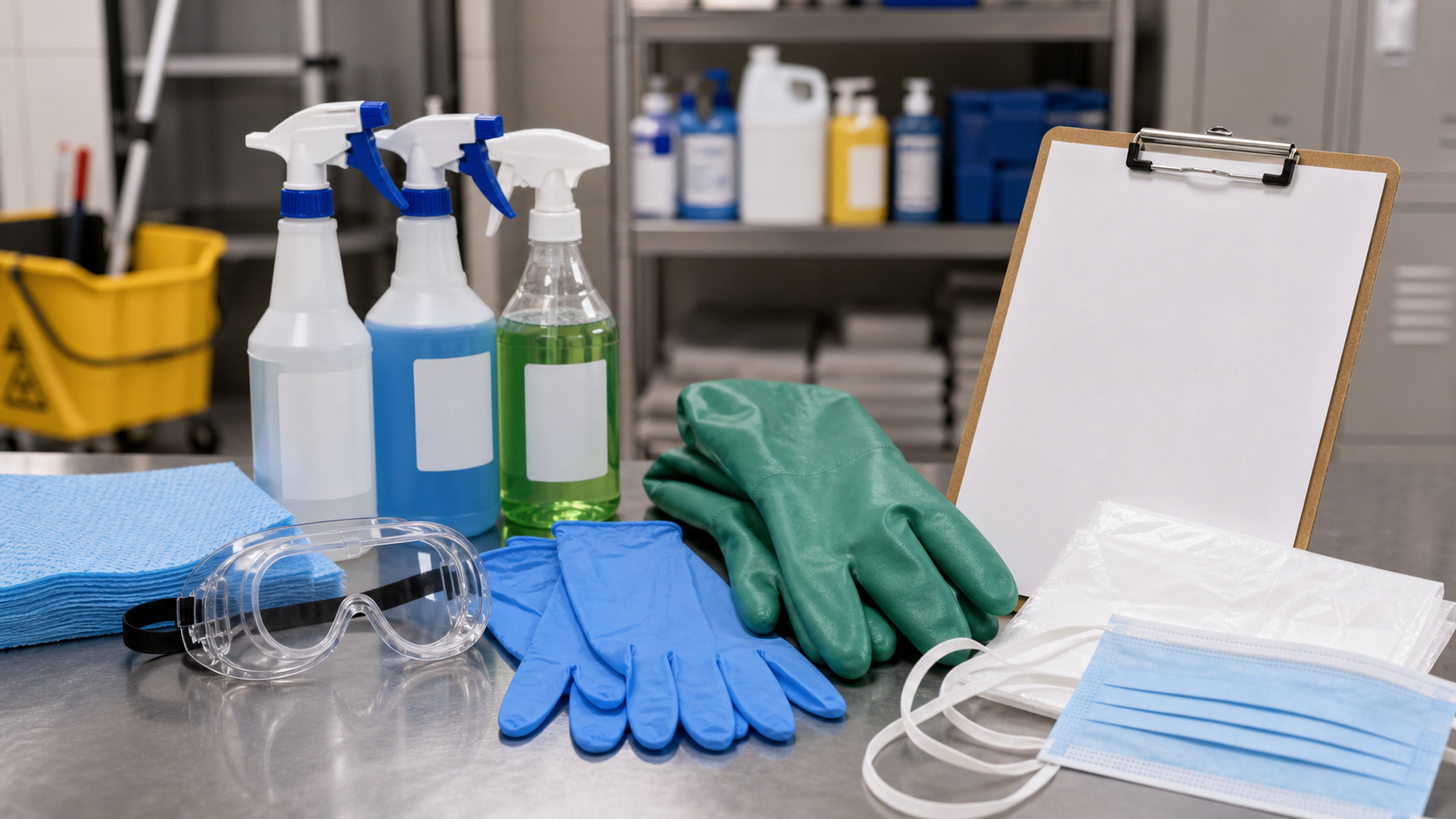
Janitorial PPE should be selected by the cleaning chemical, task, contact time, splash risk, ventilation, and surface being cleaned. Common janitorial PPE includes nitrile gloves, chemical-resistant gloves, safety goggles, face shields for splash tasks, disposable aprons or gowns, masks or respirators when required, slip-resistant footwear, and spill cleanup supplies.
The Safety Data Sheet is the first source to check before buying PPE for cleaning chemicals. Do not assume one disposable glove or one mask fits every cleaning job.
Janitorial PPE At A Glance
| Task | PPE to evaluate | Why it matters |
|---|---|---|
| Routine surface cleaning | Nitrile gloves, eye protection where splash is possible | Skin and eye contact can occur during spraying and wiping. |
| Disinfecting | Gloves, goggles, apron, ventilation review | Some disinfectants are irritating or corrosive depending on concentration. |
| Restroom cleaning | Chemical gloves, goggles, apron, slip-resistant footwear | Splash, body fluids, and wet floors may be present. |
| Floor stripping or heavy chemicals | Chemical-resistant gloves, goggles, face shield, apron, respiratory review | Higher chemical exposure and poor ventilation can raise risk. |
| Trash and facility maintenance | Cut-resistant or puncture-resistant gloves, eye protection | Unknown sharp objects and debris may be present. |
Start With The SDS
OSHA’s Hazard Communication Standard requires chemical information to be available to workers, including hazard and protective measures. For janitorial teams, the SDS can identify whether a product is corrosive, irritating, flammable, or requires specific gloves, eye protection, ventilation, or respiratory protection.
Cleaning products can be especially risky when concentrated, mixed incorrectly, sprayed in enclosed areas, or used longer than expected. The PPE for a diluted cleaner may not be the same as the PPE for the concentrated product.
Glove Selection
Nitrile gloves are a common choice for many cleaning tasks because they avoid latex allergy concerns and provide useful splash protection for many products. For stronger chemicals, longer contact, or immersion, thicker chemical-resistant gloves may be needed. Check manufacturer compatibility data for the actual chemical instead of relying only on glove material names.
Eye, Face, And Body Protection
Safety glasses may be enough for some low-splash tasks, but goggles are usually better when liquid splash is possible. Face shields add broader face coverage, but they should be used with goggles when eye splash exposure exists. Aprons or disposable protective clothing can help keep chemicals off skin and work clothing.
Respiratory Protection
Do not treat a dust mask as a universal chemical protection device. If respiratory protection is required, OSHA’s respiratory protection standard may apply, including proper selection, medical evaluation, fit testing for tight-fitting respirators, training, and cartridge change schedules. Improve ventilation and follow product instructions before relying on respiratory PPE.
Buying Checklist
- Inventory all cleaning chemicals and concentrated products.
- Review SDS PPE and first-aid sections.
- Separate routine cleaning PPE from strong chemical and spill response PPE.
- Stock nitrile and chemical-resistant glove options where tasks differ.
- Place goggles and splash protection near chemical mixing and restroom cleaning areas.
- Use slip-resistant footwear policies for wet floor work.
- Train workers not to mix chemicals unless the product instructions specifically allow it.
Common Mistakes To Avoid
Do not buy only thin disposable gloves if workers handle concentrated chemicals. Do not assume a face mask protects against chemical vapors. Do not store PPE far away from the cleaning closet. Also avoid unlabeled secondary bottles; workers need to know what chemical they are using before selecting PPE.
FAQ
What gloves are best for janitorial cleaning?
Nitrile gloves are common for many routine tasks. Stronger chemicals, longer contact, or immersion may require thicker chemical-resistant gloves matched to the SDS and manufacturer compatibility chart.
Do cleaners need goggles?
Goggles are appropriate when splashes, sprays, or chemical mixing can expose the eyes. Safety glasses may not seal well enough for splash tasks.
Is a mask enough for cleaning chemicals?
No. A mask is not a universal protection against chemical vapors. If respiratory protection is required, use the correct respirator under a compliant respiratory protection program.
Mick Chan Bio
Mick Chan contributes practical safety supply guidance for eSafetySupplies.com, helping buyers compare PPE by hazard, task, compliance context, and day-to-day usability. His content is written to support safer purchasing decisions and should be paired with site-specific safety review.
Final CTA
Need PPE for janitorial teams, cleaning closets, restroom crews, or facility maintenance? Compare nitrile gloves, chemical-resistant gloves, goggles, masks, aprons, and spill supplies at eSafetySupplies.com.
Sources: OSHA Hazard Communication, OSHA Hand Protection, OSHA Eye and Face Protection, NIOSH Cleaning and Disinfecting.