
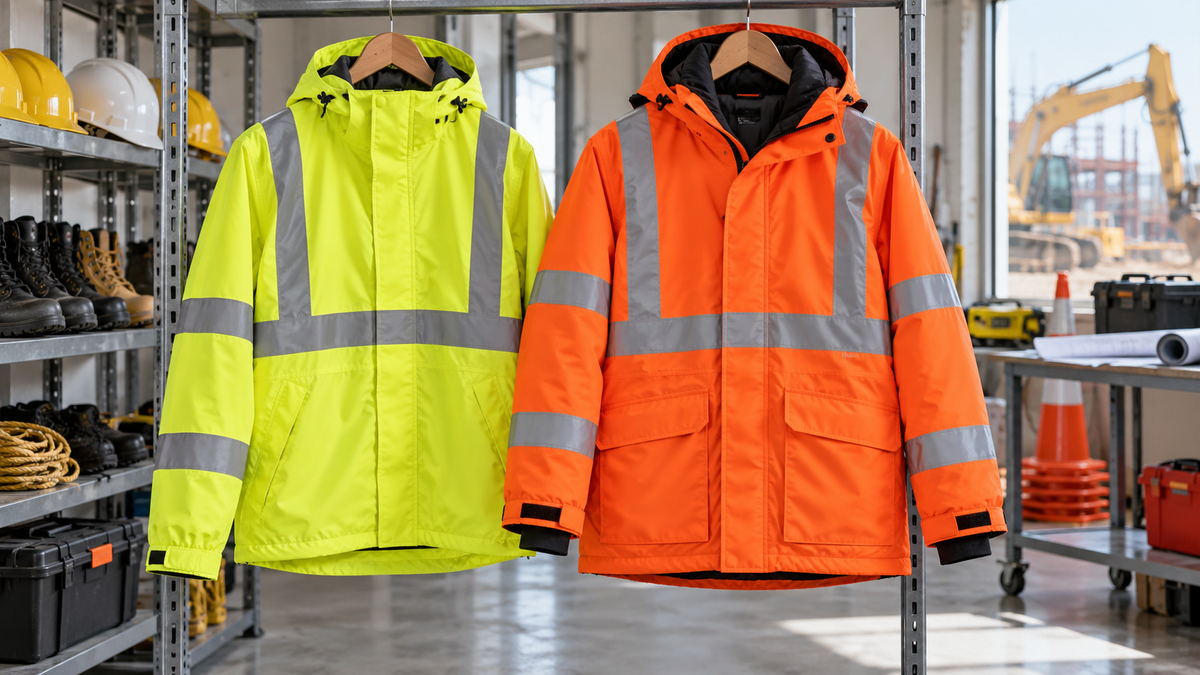
Quick Answer
Choose a high-visibility safety jacket in this order: identify the worksite's visibility requirement; verify the garment's ANSI/ISEA 107 Type and Performance Class on the product label; then select the weather protection, mobility, and fit the job needs. A bright jacket is not automatically a compliant high-visibility garment, and a compliant jacket is not automatically waterproof, warm, flame-resistant, or suitable for every exposure. Check the exact product documentation, not just the color in a photo.
A Jacket Has Two Jobs
A crew working outdoors needs to be seen and to stay functional in the weather. Those goals overlap, but they are not identical. A lightweight reflective shell may make sense for a rainy shoulder-season shift. An insulated parka may be more comfortable for a stationary winter task. A soft shell may move well but may not keep out sustained rain. The worker still needs to reach, turn, climb, operate controls, and wear other PPE without the jacket riding up or covering important equipment.
The ANSI/ISEA 107-2020 standard covers design, performance, testing, and labeling for high-visibility safety apparel. It identifies garments by Type and Performance Class. That label is the starting point for comparison. A marketing phrase such as "safety yellow" or "reflective jacket" does not establish conformance.
Read the Type and Class Before Comparing Fabric
The Type identifies the expected use setting: Type O for off-road occupational environments, Type R for roadway exposure, and Type P for public-safety uses. Performance Class describes the garment's visible-material coverage and design. The appropriate selection depends on the site risk assessment and applicable requirements, not an automatic preference for the highest number.
For roadway work, pay particular attention to the applicable traffic-control requirements and agency or contract rules. FHWA guidance explains high-visibility requirements for workers exposed to traffic or construction equipment in the right-of-way of a Federal-aid highway. The details can depend on the work setting and governing version; verify current project specifications rather than treating a general blog guide as a legal determination.
Ask the supplier for the specific jacket's label and declaration or test documentation. A garment with a bright hood, reflective piping, or a few stripes may still lack the material area and configuration of the required Type and Class. Conversely, a jacket already labeled to the needed classification may be simpler to buy than assembling a vest-over-coat combination whose fit and visibility change as layers shift.
Jacket Styles at a Glance
| Style | Useful for | Important limitation to check |
|---|---|---|
| Rain shell | Wet and windy conditions with variable temperature | Seams, closure, hood, ventilation, and whether it is breathable enough for the workload |
| Soft shell | Movement and moderate weather | Not all models are waterproof or sufficiently insulating |
| Insulated parka | Prolonged cold or lower-activity work | Bulk, mobility, overheating during heavy work, and drying time |
| 3-in-1 jacket | Changing seasons with removable liner | Whether the shell and each wearing configuration retain the claimed classification |
| Lightweight unlined jacket | Mild weather or work with high physical effort | Limited warmth and weather barrier |
Do not infer water resistance, breathability, or insulation from the jacket's visibility class. Those are separate product properties. Ask about the garment's stated weather performance and care instructions, then test it in representative conditions.
Rain Protection: Look Beyond a Waterproof Claim
During a wet shift, water often enters at the cuffs, neck, zipper, pocket openings, and hem before it passes through the main fabric. Check the seam construction and hood adjustment. Can the worker look over a shoulder without the hood blocking peripheral vision? Can the cuffs close over or under the required gloves? Will the hem stay down when bending and reaching?
Try the jacket over the layers workers actually wear, including a harness where applicable. A size that looks right over a T-shirt may become tight over insulation and restrict movement. If the jacket is routinely unzipped for ventilation, ask whether the visible material remains positioned as intended. A breathable fabric may help, but workload, temperature, and rest breaks still matter.
Cold Weather: Keep Visibility and Movement
An insulated safety parka should help keep a worker warm without making the job clumsy. Test the sleeve length with arms raised, the shoulder reach for equipment operation, and the closure while wearing gloves. Check whether the garment's reflective material remains visible when workers wear tool belts, backpacks, harnesses, or outer PPE. Use a suitable glove and head-protection plan rather than assuming the jacket solves cold stress alone.
NIOSH recommends appropriate cold gear, warm areas, and cold-stress training. It notes that wet PPE loses some of its insulating benefit and that heavy activity inside overly warm PPE can cause sweating followed by cooling. A jacket that works for a flagger standing still may be too warm for a crew unloading materials continuously.
Explore high-visibility jackets and parkas together with winter protection, then narrow by the required garment label and job conditions.
Color, Reflective Material, and Care
Fluorescent background material helps a worker stand out in daylight; retroreflective material returns light toward its source in low light. Their placement, amount, and performance are part of the garment standard. The best color choice also depends on site background and project rules. Do not rely on color alone to judge nighttime visibility.
Dirt, abrasion, fading, and damage can reduce a garment's effectiveness. Inspect the fluorescent material and reflective bands regularly, especially on high-wear sleeves and fronts. Follow the manufacturer's laundering instructions; aggressive cleaning or heat can shorten the useful life of some fabrics and reflective materials. Replace a garment that no longer meets the site's visibility and condition requirements. There is no universal calendar replacement date that fits every jacket and worksite.
A Five-Minute Fit Test
- Confirm the garment label shows the required Type, Performance Class, and standard edition.
- Put on all normal layers and PPE, including a harness where used.
- Reach overhead, turn, bend, climb a step, and operate a representative control.
- Check the jacket with the hood up and down, and with gloves on.
- Look at the wearer from the side and back, not only from the front.
- Repeat with the garment wet or loaded with tools if those are routine conditions.
If a large jacket droops over a tool belt or a tight jacket stops a worker from closing it, size and style need another pass. Workers need a range of sizes; a one-size order is rarely a good fit strategy.
Buying Checklist for Crew Orders
- Document the work area, traffic or equipment exposure, time of day, and governing apparel requirement.
- Record the required ANSI/ISEA 107 Type and Performance Class for each role.
- Separate weather needs into rain, wind, cold, and changing activity levels.
- Compare labels, product specifications, washing instructions, and size charts.
- Trial the jacket with the crew's actual tools and other PPE.
- Establish inspection, cleaning, storage, and replacement responsibility.
For adjacent choices, review high-visibility apparel and our Class 2 versus Class 3 vest guide. A vest may be enough in some conditions, while a compliant outer jacket can be more practical when the crew needs weather protection too.
FAQ
Is a bright yellow raincoat a high-visibility safety jacket?
Not necessarily. Verify the product's ANSI/ISEA 107 label, Type, and Performance Class against the job requirement. Bright color alone is not proof of conformance.
Is a Class 3 jacket always required for roadwork?
Not universally. Requirements vary with work setting, risk, agency rules, and the applicable standard or contract. Use the site's documented visibility assessment and specifications.
Can I wear a vest over a regular winter coat?
Sometimes, if the combination meets the applicable requirement and remains correctly positioned and visible during work. Check fit, coverage, and project rules. A compliant insulated jacket may be easier to manage.
Are all high-visibility jackets waterproof?
No. Visibility classification and weather resistance are separate properties. Check the manufacturer's rain protection claims, seam construction, and care instructions.
When should a safety jacket be replaced?
Replace it when fading, soiling, tears, or damaged reflective material undermine visibility or when the garment no longer meets site requirements. Follow manufacturer instructions and the employer's inspection process.
About Mick Chan
Mick Chan contributes safety supply guidance for eSafetySupplies content, with a focus on practical PPE selection, workplace readiness, and helping teams connect safety requirements to the right supplies. His review perspective is included to keep recommendations grounded in real purchasing and jobsite use.
Final CTA
Start with the required visibility label, then choose a jacket workers can wear correctly through the full shift. Compare high-visibility jackets and parkas, high-visibility apparel, and outerwear by weather, fit, and documented performance.