
Quick Answer
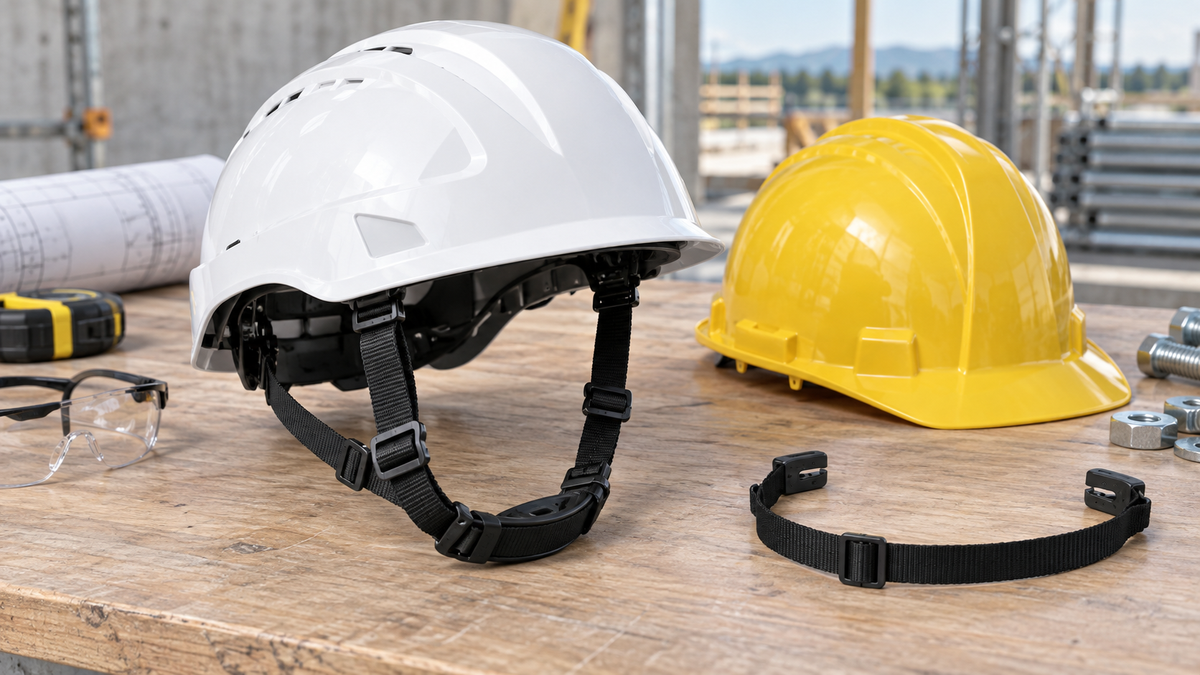
Hard hats and safety helmets with chin straps can help keep head protection in place when a worker slips, falls, looks up or down repeatedly, works in wind, or performs tasks where the helmet could be dislodged. A chin strap is not a universal substitute for selecting the correct helmet type and class, and it is not automatically required for every Type I or Type II helmet. Use only a manufacturer-approved strap or helmet system, and base the decision on the hazard assessment, product instructions, fit, and applicable site rules.
Who This Guide Is For
This guide is for employers and buyers evaluating retained head protection for construction, utilities, work at height, industrial maintenance, warehouses, public works, and other jobs where a helmet may come off during movement or an incident.
This article is educational and does not replace legal, regulatory, engineering, or site-specific safety advice. Verify requirements against applicable OSHA standards, state plans, project rules, manufacturer instructions, current ANSI/ISEA markings, and the workplace hazard assessment.
Are Chin Straps Required on Hard Hats?
There is no blanket rule that every industrial hard hat must have a chin strap. OSHA requires appropriate head protection where employees face potential head injury from falling objects and electrical hazards, and employers must select PPE from the hazards identified.
NIOSH explains that Type I and Type II industrial helmets do not universally require chin straps. It also notes that chin straps are important for applications where a helmet can become dislodged. When a Type II helmet is supplied with a chin strap, the strap must meet applicable width, retention, and elongation requirements in the ANSI standard cited by NIOSH.
The practical question is not simply, "Does OSHA require a strap?" It is, "Could this worker lose the helmet when protection is needed?" The employer should document that assessment and follow any stricter owner, contractor, manufacturer, or site rule.
When a Chin Strap May Be Appropriate
A retained helmet may be worth evaluating when work involves:
- Ladders, scaffolds, lifts, roofs, or other elevated locations
- Slip, trip, or fall exposure
- Frequent bending, climbing, crawling, or looking overhead
- Windy outdoor work
- Confined or congested spaces where the shell can contact nearby surfaces
- Rescue, rope access, or climbing activities
- Vehicle, equipment, or struck-by exposure where helmet retention is part of the selected system
- Tasks where a dropped helmet could create a secondary hazard below
These conditions do not prove that any strap will work. The helmet, suspension, strap, adjustment points, and buckle should function as one manufacturer-approved system.
Hard Hat, Safety Helmet, and Chin Strap Basics
Traditional hard hats commonly use a suspension and may be sold without a chin strap. Newer safety-helmet designs often use a retention system that includes a chin strap and may provide additional side-impact protection depending on the model.
Do not use appearance to determine protection. Verify the interior label and documentation for:
- Type I or Type II impact protection
- Class G, E, or C electrical classification
- Manufacturer and model
- Approved suspension and chin-strap options
- Size range and adjustment method
- Any reverse-donning marking
- Date, inspection, and replacement guidance
Type I protection addresses blows to the top of the head. Type II protection addresses impacts to the top and sides. The chin strap helps retention; it does not change a Type I helmet into Type II.
2-Point vs 4-Point Chin Straps
2-point chin straps
A 2-point strap attaches at two locations and typically runs beneath the chin. It can provide straightforward retention for compatible hard hats and may be lighter and easier to adjust.
Verify that the attachment points are designed for the exact helmet. A strap advertised as fitting several models still needs written compatibility for the model in service.
4-point chin straps
A 4-point strap connects at four locations around the helmet. The additional anchor points can help stabilize the helmet during movement and are common on climbing-style or modern safety helmets.
More attachment points do not automatically mean a higher impact rating. Compare the complete helmet's ANSI type, electrical class, retention design, and manufacturer instructions.
Chin cups and adjustment hardware
Some straps include a chin cup; others use webbing positioned under the jaw. Check adjuster placement, buckle operation, webbing width, comfort, and whether workers can operate the buckle while wearing other required PPE.
Compatibility Is Non-Negotiable
Do not drill holes, tie cord to the shell, attach an unapproved strap, or modify the suspension. Changes can damage the shell, interfere with breakaway or retention behavior, and invalidate the manufacturer's specifications.
Use a chin strap listed by the helmet manufacturer for that exact model or purchase a complete helmet designed with the retention system. Confirm compatibility with:
- Face shields and visor carriers
- Helmet-mounted earmuffs
- Safety glasses and goggles
- Respirator straps
- Hoods, balaclavas, and cold-weather liners
- Headlamps and communication equipment
- Fall-protection equipment and rescue gear
Accessories should not lift the shell, push the suspension out of position, prevent buckle release, or create pressure points.
How to Fit a Hard Hat Chin Strap
Follow the manufacturer instructions for the exact system. A general fitting sequence is:
- Adjust the suspension so the helmet sits level and securely on the head.
- Place the strap in the manufacturer-specified position under the chin or jaw.
- Adjust each side evenly so the helmet remains centered.
- Tighten the strap enough to retain the helmet without painful pressure or restricted movement.
- Move the head up, down, and side to side to check stability.
- Test the buckle and confirm the worker can release it as designed.
- Recheck fit after adding approved eye, hearing, face, or respiratory protection.
The strap should not be worn behind the head, left dangling, twisted, tied in a knot, or routed through unapproved points. Long hair, facial hair, jewelry, clothing, and cold-weather layers can affect positioning and should be considered during the fit check.
Chin Straps and Electrical Protection
Helmet electrical class remains a separate specification. Class G and Class E helmets are designed and tested for specified electrical protection, while Class C helmets provide no electrical protection.
Do not assume that adding a chin strap preserves the original electrical classification. Use only approved components and check the manufacturer documentation for the complete system. Metal hardware, unapproved accessories, vents, contamination, and damage may matter in electrical environments.
Workers exposed to electrical hazards need a head-protection selection based on the voltage and task, along with the rest of the electrical safety program. The presence of a strap does not establish electrical suitability.
Chin Straps and Work at Height
A chin strap may keep a helmet on during climbing, leaning, or a fall, but it is not fall protection. It does not replace guardrails, personal fall-arrest systems, ladder controls, training, or rescue planning.
Never use the chin strap to tether a worker to a structure or to suspend the helmet. If the site uses tool and object tethering to protect people below, follow a separate engineered program and manufacturer instructions.
For work at height, evaluate helmet retention together with side-impact exposure, snag hazards, emergency removal, compatible fall-protection straps, and rescue procedures.
Inspection Before Each Use
OSHA's safety-helmet guidance recommends inspecting the shell, suspension, chin strap, cushioning, markings, fit, and approved accessories. Before each use, check:
- Strap webbing for cuts, fraying, stretching, burns, or chemical damage
- Buckles and adjusters for cracks, deformation, corrosion, or poor operation
- Attachment points for looseness or damage
- Suspension webbing and anchors for wear
- Shell for cracks, dents, chalking, soft spots, or unauthorized holes
- Labels and markings for legibility
- Cleanliness and contamination
- Secure fit after adjustment
Remove the helmet from service after an impact or when damage or degradation is present, following manufacturer guidance. Replace only with approved parts; do not mix suspensions or straps from different systems unless the manufacturer explicitly allows it.
Cleaning and Storage
Clean the helmet and chin strap according to manufacturer instructions, typically using mild soap and water where permitted. Strong solvents, paints, adhesives, and harsh cleaners can damage components even when the damage is not immediately visible.
Dry equipment fully before storage. Keep it away from direct sunlight, vehicle dashboards, excessive heat, chemicals, and sharp objects. Store straps so they are not crushed, stretched, tangled, or exposed to contamination.
Buying Checklist
Before ordering hard hats with chin straps, confirm:
- The head-injury and helmet-dislodgement hazards
- Required Type I or Type II impact protection
- Required Class G, E, or C electrical classification
- Whether the strap is integrated or an approved accessory
- 2-point or 4-point retention based on the selected system
- Fit range and worker sizing needs
- Compatibility with eye, face, hearing, respiratory, and fall-protection PPE
- Inspection and replacement parts availability
- Cleaning and storage instructions
- Site, contractor, rescue, and emergency-removal requirements
- Worker trials during representative movement and tasks
Common Mistakes
- Assuming every hard hat is designed to accept a chin strap
- Treating a chin strap as proof of Type II protection
- Adding an unapproved universal strap or drilling attachment holes
- Ignoring electrical class when selecting a retained helmet
- Wearing the strap loose, twisted, or behind the head
- Failing to test compatibility with other PPE
- Using the strap as a fall-arrest or object-tethering device
- Keeping a helmet in service after impact or visible damage
- Buying one model without fit trials across the workforce
Key Takeaways
- Chin straps can help retain head protection when movement, wind, a slip, or a fall could dislodge it.
- Type I and Type II labels describe impact protection, not simply the presence of a strap.
- A 2-point or 4-point strap must be approved for the exact helmet system.
- The strap does not replace the correct helmet type, electrical class, fall protection, or other controls.
- Fit and compatibility should be checked with all other PPE in place.
- Inspect the shell, suspension, strap, buckle, and attachment points before use.
FAQ
Does OSHA require chin straps on hard hats?
OSHA does not impose a universal chin-strap rule for every industrial hard hat. Employers must select appropriate head protection for identified hazards, and chin-strap use may follow from the hazard assessment, manufacturer instructions, or stricter project and site rules.
Is a hard hat with a chin strap automatically Type II?
No. Type II is an impact-protection designation that must appear in the helmet's markings and documentation. A strap helps helmet retention but does not change the helmet's impact type.
Can I add a universal chin strap to any hard hat?
Only use a strap the manufacturer approves for the exact helmet model. Unapproved attachments or shell modifications can compromise performance and invalidate product specifications.
Is a 4-point chin strap better than a 2-point strap?
A 4-point system can offer more stabilization, while a 2-point system may provide suitable retention for compatible applications. The correct choice depends on the complete helmet design, hazard, fit, and manufacturer requirements.
Should chin straps be used when working at height?
They are often worth evaluating because a helmet can be dislodged during climbing, leaning, a slip, or a fall. The strap is not fall protection and must be used as part of a broader work-at-height program.
When should a chin strap be replaced?
Replace it when webbing is cut, frayed, stretched, burned, chemically damaged, or contaminated, or when buckles, adjusters, or attachment points do not work correctly. Follow the helmet manufacturer's inspection and replacement guidance.
About Mick Chan
Mick Chan contributes safety supply guidance for eSafetySupplies content, with a focus on practical PPE selection, workplace readiness, and helping teams connect safety requirements to the right supplies. His review perspective is included to keep recommendations grounded in real purchasing and jobsite use.
Final CTA
Start with the hazard and the chance of helmet loss, then compare impact type, electrical class, retention system, fit, and approved accessories. Explore hard hats, head protection, and hard-hat accessories to build a compatible head-protection system for each crew.