Quick Answer
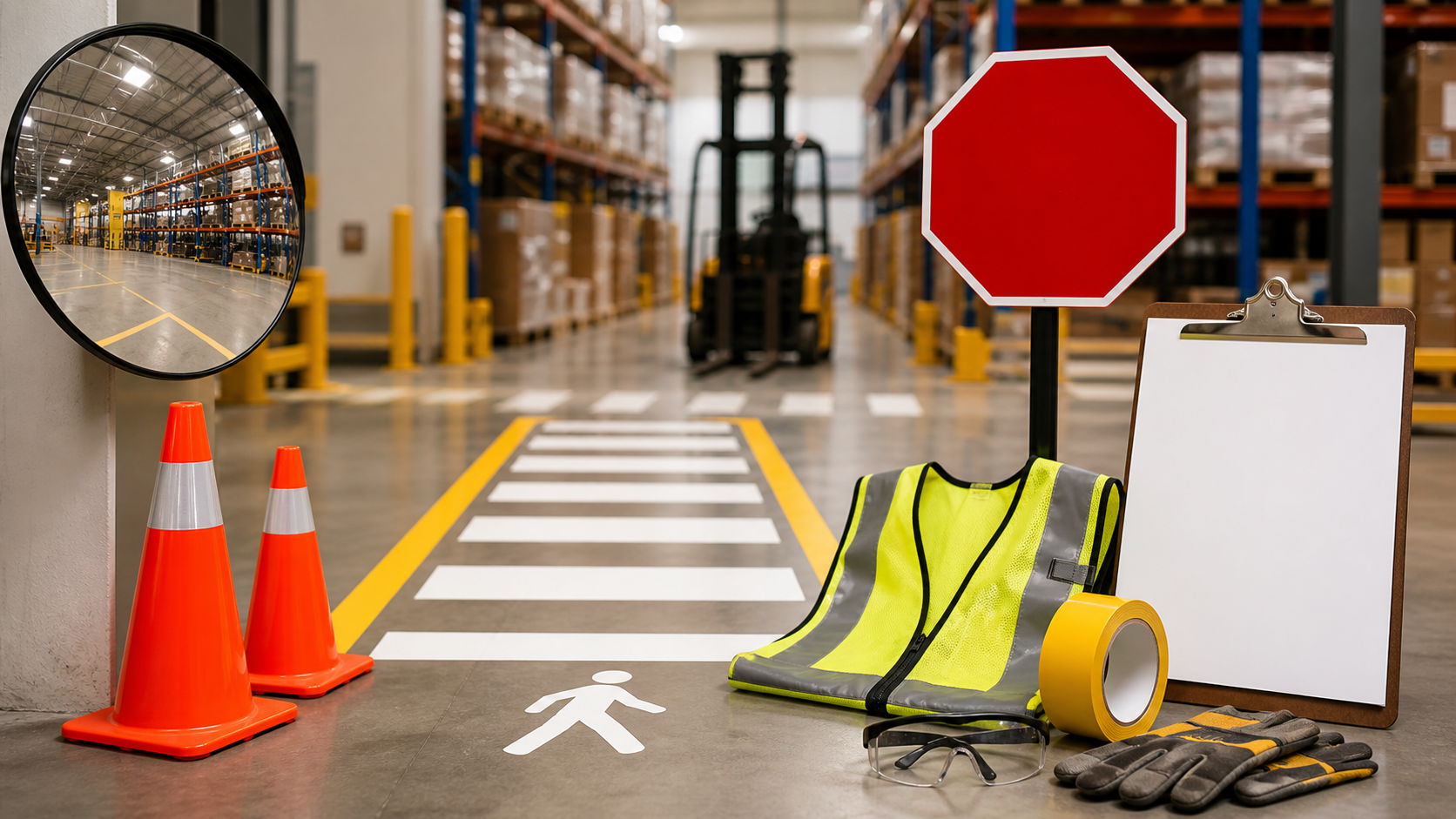
Forklift pedestrian safety depends on clear routes, trained operators, visible pedestrians, controlled intersections, and consistent traffic rules. Signs, convex mirrors, cones, floor marking tape, guardrails, and high-visibility PPE help workers understand where people and forklifts should move.
OSHA's powered industrial truck standard requires safe operation and training. Facility controls should make safe movement obvious before a forklift and a pedestrian meet at an aisle, dock, blind corner, or crossing.
Forklift Pedestrian Safety Checklist
| Control | What to check | Why it matters |
|---|---|---|
| Floor markings | Pedestrian paths, forklift lanes, crossings, and stop zones are visible. | Clear routes reduce improvisation in busy aisles. |
| Signs | Warnings are posted at crossings, blind corners, docks, and battery areas. | Signs reinforce traffic rules at decision points. |
| Mirrors | Convex mirrors cover blind intersections and are kept clean. | Mirrors improve sightlines before entry into shared spaces. |
| Cones and barriers | Temporary work zones and blocked aisles are controlled. | Temporary changes need temporary controls. |
| High-visibility PPE | Vests are available and worn in forklift traffic areas. | Contrast helps operators see pedestrians earlier. |
| Housekeeping | Pallets, shrink wrap, and staging do not block views or paths. | Clutter creates blind spots and detours. |
Where to Start
- Map forklift routes and pedestrian routes separately.
- Mark crossings where routes must intersect.
- Add mirrors at blind corners and rack ends.
- Use cones or barricades during maintenance, spills, or layout changes.
- Review near misses to identify missing signs or confusing routes.
Common Mistakes to Avoid
Do not rely only on painted lines if signs, training, and enforcement are weak. Do not let stored product block mirrors or signs. Do not create pedestrian paths that end in forklift lanes without a clear crossing point.
FAQ
Do forklift areas need floor marking?
Floor marking is a practical way to separate routes and reinforce traffic rules, especially in warehouses with repeated pedestrian and forklift interaction.
Where should convex mirrors be placed?
Place them at blind corners, aisle intersections, rack ends, and dock areas where they improve sightlines.
Are high-visibility vests enough?
No. Vests help visibility, but routes, signs, training, speed control, and housekeeping still matter.
About Mick Chan
Mick Chan is a safety supply specialist who helps businesses choose practical PPE, facility safety, and emergency readiness products for real workplace conditions. His guidance focuses on simple, usable safety programs that are easier for teams to follow every day.
Final CTA
Improve warehouse traffic control with floor marking tape, signs, mirrors, cones, high-visibility vests, gloves, safety glasses, and facility safety supplies from eSafetySupplies.com.