Quick Answer
A roofing harness kit is a convenient package, not a complete fall-protection plan. Before buying, confirm whether personal fall arrest is the right method for the roof, then check that the anchor, harness, lifeline, rope grab, and connector are compatible and that the work area has enough fall clearance. A qualified person and the employer's site-specific plan must address anchor installation, training, inspection, and prompt rescue.
Who This Guide Is For
This guide is for crews comparing packaged fall-protection equipment for construction roofing. It is educational and does not replace an OSHA assessment, manufacturer instructions, engineering judgment, or state-plan requirements. A kit's components must be evaluated as one system at the actual worksite. Do not use a shopping page to decide where an anchor may be installed.
Start With the Roof and the Work
OSHA's construction fall-protection rule has different provisions for low-slope roofing, steep roofs, holes, and other exposures. The familiar six-foot threshold appears in several provisions, but it does not mean every roof uses the same method. Low-slope roofing can involve several permitted combinations of systems under specified conditions. Steep-roof work has its own requirements. Skylights and other holes deserve separate attention.
Write down the roof slope, edge and hole locations, access route, work sequence, and lower-level hazards. Then select a compliant protection method for each phase. Guardrails or other systems may be more suitable than personal fall arrest for some tasks. The package on the shelf should follow that decision, not make it.
What a Kit May Include
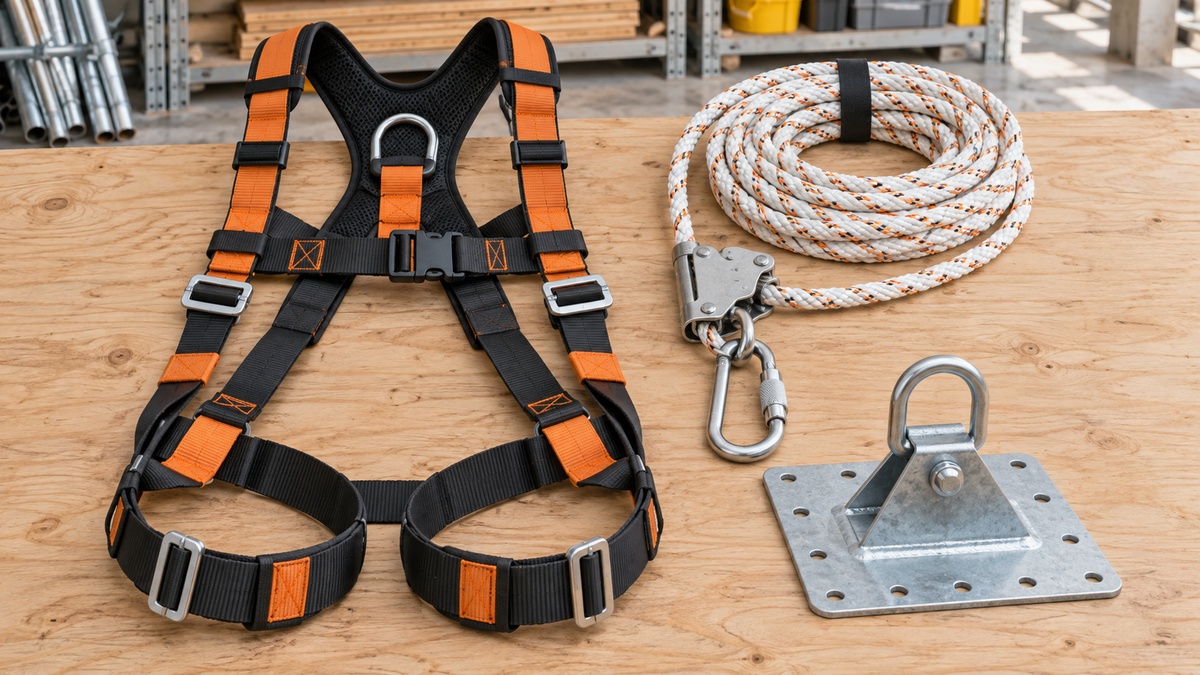
Packaged roof kits vary. One active ESS example, the Safewaze V-Line Bucket Roof Kit, is identified by Safewaze as a harness, 50-foot vertical lifeline assembly, reusable roof anchor, and bucket. Its technical sheet lists the specific component model numbers. That is useful for comparing a purchase order with what arrives, but it does not prove the anchor suits a particular roof or that every component suits every worker.
Check the manufacturer's current component documents for the exact model and revision. A different kit may have a different rope length, connection arrangement, anchor, harness size range, or user-weight range. Never assume that the word "complete" means rescue equipment, training, or a site-approved anchor location is included.
Anchor Selection Is a Design Decision
OSHA 29 CFR 1926.502 sets criteria for personal fall arrest anchorages. The rule includes a 5,000-pound-per-worker option and an alternative in which a complete system with a safety factor of at least two is designed, installed, and used under a qualified person's supervision. This is not a permission to fasten an anchor to any convenient piece of roof structure.
The roof substrate, fasteners, attachment details, expected loading, and placement all matter. The crew must follow the anchor manufacturer's instructions and the site plan. Position also affects swing-fall exposure: a worker who falls sideways toward a roof edge can hit a lower obstruction even when the vertical clearance calculation looked adequate.
Calculate Clearance Before Anyone Clips In
The available distance below a worker must exceed the total distance needed for the system to stop a fall. The calculation depends on the anchor position, free fall, connector or energy absorber extension, harness stretch and D-ring movement, worker height, and a safety margin specified by the manufacturer. A roof edge above a lower roof, truck, or equipment makes this especially important.
Do not borrow a clearance number from another kit's sales sheet. Use the instructions for the exact lifeline, rope grab, connector, and harness combination, then confirm the geometry of the work area. If the calculation fails, change the method or system before starting work.
Fit and Compatibility Are Not Box-Checking
Try on the exact harness with the worker's normal clothing and tools. Adjust shoulder, chest, and leg straps as the manufacturer directs. Check that the dorsal connection is positioned correctly and that the worker can move without loosening the harness. A kit size label is not a substitute for a fit check.
The lifeline, rope grab, and connector must also be approved for use together. Confirm rope diameter, travel direction, connector orientation, and any limits on tying knots or connecting multiple workers. Do not replace a lost component with an apparently similar item unless the manufacturers' instructions and the program administrator approve the combination.
Inspection and Rescue Are Part of the Order
OSHA requires personal fall arrest systems to be inspected before each use for wear, damage, and deterioration, and defective components removed from service. Equipment that has been subjected to impact loading must be removed from service unless a competent person determines it is suitable for reuse. Keep a way to identify the kit, its component models, inspection history, and the responsible owner.
The employer must also provide for prompt rescue after a fall or ensure employees can rescue themselves. A fallen worker hanging in a harness cannot be treated as a problem to solve after the event. Document who responds, how they reach the worker, what equipment is available, and how the site communicates an emergency. Practice the plan before work starts.
A Purchase-Order Checklist
- Roof condition, slope, edges, holes, work phase, and selected protection method.
- Approved anchor model, location, installation method, and qualified-person review where required.
- Exact kit components and manufacturer compatibility documentation.
- Worker fit, user-weight range, and required training.
- Fall-clearance and swing-fall calculations for each work area.
- Inspection, storage, replacement, and impact-loading procedures.
- A prompt-rescue plan and any equipment it requires beyond the kit.
Questions Buyers Ask
Does a roof kit make a job OSHA compliant?
No. Compliance depends on the hazard assessment, chosen protection method, installation, compatible equipment, training, inspection, and rescue arrangements. A product bundle addresses only some of those needs.
Can any roof anchor be used with the kit?
No. The anchor must meet the applicable system criteria and be installed for the specific roof and manufacturer instructions. The complete system and worker load must be evaluated.
Is a longer lifeline always safer?
No. Length alone says little about fall clearance or swing-fall risk. The system configuration and anchor placement control those outcomes.
Final CTA
Have the person responsible for fall protection approve the system specification before ordering. Compare the ESS roofing harness kit with the manufacturer's component sheets, or request a quote listing the exact approved models and quantities.
About Mick Chan: Mick Chan contributes safety supply guidance for eSafetySupplies content, with a focus on practical PPE selection, workplace readiness, and helping teams connect safety requirements to the right supplies. His review perspective is included to keep recommendations grounded in real purchasing and jobsite use.