
Quick Answer
A security vest should be selected for the guard's actual visibility exposure, not simply because the garment says "SECURITY." For work near vehicles or moving equipment, confirm the required high-visibility apparel Type and Class, then check fit over duty gear, access to a radio and belt, and whether a breakaway design is appropriate. The role label helps people identify the wearer; it does not establish the vest's safety rating.
Who This Guide Is For
This guide covers guards, event staff, parking teams, and other security personnel who need to be seen while working. It does not declare one vest compliant for every assignment. Worksite traffic plans, employer hazard assessments, contract terms, and applicable rules determine the specification.
Begin With Where the Guard Stands
A guard stationed at a reception desk has a different exposure from one directing vehicles in a loading area. The second assignment may involve low light, reversing vehicles, and a need for quick movement. Start by documenting the location, nearby traffic, lighting, weather, shift hours, and whether the worker is directing traffic or merely crossing a vehicle route.
This also keeps a purchasing shortcut from becoming a safety decision. A black vest with a bold SECURITY imprint may make a role obvious, but the print does not make the wearer highly visible to drivers. Conversely, a bright garment is not automatically a documented ANSI/ISEA 107 garment. Check the actual product label and declaration.
Understand Type P and Class Without Guesswork
ANSI/ISEA 107 classifies high-visibility safety apparel by Type and Performance Class. Type P is designed for public safety personnel. The garment label and manufacturer documentation, not a search-filter label, should be used to verify the exact rating. Do not assume that every public-safety vest has the same class or that a public-safety classification is required for every security role.
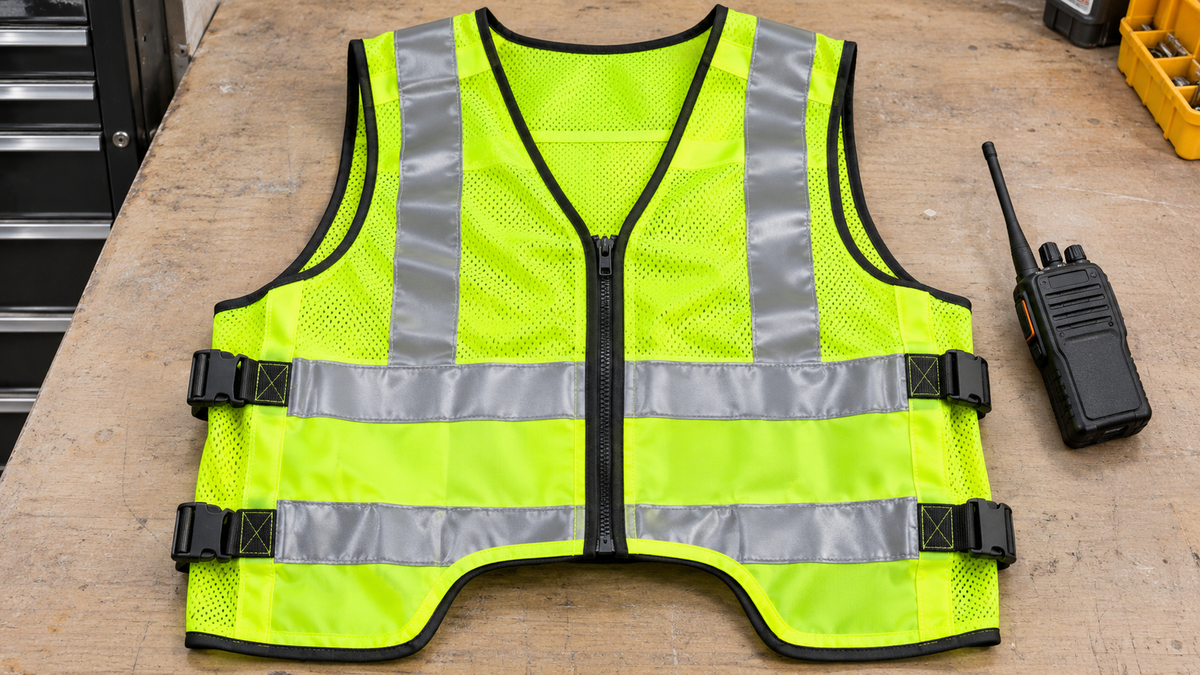
One concrete example is the Ergodyne GloWear 8244PSV Type P Class 2 expandable vest. Ergodyne publishes an ANSI/ISEA 107-2020 declaration for that model. Its shorter cut and expansion over bulky gear address a real problem: a vest that blocks a duty belt may be moved or worn open, reducing intended coverage. Confirm the exact ESS variant, current product documentation, and site requirement before specifying it.
Fit Over Equipment Is Part of the Selection
Try the vest over everything the guard actually wears. A garment that fits over a shirt may pull tight over a jacket or body armor. Check shoulder movement, closure, reflective material exposure, and access to the radio, badge, keys, and belt-mounted tools. The worker should be able to sit, walk, bend, and turn without the vest riding up or obscuring gear needed in an emergency.
Mic tabs and pockets can help, but they are not universal benefits. A pocket placed under a radio strap is wasted; a loose item in a pocket may fall out when a worker leans over a vehicle. Assign only the storage the job needs and verify that carried gear does not cover reflective material.
When a Breakaway Vest Makes Sense
Some public-safety vests have breakaway shoulders or sides intended to release if snagged. Ergodyne describes this feature on the 8244PSV. It may matter where a guard works near moving machinery, gates, or other snag points. But a breakaway design can also affect how equipment is mounted and how the vest stays in place. Make that choice from the task assessment, not from a generic feature list.
A Short Buying Checklist
Before placing a team order, record:
- The assignment and visibility hazard, including traffic and nighttime work.
- The required apparel Type and Class, if any, and the documentation used to verify it.
- Whether a SECURITY identifier is needed and how it will be applied without obscuring required materials.
- The layers and duty equipment the vest must fit over.
- Closure, breakaway, pocket, mic-tab, and belt-access needs.
- A size run and try-on process, including the smallest and largest sizes.
- Inspection and replacement triggers, such as damaged closures, tears, or visibly degraded reflective material.
An order that records the approved model and size range is easier to repeat than one that says only "security vest, yellow."
Questions Buyers Ask
Does a vest that says SECURITY meet a high-visibility standard?
Not necessarily. Role identification and documented high-visibility performance are separate questions. Check the garment label and manufacturer declaration for the exact model.
Are public safety vests only for police and fire personnel?
The Type P design category addresses public-safety work. Whether it is appropriate for a security assignment depends on the actual task and the site's requirements. Do not infer an occupational entitlement or regulatory requirement from the product name alone.
Should every security vest be breakaway?
No. The feature is worth evaluating for snag hazards, but it should be balanced against the way the worker carries gear and the employer's worksite assessment.
Final CTA
Write down the exposure and fit requirements first, then compare the ESS safety vest selection and individual manufacturer declarations. For a team order with sizes or imprint needs, request a quote using that specification.
About Mick Chan: Mick Chan contributes safety supply guidance for eSafetySupplies content, with a focus on practical PPE selection, workplace readiness, and helping teams connect safety requirements to the right supplies. His review perspective is included to keep recommendations grounded in real purchasing and jobsite use.