
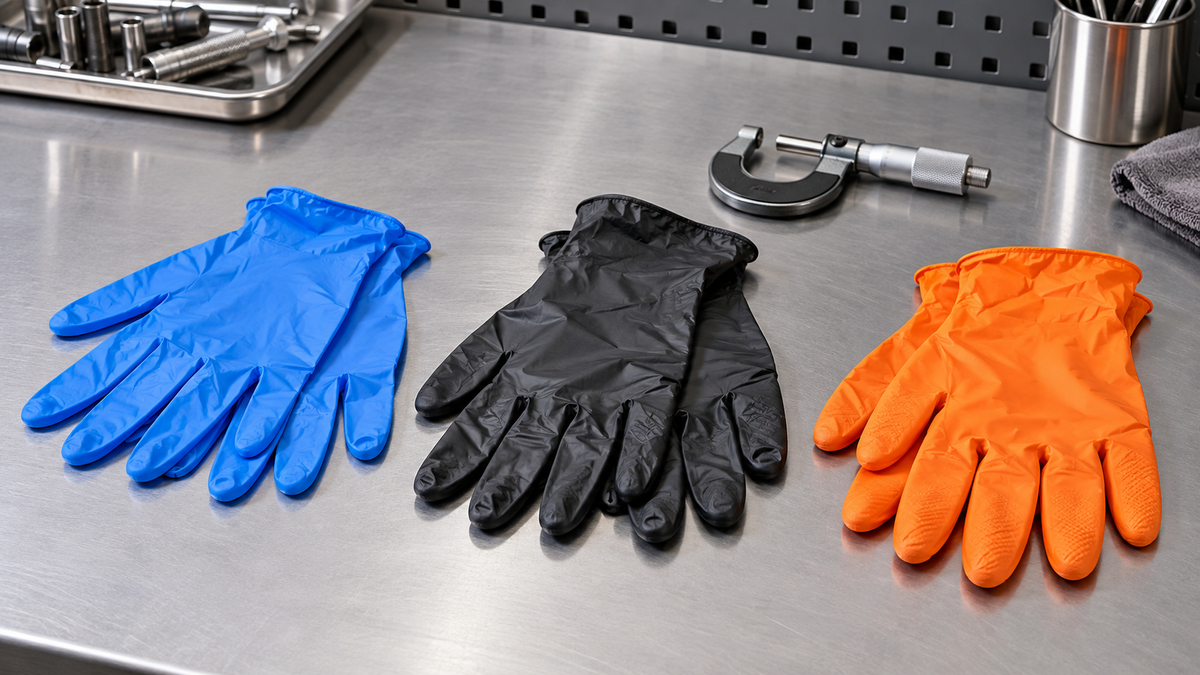
Quick Answer
Choose 4 mil nitrile gloves for light, short-duration tasks where touch sensitivity and frequent glove changes matter. Choose 6 mil for a practical balance of dexterity and durability, and consider 8 mil for more demanding disposable-glove tasks where extra material and tear resistance are useful. Thickness alone does not prove chemical compatibility, puncture protection, food-contact suitability, or medical use, so verify the exact glove's specifications against the hazard before ordering.
Who This Guide Is For
This guide is for safety managers, maintenance teams, automotive shops, janitorial departments, food-service operations, laboratories, and procurement buyers comparing disposable nitrile gloves by thickness.
This article is educational and does not replace legal, regulatory, industrial hygiene, medical, or site-specific safety advice. Always verify requirements against applicable OSHA standards, state plans, safety data sheets, manufacturer instructions, chemical-resistance data, and your workplace hazard assessment.
What Does Mil Mean for Nitrile Gloves?
A mil is one-thousandth of an inch. A 4 mil glove is nominally about 0.004 inch thick, a 6 mil glove about 0.006 inch, and an 8 mil glove about 0.008 inch at the location measured.
That last phrase matters. Manufacturers may report thickness at the palm, fingertip, or another test location, and a glove is not necessarily the same thickness across its entire surface. Product measurements may also be nominal or provided as a range. When comparing gloves, check that the measurements refer to the same location and use the current manufacturer specification rather than relying only on a product name.
Thickness is one useful buying factor. It can influence tactile feel, flexibility, durability, and how quickly a worker notices small parts or surface details. It does not replace a hazard assessment or tell you everything about the glove compound, quality, fit, texture, cuff, or barrier performance.
4 Mil vs 6 Mil vs 8 Mil Nitrile Gloves at a Glance
| Thickness | Typical buying priority | Common advantages | Important tradeoffs |
|---|---|---|---|
| 4 mil | Dexterity and frequent changes | Lighter feel, good touch sensitivity, easy to change between short tasks | Less material for demanding or abrasive work; may tear sooner under stress |
| 6 mil | Balanced general-purpose use | More substantial feel while retaining useful dexterity | Not as light as 4 mil or as substantial as many 8 mil options |
| 8 mil | Heavier disposable use | More material, stronger feel, useful for longer or tougher tasks | Reduced tactile sensitivity, more hand fatigue for some users, often higher cost per glove |
These are practical tendencies, not guaranteed performance ratings. A well-made 6 mil glove can outperform a poorly matched 8 mil glove for a specific task. Fit, formulation, manufacturing quality, texture, cuff length, and test data all matter.
When 4 Mil Nitrile Gloves Make Sense
4 mil nitrile gloves are commonly considered for light-duty work where workers need to feel small parts, controls, instruments, food, or cleaning surfaces. Their lighter construction can make repeated donning and short work cycles more comfortable.
Potential applications include:
- Food preparation and service when the specific glove is approved for the intended food-contact use
- Light cleaning without incompatible chemical exposure
- Inspection, sorting, and packaging
- Beauty, tattoo, or personal-care tasks when the exact glove meets applicable requirements
- Short-duration assembly or electronics handling
- Frequent glove changes used to prevent cross-contamination
The main limitation is mechanical demand. Thin disposable gloves are easier to damage when workers encounter rough edges, sharp parts, heavy friction, or forceful pulling. If workers regularly double-glove because a 4 mil product tears, a properly selected 6 mil or 8 mil option may be more practical.
When 6 Mil Nitrile Gloves Make Sense
6 mil nitrile gloves often occupy the middle of the range. They can provide a more substantial barrier and better durability than many lighter gloves without giving up as much finger feel as a heavier disposable glove.
They are often evaluated for:
- Janitorial and facility maintenance
- Automotive inspection and light repair
- General industrial handling
- Warehousing, receiving, and parts work
- Sanitation tasks requiring dependable grip
- Longer disposable-glove wear where 4 mil gloves fail too frequently
For many mixed-task workplaces, 6 mil can be a useful trial point. It is still important to test the actual glove with the actual task. Workers with small hands, high-dexterity work, or frequent changes may prefer a lighter glove, while demanding maintenance work may justify a thicker option.
When 8 Mil Nitrile Gloves Make Sense
8 mil nitrile gloves are often marketed as heavy-duty disposable gloves. The added material can provide a more substantial feel and may improve durability for tasks involving friction, tools, oils, grime, or longer wear.
Common buying scenarios include:
- Automotive and diesel maintenance
- Equipment cleanup and industrial maintenance
- Painting, coating, and shop work when the glove is compatible with the product used
- Tough janitorial tasks
- Handling parts with moderate friction or rough surfaces
- Jobs where workers frequently tear lighter disposable gloves
An 8 mil glove is still disposable hand protection. It should not be substituted for a cut-resistant glove, heat-resistant glove, electrical glove, or reusable chemical-protective glove when those hazards are present. Browse work gloves, cut-resistant gloves, or chemical-resistant gloves when the hazard calls for a different product category.
Does a Thicker Nitrile Glove Provide Better Chemical Protection?
Sometimes a thicker sample of the same material and formulation can take longer for a chemical to break through, but thickness alone is not enough to select a chemical glove. Chemicals interact differently with glove formulations, and performance can change with concentration, temperature, contact time, movement, and physical damage.
NIOSH advises using manufacturer chemical-resistance guidance because chemicals permeate protective materials differently. OSHA guidance also emphasizes selecting hand protection for the specific task, conditions, duration, and identified hazard.
Before using nitrile gloves with a chemical:
- Identify the exact chemical, mixture, and concentration.
- Review the product's safety data sheet, especially the exposure-control and PPE information.
- Check the glove manufacturer's permeation, degradation, and breakthrough-time data for that product.
- Consider splash contact versus immersion, contact duration, temperature, and glove reuse.
- Establish a change schedule and removal method that prevents skin contact.
Do not assume that an 8 mil nitrile glove is automatically compatible because it is thicker, or that the same glove is suitable for every cleaner, solvent, oil, adhesive, or coating.
Other Glove Specifications Matter as Much as Thickness
Fit and sizing
A glove that is too tight can increase hand fatigue and may be stressed during movement. A glove that is too loose can reduce grip, snag, or make fine work difficult. Stock enough sizes for workers to get a secure fit without excessive stretching.
Grip texture
Textured fingertips or a fully textured surface can help with wet, oily, or small-object handling. Texture does not make a glove universally slip-resistant, so trial the glove with representative tools and materials.
Cuff length
Standard cuffs cover the hand and wrist area, while extended cuffs provide additional coverage toward the forearm. Choose cuff length based on splash direction, garment overlap, and the rest of the PPE ensemble.
Intended use and product claims
General-purpose, food-contact, examination, chemotherapy-tested, and other gloves are not interchangeable labels. Confirm the exact product's current documentation and intended use. Color is also not a protection rating; black, blue, orange, and other colors may help departments organize supplies, but they do not establish performance.
Quality and barrier testing
Review applicable quality information, barrier claims, and standards listed by the manufacturer. For medical or other regulated applications, use products specifically labeled for that use. Do not infer a certification from thickness or from the word "industrial."
Match Thickness to the Work
Food service and frequent changes
For brief tasks with frequent glove changes, a lighter glove may preserve dexterity and control costs. Verify food-contact suitability and change gloves whenever workers switch tasks, handle contamination, or damage the glove. Compare the broader disposable gloves collection if nitrile is not the only appropriate material.
Janitorial and facility cleaning
General cleaning may favor 4 mil or 6 mil gloves, depending on duration and mechanical stress. Strong disinfectants, degreasers, or concentrated chemicals require product-specific compatibility checks; a reusable chemical-resistant glove may be the correct choice.
Automotive and maintenance
Six or eight mil gloves can be useful when workers need more durability around tools, grease, and parts. Sharp edges, heat, rotating equipment, and aggressive chemicals introduce hazards that thickness alone cannot control.
Laboratory and healthcare-adjacent work
Choose gloves based on the procedure, biological or chemical exposure, required certification, and facility protocol. An 8 mil industrial glove is not automatically an examination glove, and a medical glove is not automatically compatible with laboratory chemicals.
Assembly, inspection, and small parts
Four mil gloves may offer better tactile feedback for small components. If tears or abrasion are common, trial 6 mil gloves and compare task completion, glove-change frequency, comfort, and defect rates instead of relying on thickness alone.
Nitrile Glove Buying Checklist
Before placing a bulk order, confirm:
- The task and hazard each glove will cover
- Whether the glove is for incidental contact, splash, or another exposure pattern
- The exact chemicals, mixtures, and concentrations involved
- Manufacturer compatibility and permeation data when chemicals are present
- Required food-contact, exam, or other product status
- Palm and fingertip thickness measurement locations
- Sizes needed across the workforce
- Grip texture and cuff length
- Expected change frequency and disposal process
- Whether a reusable, cut-resistant, thermal, or other glove category is more appropriate
- A small worker trial before standardizing a large order
For mixed operations, it can be better to stock two clearly assigned gloves than force one thickness into every department. Label storage locations by task and train workers on where each glove should and should not be used.
When to Replace Disposable Nitrile Gloves
Replace a disposable glove immediately when it is torn, punctured, visibly degraded, contaminated, or no longer fits securely. Also change gloves when moving from a contaminated task to a clean one and according to the workplace's chemical change schedule or infection-control procedure.
Do not wash or reuse a disposable glove unless the manufacturer specifically permits it for the intended application. If workers routinely wear gloves until the inside becomes wet, the surface becomes slick, or the glove stretches out of shape, review task duration, glove thickness, sizing, and change frequency.
Common Buying Mistakes
- Treating mil thickness as a complete protection rating
- Assuming every nitrile formulation resists the same chemicals
- Comparing palm thickness on one glove with fingertip thickness on another
- Buying one size for every worker
- Choosing 8 mil for sharp-edge work instead of evaluating cut resistance
- Assuming glove color proves intended use or performance
- Using general-purpose gloves for medical, food-contact, or regulated work without verification
- Ignoring cuff length, grip texture, and worker comfort
- Ordering a large quantity before conducting a task-based trial
Key Takeaways
- Four mil nitrile gloves prioritize dexterity and frequent glove changes for lighter tasks.
- Six mil nitrile gloves often balance tactile control with added durability for general workplace use.
- Eight mil nitrile gloves can suit tougher disposable applications, but they are not a substitute for specialized protective gloves.
- Thickness does not prove chemical compatibility, puncture resistance, or regulatory status.
- Compare the same measurement location, then verify fit, cuff, texture, intended use, and manufacturer test data.
- Select gloves from the hazard assessment and trial them with real tasks before buying in bulk.
FAQ
Is 6 mil thicker than 4 mil?
Yes. Nominally, a 6 mil glove is 0.006 inch thick and a 4 mil glove is 0.004 inch thick at the stated measurement location. Check whether each manufacturer reports palm or fingertip thickness before comparing products.
Are 8 mil nitrile gloves puncture-proof?
No disposable nitrile glove should be treated as puncture-proof. More material may improve durability in some tasks, but sharp objects require a product selected and rated for the mechanical hazard.
What thickness of nitrile glove is best for mechanics?
Many mechanics consider 6 mil or 8 mil gloves for added durability, but the right choice depends on chemicals, sharp edges, heat, tool control, and required dexterity. Trial the exact glove and use specialized hand protection when disposable nitrile is not enough.
Are thicker nitrile gloves safer for chemicals?
Not automatically. Chemical performance depends on the glove formulation, chemical, concentration, temperature, contact time, and test data. Use the safety data sheet and the manufacturer's chemical-resistance chart for the exact glove.
Are 4 mil nitrile gloves good for food handling?
They can be when the specific product is documented for the intended food-contact use and the task does not exceed the glove's durability. Thickness by itself does not establish food-contact suitability.
Should I buy 4 mil, 6 mil, or 8 mil nitrile gloves?
Start with 4 mil for light, dexterity-focused work, 6 mil for balanced general use, and 8 mil for tougher disposable tasks. Then confirm the selection through hazard review, product documentation, sizing, and a worker trial.
About Mick Chan
Mick Chan contributes safety supply guidance for eSafetySupplies content, with a focus on practical PPE selection, workplace readiness, and helping teams connect safety requirements to the right supplies. His review perspective is included to keep recommendations grounded in real purchasing and jobsite use.
Final CTA
Choose glove thickness from the task, not the box label alone. Compare nitrile gloves, disposable gloves, chemical-resistant gloves, and work gloves at eSafetySupplies, then build an ordering list by department, hazard, size, and change frequency.