
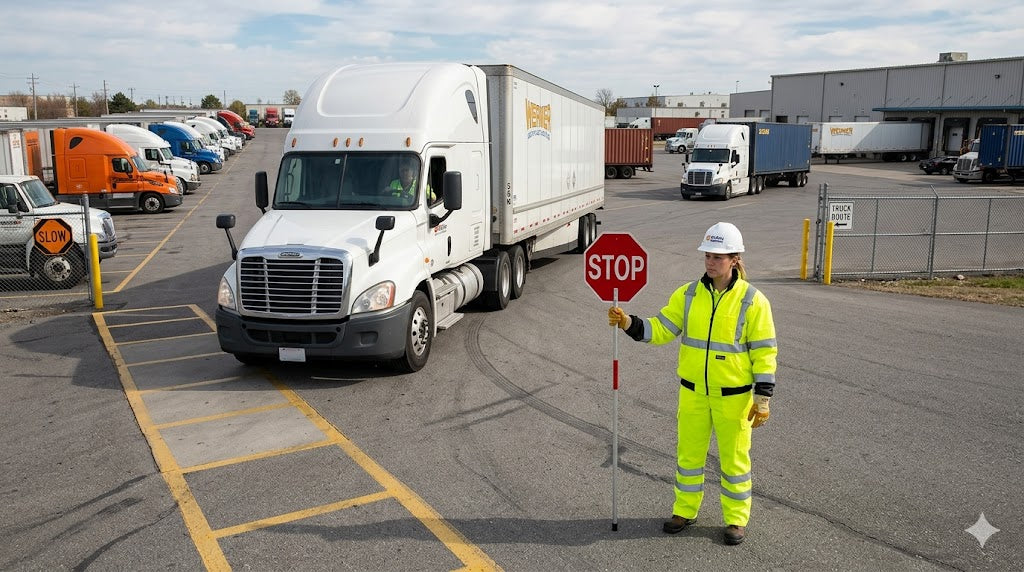
For highway engineering contractors, utility crews, and municipal public works directors, hand-signaling devices are the last line of defense separating your field crew from high-speed vehicular traffic. Among all traffic control tools, the handheld paddle is the most critical asset for active flagger control.
Deploying unverified, non-compliant traffic control hardware isn't just an operational oversight. It is a severe regulatory risk that triggers immediate state Department of Transportation (DOT) citations, costly work site shutdowns, and substantial civil liability if an intersection incident occurs.
To ensure absolute field safety and pass local audits, operations must navigate dense technical criteria. This comprehensive guide breaks down the official MUTCD STOP SLOW paddle standards, detailing exact physical dimensions, color configurations, retroreflective requirements, and state-specific variations to keep your operations compliant and your flaggers completely visible.
What is the Official Size Standard for STOP SLOW Paddles?
Under the federal Manual on Uniform Traffic Control Devices (MUTCD) Section 6E.03, the STOP/SLOW paddle must be the primary and preferred hand-signaling device for temporary traffic control. The paddle shall feature a rigid octagonal shape and maintain a minimum physical dimension of at least 18 inches wide (450 mm) with upper-case letters measuring at least 6 inches (150 mm) high. For high-speed roadways where ambient limits reach or exceed 30 mph, the MUTCD strongly recommends upgrading to a 24-inch wide paddle with 8-inch lettering to optimize driver stopping distances.
The MUTCD Section 6E.03 Compliance Matrix
Federal highway standards establish exact hardware engineering baselines. Merely picking up a light consumer crossing-guard paddle will not satisfy an interstate road safety coordinator or a municipal inspector. Below is the baseline breakdown for a standard temporary traffic control zone:
| Compliance Metric | Federal MUTCD Baseline Standard | Technical Purpose & Function |
|---|---|---|
| Minimum Paddle Width | 18 inches (450 mm) wide | Ensures shape recognition from long-range approaches |
| Minimum Letter Height | 6 inches (150 mm) tall | Guarantees text legibility at safe braking distances |
| STOP Face Layout | Red background, white letters, white border | Replicates standard R1-1 regulatory sign geometry |
| SLOW Face Layout | Orange background, black letters, black border | Replicates standard W20-8 warning sign geometry |
| Nighttime Visibility | Must be fully retroreflectorized | Bounces ambient headlight illumination back to drivers |
| Minimum Staff Height | 6 feet (72 inches) from pavement to sign bottom | Elevates the message over active utility truck silhouettes |
1. Dimensional Layout and Fabrication Materials
The construction of the paddle must balance physical durability with flagger ergonomics. Holding a heavy sign body for a full 8-to-12 hour shift causes muscle fatigue, directly reducing a flagger's reaction speeds.
- Substrate Composition: The MUTCD dictates that paddles should be fabricated from light, semi-rigid materials. High-impact polyethylene plastic, ABS reflective polymers, and heavy-duty .063-gauge tarnish-free aluminum blanks are all approved substrates.
- The Staff Height Advantage: While short 12-inch handles are legal for low-speed municipal utility stops, the optimal method of displaying a flagger signal is mounting the paddle to a rigid vertical staff. When the bottom of the staff rests firmly on the ground, the lowest edge of the sign body must stand a minimum of 6 feet above the pavement. This structural height relieves arm strain and prevents the sign face from dipping out of site lines.
2. Retroreflectivity Film and Night Operations
Operating a temporary traffic control zone after sunset or in low-visibility environments requires upgrading from basic painted sign options. Under federal standards, flags are explicitly banned for nighttime traffic control except in absolute emergency situations.
Every hand-signaling paddle utilized after dark must be fully retroreflectorized to meet or exceed minimum reflectivity benchmarks.
Reflective Sheeting Grade Designations:
- Engineering Grade (Type I): Suitable primarily for low-speed, bright ambient light urban corridors or daytime local residential utility repairs.
- High-Intensity Prismatic (HIP - Type IV): The preferred commercial baseline for highway work zones. HIP sheeting bounces light efficiently through wide angles, slicing through peripheral industrial dust and heavy atmospheric mist.
- Diamond Grade (Type XI): The maximum visibility option available for multi-lane high-speed intersections and complex roadway layouts where maximum light return is vital.
3. High-Visibility Conspicuity Modifications: LED Integration
To protect crews operating in high-exposure or high-speed corridors, the MUTCD permits the integration of flashing lights into the sign face to boost active driver awareness. However, spontaneous wiring configurations will cause an immediate citation. The flashing systems must match strict structural constraints:
- STOP Face Flashers: Must be all-white or all-red light elements.
- SLOW Face Flashers: Must be all-white or all-yellow light elements.
- Pattern Layout: Small LED lights (1/4 inch maximum diameter) must form an octagonal pattern along the outer edge of the border, or form the clear shape of the letters inside the legend.
- Flash Rate Threshold: Flashing mechanisms must cycle at a strict frequency of at least 50, but no more than 60, flashes per minute.
4. Understanding Critical State-Level Variations
A common trap for regional civil contractors is assuming federal MUTCD guidelines are globally accepted across all jurisdictions. Numerous state agencies enforce stricter criteria that automatically supersede federal minimums.
- The 24-Inch Mandate States: High-density jurisdictions like Virginia, Delaware, and New York state transportation maintenance agencies explicitly mandate that a STOP/SLOW paddle utilized on any state highway or active public road have a minimum width of 24 inches. Attempting to deploy a standard federal 18-inch paddle in these states will halt work site operations instantly.
- Color Profile Exceptions: Verify your specific state supplement directives. While federal regulations allow orange or yellow backgrounds for the SLOW face depending on historical regional edits, modern standards demand the high-visibility orange profile to unify field warnings.
Frequently Asked Questions About STOP SLOW Paddles
1. Can a flagger use a red safety flag instead of a paddle?
Under MUTCD Section 6E.03, the use of flags for hand-signaling must be limited strictly to emergency situations where a compliant paddle is unavailable. Flags do not provide drivers with positive directional guidance. When an emergency dictates using a flag, it must measure at least 24 inches square, be solid red or fluorescent orange-red, and be fastened securely to a 36-inch staff.
2. What are the legal hand-signaling motions required when using a paddle?
To stop road users, the flagger must face traffic, extend the arm holding the STOP paddle horizontally away from the body, and hold the free hand with the palm up above shoulder level. To let traffic proceed, the flagger must face traffic with the SLOW face aimed outward and motion with the free hand in an upward arc toward the head.
3. How often do retroreflective paddles need to be replaced?
Paddles must be replaced as soon as their retroreflective surface falls below standard visibility levels. If a paddle is deeply scratched, faded by UV solar exposure, or caked in heavy asphalt binders to where it no longer reflects headlights clearly at night, it fails field inspection criteria.
4. Are STOP/GO paddles legal for roadway construction flaggers?
No. The MUTCD explicitly specifies a STOP/SLOW configuration for active, temporary roadway construction zones. Twin-message STOP/GO or STOP/STOP paddles are specialized tools primarily optimized for school crossing guards, low-speed parking structures, or internal industrial logistics yards.
5. What are the citation risks for using non-compliant traffic paddles?
OSHA closely cooperates with DOT road safety inspectors. If a compliance officer documents an unrated, undersized, or non-reflective traffic paddle inside an active lane, they can issue a "Serious Violation" citation under traffic safety guidelines, accompanied by immediate daily fines and work stop-orders until the asset group is fully modernized.
box. -->Actionable Next Steps: Secure Your Field Lines Today
Deploying field personnel with non-compliant, worn-out traffic paddles is an open invitation for costly regulatory fines and severe roadway accidents. Take absolute control of your enterprise field safety protocol by performing a full, comprehensive inventory audit on your field traffic management gear this week.
Are your hand-signaling assets measuring a true compliant diameter? Is your reflective sheeting bright enough to secure night-shift crews?
Upgrade Your Temporary Traffic Control Hardware Today
Explore eSafety Supplies’ comprehensive inventory of high-performance regulatory assets, including MUTCD-compliant 18-inch and 24-inch aluminum STOP/SLOW paddles, high-intensity prismatic retroreflective sheeting units, and heavy-duty telescoping support staffs engineered to keep your crews visible and 100% compliant in any active lane.
Shop MUTCD Compliant Traffic Paddles
Seeking custom contract configurations or bulk fleet agency fulfillment bundles? Contact our dedicated industrial support specialists today.
About the Author
Mick Chan is a Senior EHS Compliance Specialist and Safety Content Strategist with over 15 years of boots-on-the-ground experience auditing industrial facilities, logistics hubs, and heavy civil construction corridors across the Western United States. Raised in the San Gabriel Valley, California, Mick holds a Bachelor of Science degree from California State University, Los Angeles (CSULA). He specializes in transforming complex federal DOT, OSHA, and MUTCD guidelines into robust, high-efficiency physical safety programs that preserve workforce line-of-sight and shield companies from structural liability.