
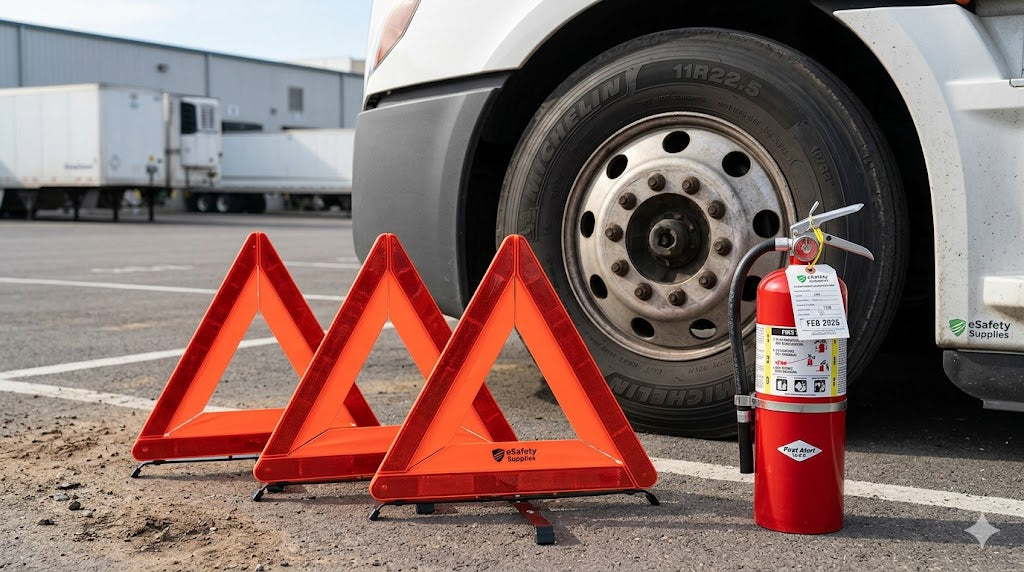
For fleet managers, safety directors, and owner-operators, keeping an interstate commercial motor vehicle (CMV) on the road requires tracking dozens of moving parts. But during a surprise roadside inspection or a sudden breakdown on a busy highway corridor, your most critical asset isn't under the hood—it is your safety compliance kit. Failing to carry a complete, fully operational cab kit is a rapid way to rack up expensive safety violations or find your asset placed out of service (OOS).
The Federal Motor Carrier Safety Administration (FMCSA) does not view safety kits as optional accessories. Under federal mandate FMCSA 49 CFR Section 393.95, specific emergency equipment is strictly required for all commercial buses, trucks, and truck-tractors. A compliance gap here doesn't just result in steep fines; it significantly escalates your company’s Compliance, Safety, Accountability (CSA) risk score.
This comprehensive guide delivers an inspection-ready breakdown of the exact commercial vehicle DOT emergency kit checklist items required by law, detailing material specifications and storage rules to keep your drivers protected and your fleet fully compliant.
What is Required in a DOT Emergency Kit for Commercial Vehicles?
Under federal regulation FMCSA 393.95, a compliant commercial vehicle DOT emergency kit must contain three mandatory safety items: **one fully charged fire extinguisher** with a minimum UL rating of 5-B:C (or 10-B:C for hazardous materials), **three bidirectional emergency reflective triangles** (or approved fusees/liquid-burning flares), and **fuses** consisting of at least one spare fuse for each type and size required to operate all parts of the vehicle's electrical system. These items must be securely mounted, easily accessible, and free of defects to pass roadside DOT safety inspections.
The FMCSA 393.95 Compliance Matrix: Required On-Board Hardware
Federal transportation codes establish precise engineering and performance specifications for each component inside your vehicle's cab. Simply carrying consumer-grade roadside safety items will not satisfy a state trooper or DOT inspector.
| Required Kit Component | FMCSA Minimum Specification | Critical Storage & Inspection Rule |
|---|---|---|
| Fire Extinguisher (Standard) | Minimum 5-B:C rating (or two 4-B:C extinguishers) | Must be securely mounted using a physical bracket; must have a visible, intact locking pin. |
| Fire Extinguisher (Hazmat) | Minimum 10-B:C rating | Mandatory if the vehicle transports hazardous materials requiring placards. Gauge must read in the green zone. |
| Warning Devices | 3 bidirectional reflective triangles (or 6 fuses / 3 liquid flares) | Triangles must feature a heavy, weighted base and pass strict stability tests against high winds. |
| Spare Electrical Fuses | Minimum of 1 spare fuse for every size and type used | Only required if the vehicle’s circuits utilize fuses instead of resettable circuit breakers. |
1. Fire Extinguisher Rules: Mounting and Pressure Mandates
The single most frequent citation issued under FMCSA 393.95 involves the vehicle's fire extinguisher. Drivers often toss their extinguishers loosely into sleeper berths, side toolboxes, or behind the passenger seat. This is an immediate compliance failure.
The law dictates that the fire extinguisher must be securely mounted to the vehicle using a heavy-duty, vibration-resistant mounting bracket. It must be positioned where it is immediately accessible to the driver or emergency personnel without delay. Furthermore, safety managers must audit the pressure gauge monthly to guarantee the needle rests inside the green operational zone, and verify that the visual inspection tag is up to date.
2. Bidirectional Reflective Triangles: Placement Standards
If a commercial motor vehicle breaks down on the shoulder of a highway or divided road, the driver must deploy their emergency warning devices within 10 minutes of stopping. Federal highway rules mandate using three bidirectional reflective triangles arranged to warn oncoming traffic from both directions.
- On a Two-Lane Road: Place one triangle on the traffic side of the vehicle 10 feet away in the direction of oncoming traffic. Place a second triangle 100 feet back in the center of the shoulder or lane, and place the third triangle 100 feet ahead of the vehicle.
- On a Divided Highway / One-Way Road: All three triangles must be placed behind the commercial asset. Position them at intervals of 10 feet, 100 feet, and 200 feet from the rear bumper to give high-speed traffic ample warning.
- Obstructed View (Curves or Hills): If a hill or sharp curve blocks the view of your vehicle, the rear triangle must be moved further back—up to 500 feet—to ensure drivers rounding the bend have clear line-of-sight.
3. Spare Fuses vs. Circuit Breakers
The spare fuse requirement is highly contextual but strictly enforced. If your commercial truck features an older or specialized electrical distribution network that relies on traditional physical fuses, you must carry at least one spare for every single fuse rating present in the panel.
If your modern fleet assets utilize automated, resettable circuit breakers instead of fuses, you are legally exempt from carrying spare fuses. However, drivers must be fully prepared to explain this mechanical configuration to an inspector to prevent an unearned safety citation during a roadside audit.
Frequently Asked Questions About DOT Emergency Kits
1. Is a first aid kit required by the DOT for all commercial vehicles?
Surprisingly, federal FMCSA rules do not universally mandate a first aid kit for standard commercial cargo trucks. However, first aid kits are strictly required under 49 CFR 393.95 for all commercial buses and passenger-carrying vehicles, and OSHA mandates first aid supplies for various specialized industry operations.
2. What happens if a truck’s fire extinguisher is missing its inspection tag?
A missing inspection tag can trigger a DOT write-up. While federal rules focus heavily on the extinguisher being securely mounted, fully charged, and properly rated, state-level commercial vehicle enforcement officers often utilize NFPA standards to penalize units missing annual professional inspection tags.
3. Can I use emergency flares instead of reflective triangles?
Yes, the FMCSA permits the use of 6 red burning fusees (flares) or 3 liquid-burning flares as an alternative to reflective triangles. However, flares are completely prohibited if your commercial vehicle is transporting explosives, flammable liquids, or compressed gases, as they present an immediate ignition hazard.
4. Where should the emergency kit components be stored inside the cab?
There is no single designated compartment required by law, but they must be located where they can be produced immediately upon an inspector's request. Storing warning triangles deep inside a locked, packed exterior trailer nose-box where a driver cannot access them easily during a midnight breakdown is non-compliant.
5. Are light-duty commercial delivery vans subject to these emergency kit rules?
Yes. If a commercial delivery van operates in interstate commerce and possesses a Gross Vehicle Weight Rating (GVWR) or Gross Combination Weight Rating of 10,001 pounds or more, it meets the statutory definition of a commercial motor vehicle and must carry a full complement of compliant safety gear.
Actionable Next Steps: Audit Your Fleet's Safety Armor
Sending a driver out onto public highways without a verified, fully equipped DOT compliance kit is an expensive gamble with your company's regulatory profile and driver safety. Avoid costly out-of-service delays and protect your logistics line by implementing a mandatory pre-trip emergency gear checklist across your entire fleet this week.
Are your fleet trucks completely outfitted to pass a surprise roadside DOT safety inspection? Equip your drivers with heavy-duty safety gear built to protect under pressure.
Procure Compliant Fleet DOT Emergency Equipment Today
Explore eSafety Supplies’ elite fleet management collection to secure commercial-grade, FMCSA-compliant bidirectional reflective triangle kits, heavy-duty vehicle fire extinguishers with premium mounting brackets, and comprehensive vehicle emergency response gear engineered to keep your assets moving safely.
Shop DOT Compliant Fleet Safety Equipment
Managing an enterprise fleet line? Contact our corporate accounts team for bulk volume contract pricing and automated facility fulfillment bundles.
About the Author
Mick Chan is a Senior EHS Compliance Specialist and Safety Content Strategist with over 15 years of boots-on-the-ground experience auditing industrial facilities, logistics hubs, and commercial vehicle fleets across the Western United States. Raised in the San Gabriel Valley, California, Mick holds a Bachelor of Science degree from California State University, Los Angeles (CSULA). He specializes in translating complex federal Department of Transportation (DOT) and FMCSA codes into actionable, high-efficiency fleet compliance programs that shield logistics operations from liability and keep roads safe.