Quick Answer
Choose a Justrite safety can from the liquid and transfer task first. Type I cans use one opening for filling and pouring; Type II cans use separate fill and dispense openings, typically with a hose for more controlled transfer. Before ordering, verify the liquid's safety data sheet, container material compatibility, required capacity, product approvals, and your site's storage and dispensing procedure. A familiar red can is not proof that the container suits every chemical.
Who This Guide Is For
This guide is for workplace buyers selecting portable safety cans for flammable-liquid handling. It is not a hazardous-materials design, fire-code determination, or permission to transfer a substance without a site procedure. OSHA requirements, local fire codes, the liquid's safety data sheet, and the can manufacturer's current instructions all matter.
Separate the Container Job From the Cabinet Job
A safety can is a portable container for handling a liquid. A flammable-liquid cabinet is a storage system. Both may appear on the same purchase list, but they solve different problems. If the task is pouring a small quantity into equipment, start with the transfer process and container. If the concern is how much material may be kept in a room, review storage limits and cabinet requirements separately.
OSHA 29 CFR 1910.106 defines a safety can and sets rules for flammable liquids. Its container provisions vary by liquid category and context. Do not lift a capacity number from a generic chart without checking which operation and liquid it applies to. The safety data sheet's identification and handling sections are the starting documents for the substance at hand.
Type I or Type II?
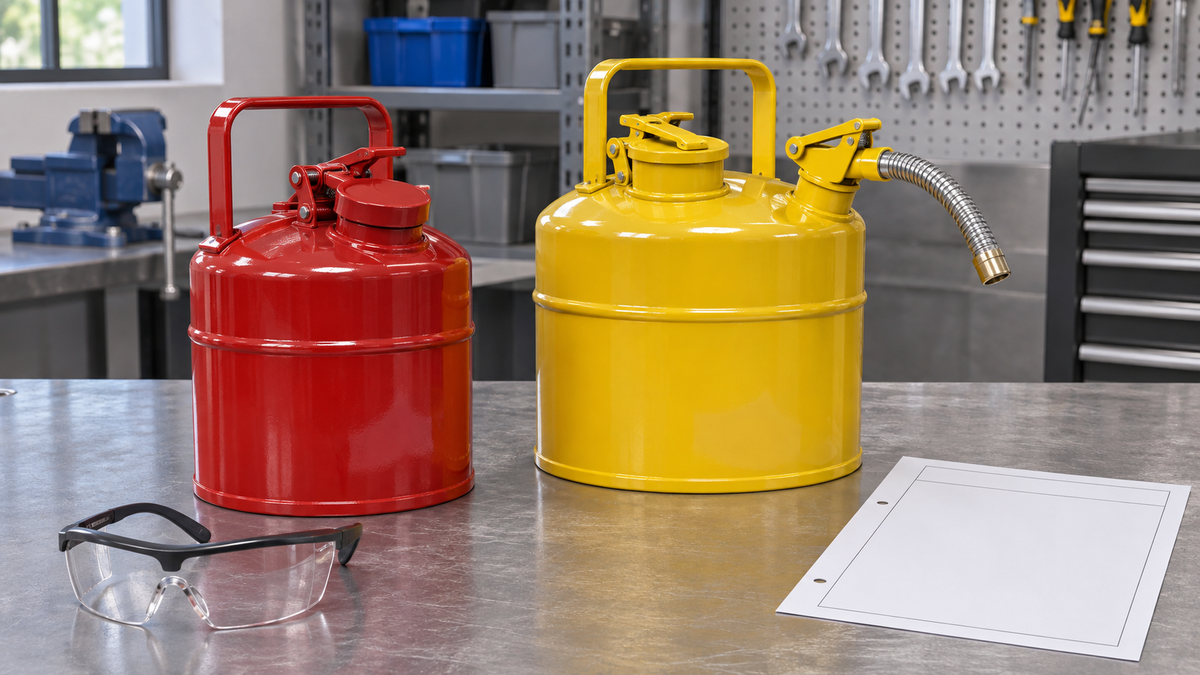
Justrite's own guidance draws a straightforward distinction. A Type I can has one opening used to fill and dispense. It is a practical choice when the destination has a reasonably large opening and the pouring method is controlled. A suitable funnel may help with smaller openings, but it must be compatible with the can and liquid.
A Type II can has a filling opening and a separate dispensing spout. Justrite describes a flexible hose and controlled-pour features on its Type II line. That can make repeated transfer into smaller openings easier to control. It does not remove the need for a safe transfer procedure, compatible grounding or bonding arrangements where applicable, or trained handling.
The useful buying question is: where does the liquid go after it leaves the can? A fuel transfer into a machine, a bench-scale lab pour, and a maintenance refill may need different spout control and capacity. Put that destination on the order specification.
Match the Material to the Liquid
Steel and polyethylene cans are not interchangeable just because both are called safety cans. Check the chemical's compatibility with the body, cap, seals, hardware, and any hose or funnel. Justrite offers polyethylene Type I cans with stainless-steel hardware; ESS lists an active one-gallon oval polyethylene model. The listing illustrates the material choice, not a claim that the can is suitable for an unspecified corrosive or solvent.
Ask the manufacturer for the exact model's approved contents and operating instructions. Do not assume that plastic always resists a chemical or that steel always provides the right answer. A liquid may affect a gasket or fitting even if the main container material appears compatible.
Capacity, Identification, and Location
Choose a capacity workers can safely lift and pour within the site's procedure. A larger can reduces refill frequency but raises the amount handled in one movement. Confirm the permitted capacity for the liquid and operation under applicable rules before ordering cases of a model.
Label the container so the contents and hazards remain identifiable. A color convention can help recognition, but it cannot replace a correct workplace label or override the actual contents. Keep the label legible after use and cleaning. Store the can where the site fire-prevention and flammable-liquid plan permits it, away from incompatible materials and ignition sources.
Inspect the Features That Do the Work
Before use, check the lid's operation, spout or hose, seals, flame arrester where supplied, and body for damage, corrosion, or leaks. Do not tape a lid open or remove a flame arrester to speed up a pour. If a component fails, take the can out of service and follow the manufacturer's maintenance instructions. Also verify whether the model and task require grounding or bonding; a safety can does not make static electricity irrelevant.
A good receiving check compares the delivered product with the approved model number, material, capacity, and accessories. A replacement funnel or hose must be the compatible part for that can. Stocking spare parts is useful only if the site knows which model each part serves.
A Buying Checklist
- Exact liquid name, safety data sheet, hazard category, and transfer task.
- Required container approvals and applicable OSHA or local fire-code provisions.
- Type I or Type II opening based on the receiving container.
- Body, gasket, hardware, hose, and funnel compatibility.
- Capacity, lifting and pouring ergonomics, and quantity to stock.
- Labeling, storage location, inspection owner, and replacement parts.
- Written transfer procedure, including static-control measures where needed.
Questions Buyers Ask
Is Type II always safer than Type I?
Not automatically. Type II offers a separate dispense opening and often more control for small receiving openings. The safer choice depends on the actual liquid, transfer geometry, equipment, and trained procedure.
Can one Justrite can be used for different chemicals?
Only after each liquid's compatibility, labeling, contamination, and cleaning requirements are verified for that exact model. Do not switch contents by assumption or rely on the can's color.
Does buying a safety can solve flammable-liquid storage compliance?
No. Container selection is one piece of a broader storage and handling plan. Check the rules that apply to the quantities and locations at your facility.
Final CTA
Build the order from the liquid and transfer method. Compare the exact ESS Justrite Type I can with Justrite's product documentation, or request a quote that names the liquid, required model, capacity, and quantity.
About Mick Chan: Mick Chan contributes safety supply guidance for eSafetySupplies content, with a focus on practical PPE selection, workplace readiness, and helping teams connect safety requirements to the right supplies. His review perspective is included to keep recommendations grounded in real purchasing and jobsite use.