
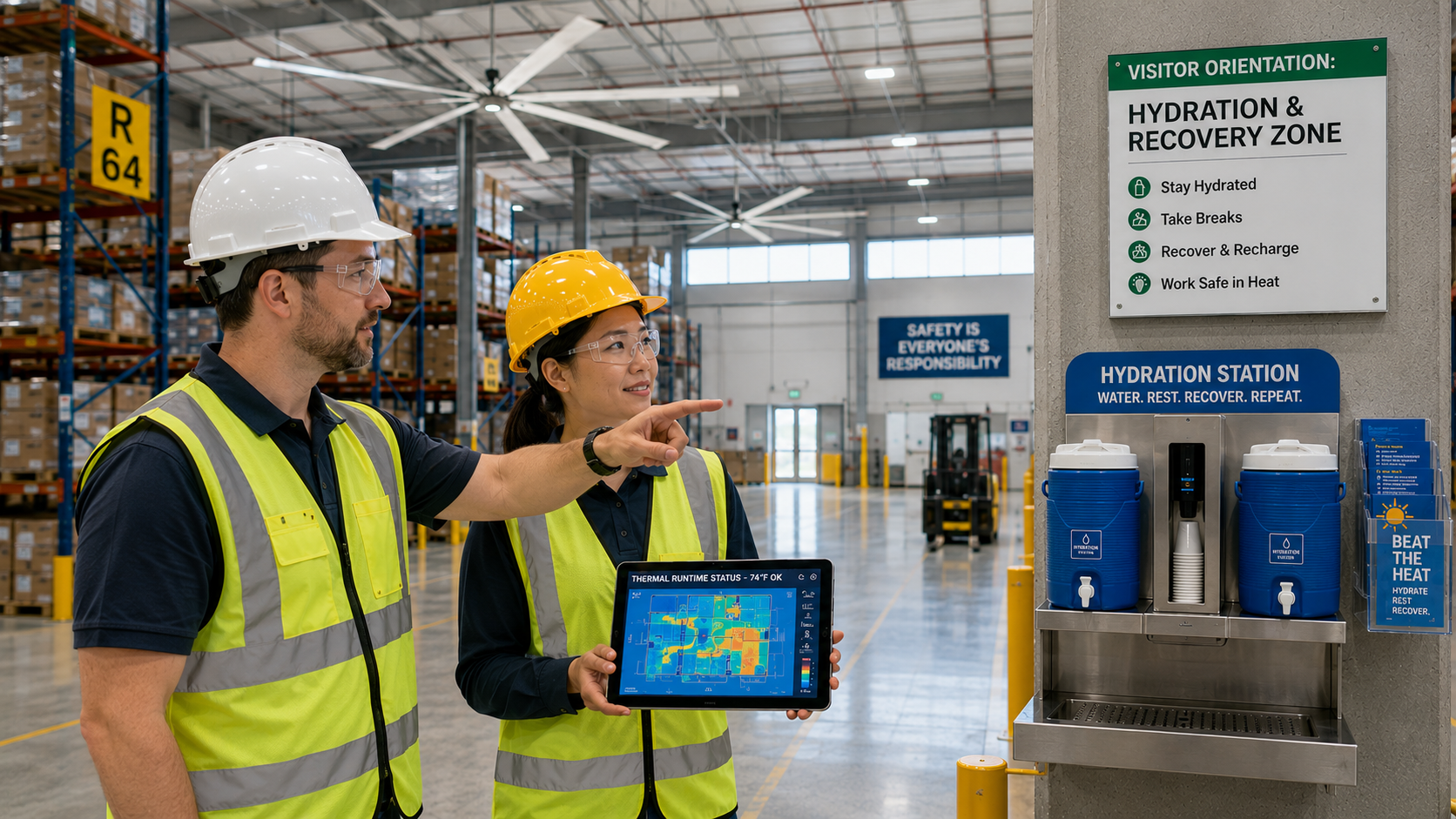
Operating high-throughput, vertical-stack inventory warehouses requires managing massive physical throughput. However, as summer seasonal fulfillment spikes arrive, facilities face a severe environmental challenge: intense indoor heat accumulation. Stagnant air trapped beneath high metal roofs, combined with the heat generated by automated sortation systems and heavy forklift fleets, can rapidly drive indoor temperatures past safe operational limits.
Historically, heat stress programs primarily targeted outdoor industries like construction or agriculture. Today, regulatory bodies like OSHA are aggressively enforcing strict indoor heat stress standards. If your fulfillment center allows indoor heat levels to rise without a formal, monitored mitigation plan, your operation faces immediate stop-work orders, massive financial penalties, and extensive liability exposure. Protecting a multi-employer workforce requires matching engineering controls with real-time digital compliance tracking.
This technical playbook outlines how to structure a code-compliant Indoor Heat Illness Prevention Plan, enforce absolute hydration and rest parameters, and eliminate the digital documentation blocks that regulatory inspectors target during site evaluations.
The Primary Triggers of Indoor Thermal Compliance
To pass modern OSHA inspections and keep indoor logistics corridors safe, operations management must actively track and verify four foundational environmental parameters:
- The 80°F (26.6°C) Action Threshold: Launching mandatory safety interventions the moment the indoor heat index touches or exceeds a continuous $80^\circ\text{F}$.
- Unimpeded Hydration Infrastructure: Providing cool, fresh, potable drinking water positioned within short walking distances of all active picking bays at absolutely no cost to workers.
- Mandatory Preventive Cool-Down Breaks: Structuring mandatory, paid rest periods inside designated cooling sanctuaries to safely drop employee core temperatures.
- Live Link Integrity Verification: Sweeping scannable facility placards regularly to ensure that thermal tracking sheets and heat emergency pathways never lead to a broken 404 screen.
Deep Dive: Balancing Physical Engineering and Real-Time Hazard Data
Achieving absolute compliance in high-heat inventory environments means looking past basic floor fans. True workspace safety relies on combining tough physical cooling hardpoints with accessible cloud documentation so that team members can react instantly.
Step 1: Establishing Compliant Cool-Down Zones
When indoor fulfillment spaces exceed standard environmental thresholds, providing a standard chair in a noisy breakroom is insufficient. Regulatory inspectors expect to see dedicated, clearly identified cooling zones. These areas must be either actively air-conditioned or structurally isolated from radiant machine heat, maintaining an ambient temperature well below the active work floor.
Mark these recovery zones out clearly. Use bold, heavy-duty visual boundaries so that third-party logistics drivers, temporary pickers, and mixed shift crews can instantly spot a safe environment from across the warehouse floor, keeping transit corridors perfectly organized.
Step 2: Aligning Multi-Employer Crews on Thermal Signs
Multi-employer yards and high-volume cross-docks are highly susceptible to heat illness due to a constant influx of outside contractors who may not be acclimated to your specific building dynamics. A transient loading sub-crew or an outside equipment mechanic might push through initial dizziness or muscle cramps simply because they aren't aware of your facility’s dedicated hydration rules.
To eliminate this life-safety risk, arm your shift marshals with standard visual reference materials during pre-shift huddles. Distribute standard Safety Awareness Handbooks to incoming contractor supervisors so that thermal hazard markers and water-break frequencies are fully understood before anyone hits the high-bay aisles.
Step 3: Eradicating 404 Gaps on Hydration and Thermal Placards
Modern compliance frameworks frequently utilize digital tools to audit warehouse conditions. Advanced facilities print QR code placards right onto their main hydration pillars and cooling zone walls so that supervisors, workers, and visiting inspectors can scan them with a mobile device to instantly log real-time wet-bulb globe temperatures (WBGT) or view local emergency response protocols.
If an inspector scans a placard during a mid-day spot audit and hits a broken 404 "Page Not Found" screen because an administrator changed an internal directory path without updating the code, that information block constitutes a critical hazard communication failure. Your compliance team must routinely audit all internal link structures. Keep your electronic asset paths live, clean, and error-free. To verify that all required workplace protective gear, signage layouts, and environmental metrics remain perfectly aligned across your warehouse floors, integrate our structured Warehouse Safety PPE Checklist into your routine facility verification walks.
       +-------------------------------------------------------+
       |             INDOOR HEAT COMPLIANCE MATRIX             |
       +-------------------------------------------------------+
       | Heat Index Threshold -> 80°F Continuous Action Point  |
       | Potable Hydration    -> Free, Cool Water Within Reach |
       | Digital Access Paths -> 100% Active Links (Zero 404s)  |
       +-------------------------------------------------------+
Strategic Action Steps for Warehouse Operations Leaders
Maintaining a completely code-compliant indoor environment requires matching physical signage with a streamlined equipment procurement loop.
Post Clear, High-Contrast Heat Hazard and Hydration Signs
Do not wait for an unexpected heat illness incident to reveal that your workers are unaware of nearest cooling centers. Mount heavy-duty, high-visibility warning signs and path markers at every aisle intersection, loading dock portal, and primary drinking fountain point. Installing durable Industrial Facility Safety Signs & Accessories gives all mixed-shift teams clear visual direction, keeping your vertical spaces organized and safe.
Implement an Automated Daily Heat-Index Logging Routine
Train your yard marshals and floor supervisors to execute an environmental check at the peak hour of every major shift change. Have them record the ambient heat index inside your highest picking tiers and tightest storage aisles. Catching localized hot spots early allows you to redirect airflows or adjust rest cycles seamlessly, ensuring your operation remains prepared for unannounced regulatory spot-checks.
Simplify Safety Sourcing with Enterprise Volume Tools
Sourcing and maintaining uniform cooling signage, specialized hydration hardware, and high-visibility breathable garments across multiple regional fulfillment sites can easily complicate your purchasing workflow. By running your facility orders through a central eSafety Supplies Bulk Procurement Account, your logistics managers can seamlessly coordinate heavy-duty marking assets for all locations while hitting corporate cost-containment goals.
Indoor Heat Stress Compliance Frequently Asked Questions
At what temperature threshold do OSHA indoor heat rules trigger?
Regulatory frameworks, including active state standards and federal enforcement initiatives, establish a critical threshold at 80°F (26.6°C) heat index. When indoor facility work areas meet or exceed this temperature, operations must implement formal heat illness prevention programs.
What are the core employer mandates under active indoor heat regulations?
Employers must provide free access to cool, potable drinking water, establish designated climate-controlled cooling zones, implement structured acclimatization schedules for seasonal crews, and provide clear visual hazard indicators across all processing bays.
How do broken digital portal links impact a heat compliance audit?
If a regulatory inspector or field worker scans a quick-response code on a hydration placard or cooling station and hits a broken 404 error instead of live thermal logs or emergency protocols, the information block is flagged as an actionable hazard communication failure.
About the Author
Mick Chan is a Senior EHS Compliance Specialist and Safety Content Strategist with over 15 years of boots-on-the-ground experience auditing industrial facilities, logistics hubs, and construction zones across the Western United States. Raised in the San Gabriel Valley, California, Mick holds a Bachelor of Science degree from California State University, Los Angeles (CSULA). He specializes in translating complex federal OSHA codes and National Electrical Codes (NEC) into practical, high-efficiency operational safety programs that shield companies from liability and protect industrial workforces.