Quick Answer
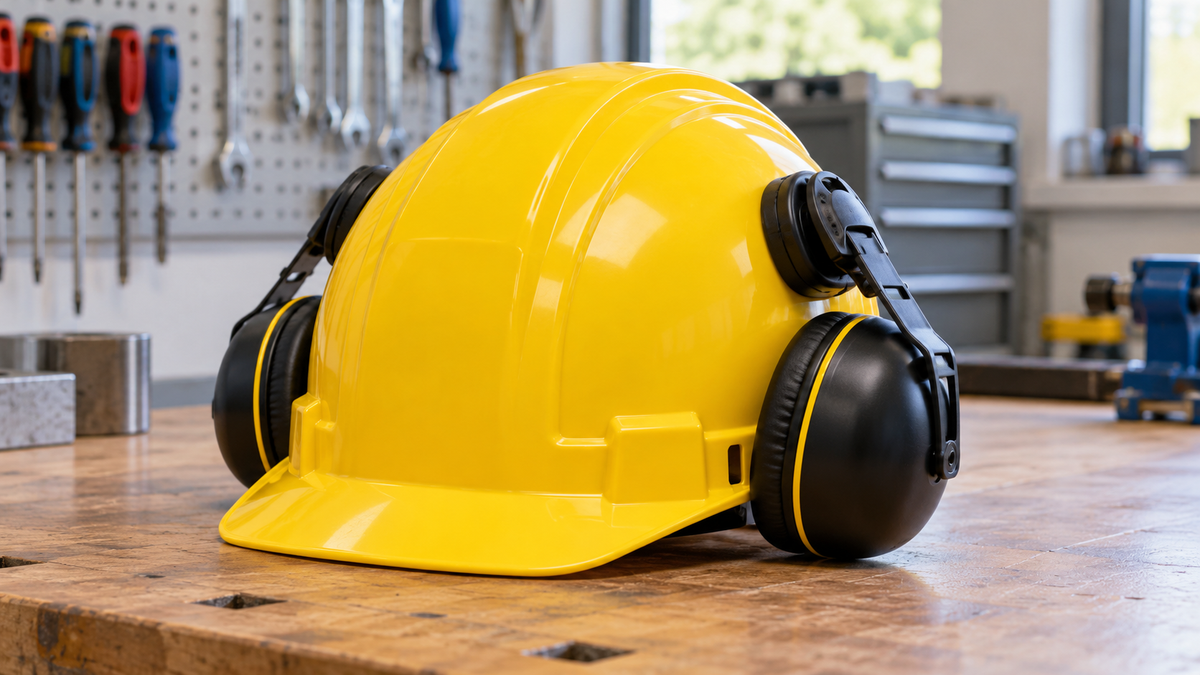
Choose hard-hat-mounted earmuffs only after confirming that the exact mount fits the exact helmet and that the protector provides enough attenuation for the measured noise exposure. Then check the earcup seal while the worker wears their glasses, face shield, respirator, and other required PPE. A high Noise Reduction Rating on the package does not fix a gap under the cushion.
Who This Guide Is For
This guide is for workplaces where head and hearing protection must be worn together. It is educational and does not replace a noise assessment, a hearing conservation program, manufacturer instructions, or a qualified safety professional's selection decision.
Start With the Noise, Not the Attachment
Cap-mounted earmuffs look tidy. The cups stay with the helmet, which can make them convenient for a worker moving between noisy and quieter tasks. Convenience is worth something, but it is not the first specification. The employer needs to know the noise exposure and whether the selected protector attenuates it adequately in that environment.
OSHA's general industry noise rule calls for a hearing conservation program at an eight-hour time-weighted average of 85 dBA and requires employers to evaluate hearing-protector attenuation for the specific noise environment. It also requires proper initial fitting and supervision of correct use. A printed NRR is a laboratory-based rating; the protection a worker gets depends on wear and fit.
If exposure changes, reassess. The same earmuff may be adequate beside one machine and insufficient beside another. Do not treat the highest NRR in a product list as a substitute for exposure data.
Confirm the Helmet and Mount Together
“Fits most hard hats” is not the same as verified compatibility with the helmet issued on your site. Compare the exact hard-hat model, accessory slot, earmuff adapter, and any face-shield or lamp hardware. Follow both manufacturers' instructions. Do not drill, trim, or improvise a mounting point.
Some ESS product descriptions make the intended pairing clearer than others. The 3M PELTOR X4P5E cap-mount protector is described as designed and tested with a 3M H-700 hard hat. The 3M H-700 hard hat listing describes accessory slots for cap-mounted earmuffs. That is a useful starting point, not permission to assume every X4P5E/H-700 variant or additional accessory combination is approved. Verify the current model-specific documents before ordering.
The Seal Test Happens With All PPE On
Put the complete ensemble on the worker. Eyeglass temples, long hair, a respirator strap, or a face shield can lift an ear cushion. OSHA's hearing-protector guidance notes that glasses, facial hair, hair, and facial movement can reduce earmuff protection. NIOSH also warns that earmuffs can interfere with other head-worn PPE.
Check both cups in the working position. The cushion should sit flat around each ear, with no trapped hair or strap. Have the worker turn their head, look up, bend, and perform ordinary task motions. A mount that springs the cup away from the ear when a face shield is lowered is not a satisfactory combination.
Where the program calls for individual verification, hearing-protector fit testing can measure a worker's personal attenuation. OSHA's fit-testing bulletin explains that the resulting personal attenuation rating can be compared with the measured exposure. Do not calculate real-world protection by simply subtracting the box NRR from a sound-level reading.
Buying Checklist
- Record the measured noise exposure and the attenuation the hearing program requires.
- Confirm the earmuff SKU, adapter, helmet model, and accessory-slot compatibility in current manufacturer documents.
- Check whether a face shield, lamp, respirator, eyewear, or winter head covering changes fit.
- Test the seal with the full PPE ensemble and normal head movement.
- Verify that cups can be moved into and out of the use position as intended, without leaving workers exposed during noisy tasks.
- Inspect cushions for compression, cracks, and contamination; plan replacement using the maker's hygiene kit and instructions.
- Provide training on when and how to wear the protector, not just how to attach it.
The hard-hat face-shield guide covers another common accessory pairing. Add one item at a time during the fit check; a compatible pair of accessories may still interfere when both are mounted.
Frequently Asked Questions
Can I put any cap-mount earmuff on any slotted hard hat?
No. Slot shape, adapter, helmet model, and other accessories matter. Confirm the pairing in current manufacturer guidance for the exact items.
Is a higher NRR always better?
Not as a standalone buying rule. The employer must evaluate attenuation for the noise exposure, and the wearer needs a reliable seal. Very high attenuation may also affect communication or warning-signal awareness in some jobs; the hearing program should assess that tradeoff.
Do safety glasses affect earmuff protection?
They can. Temples may break the earcup seal. Test the complete combination on the worker and follow the hearing program's fit procedures.
Final CTA
Compare ESS ear protection and hard hats using the exact models on your PPE issue list. Before a site-wide purchase, have workers try the full head-and-hearing setup during the tasks they actually perform.
About Mick Chan: Mick Chan contributes safety supply guidance for eSafetySupplies content, with a focus on practical PPE selection, workplace readiness, and helping teams connect safety requirements to the right supplies. His review perspective is included to keep recommendations grounded in real purchasing and jobsite use.