
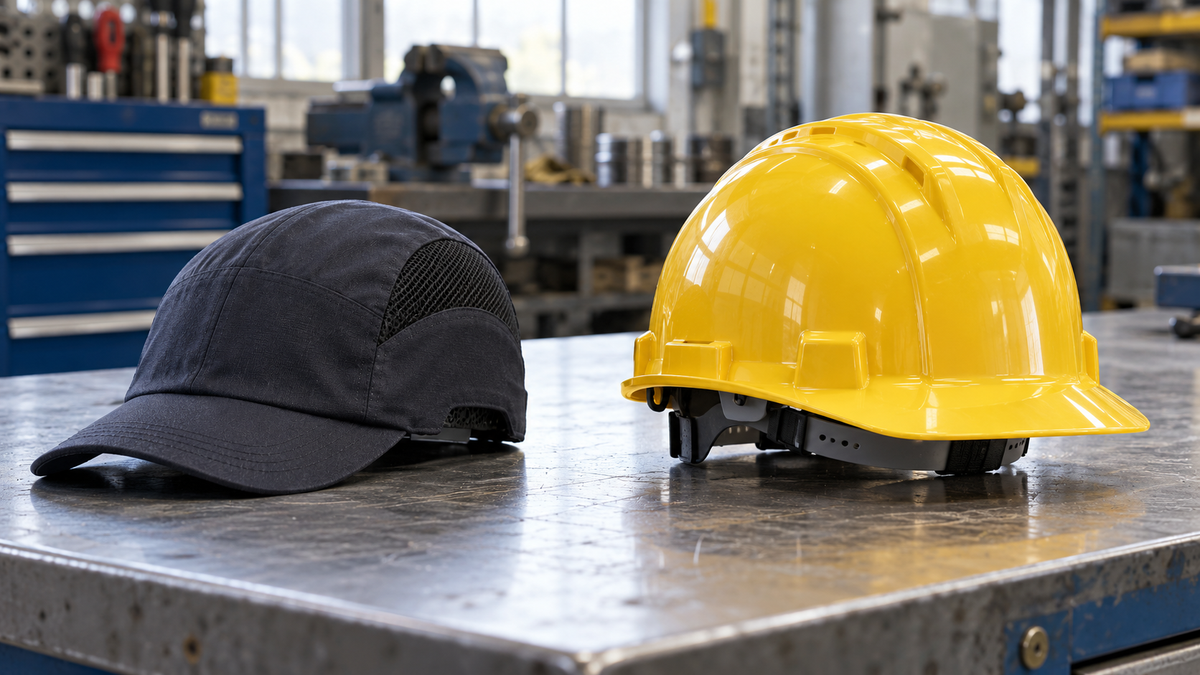
Quick Answer
A bump cap is for limited contact with stationary objects where a hazard assessment does not call for a protective helmet. It is not a substitute for a hard hat where falling objects, electrical contact, or other helmet-level hazards are present. Decide from the work area and the task, then verify the exact product's markings and manufacturer instructions.
Who This Guide Is For
This is for teams deciding whether a low-profile cap belongs in tight workspaces such as some assembly or maintenance areas. It is educational, not an OSHA determination for your site. The employer's hazard assessment, applicable rules, and the product's tested performance control the decision.
A Low Ceiling Is Not the Whole Assessment
The familiar bump-cap scenario is a worker standing up beneath a fixed beam or leaning into a machine housing. A lightweight cap may reduce minor knocks in a place with no falling-object or electrical exposure. But the same aisle may be crossed by overhead work, a raised load, or a maintenance task that changes the hazard for the afternoon. The cap does not become a hard hat because the space is cramped.
OSHA's general industry head-protection rule requires protective helmets where falling objects may injure the head, and head protection designed to reduce electrical shock when workers are near exposed conductors that could contact the head. Its nonmandatory selection guidance also states that helmets must be worn where falling-object hazards are present. A bump cap should not be represented as meeting those requirements unless the employer can establish the required protective performance for the exact device.
Compare the Job, Not the Silhouette
| Question | Bump cap may fit | Protective helmet is needed |
|---|---|---|
| Likely contact | Minor bump against a fixed object | Falling objects or other assessed helmet-level impact hazard |
| Electrical exposure | No relevant exposure | Exposed conductors that could contact the head require suitable electrical head protection |
| Product documentation | Maker's stated limited-use instructions | Required head-protection standard or employer-demonstrated equivalent performance |
The table is a screening aid, not a permission slip. If the work changes, reassess. Construction and other specific workplaces may have additional requirements.
The Label Trap
Catalog names are inconsistent. A store category may contain a product called a “hard hat bump cap,” a cap-style helmet, and a simple bump cap. Do not infer certification from the title or shape. Read the exact SKU's labeling and technical sheet for the applicable ANSI Z89.1 type, electrical class, and limitations when helmet-level protection is required.
Also resist the opposite shortcut: a hard hat is not automatically right for every head hazard or work arrangement. Top-impact and side-impact performance differ, and fit and retention matter. OSHA's 2026 interpretation says the general industry rule does not mandate one particular ANSI helmet type in all cases; the hazard assessment still has to identify adequate protection. Use the hard-hat types and classes guide to frame that separate decision.
Before You Issue a Bump Cap
- Walk the area and document where heads may contact fixed objects.
- Check for overhead storage, lifting, work above, falling tools, and electrical exposure during every relevant shift and task.
- Confirm no applicable rule or site requirement calls for a protective helmet in that area.
- Read the exact cap's manufacturer instructions, size range, and replacement guidance.
- Test fit while workers move through the real task. A cap that slips off or blocks sightlines is not a useful choice.
- Mark where a cap is permitted and where a helmet is required; revisit the decision after layout or task changes.
If workers move between zones, make the transition easy to understand. A cap left on out of habit can be the wrong head protection the moment the worker enters a loading or construction area.
Frequently Asked Questions
Is a bump cap OSHA approved?
“OSHA approved” is not a useful product claim here. OSHA sets employer duties and criteria for required head protection; it does not approve an individual bump cap for every workplace. Evaluate the hazard and the device's documented protection.
Can a bump cap replace a hard hat on a construction site?
Do not assume it can. Construction head-protection rules and the site's falling-object, flying-object, and electrical hazards must be assessed. A cap intended only for minor fixed-object contact is not a substitute for required helmet protection.
What if a product title says both “hard hat” and “bump cap”?
Ask for the exact model's markings and technical sheet. A marketing title does not establish ANSI Z89.1 performance or electrical class.
Final CTA
Browse ESS bump caps and hard hats only after the hazard assessment is clear. For any area requiring a protective helmet, choose from documented helmet models rather than relying on a low-profile cap's name or appearance.
About Mick Chan: Mick Chan contributes safety supply guidance for eSafetySupplies content, with a focus on practical PPE selection, workplace readiness, and helping teams connect safety requirements to the right supplies. His review perspective is included to keep recommendations grounded in real purchasing and jobsite use.