
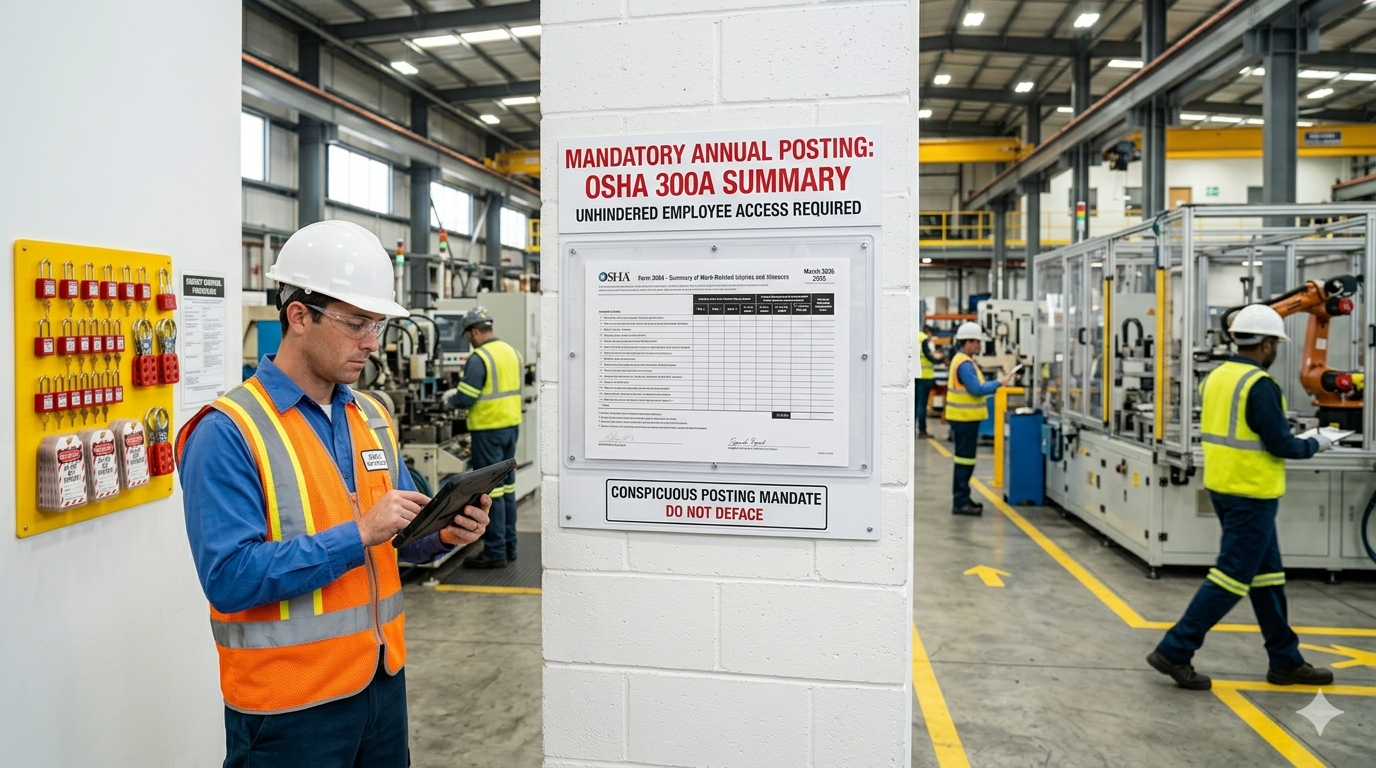
Completing your digital submission to the federal injury database is only half the battle during the heavy Q1 compliance season. While safety managers frequently focus on digital transmission deadlines, a separate, equally critical mandate governs physical recordkeeping visibility right on your facility floor.
Failing to preserve the physical visibility of your regulatory logs is a common and costly oversight during unannounced field audits. Under OSHA Standard 29 CFR 1904.32, employers must maintain a physical, certified summary of the previous year's injuries in an unhindered location for a dedicated three-month window every year.
This structural guide outlines the exact placement rules for your mandatory annual OSHA Form 300A summary, details the accessibility parameters required for dynamic workforces, and shares the field-tested maintenance practices needed to bulletproof your facility against structural recordkeeping citations.
What Are the Spatial and Time Mandates for Physical OSHA 300A Postings?
According to the strict compliance parameters established by federal inspectors, displaying your annual injury summary requires adherence to clear calendar dates and structural staging rules:
- The Fixed Calendar Window: The certified OSHA Form 300A must be physically posted on **February 1** and remain fully visible until **April 30** of each calendar year without exception.
- Conspicuous Placement Controls: Forms must be pinned or secured in prominent spaces where official company notices and labor law employee layouts are customarily arranged.
- Unhindered Employee Access: Frontline personnel must be able to view and read the data completely without asking a manager, entering locked administrative offices, or accessing a terminal.
- Multi-Establishment Separation: If your corporate footprint utilizes distinct physical buildings or remote warehouse yards, each separate location must post its own unique, localized data summary.
- Total Dynamic Continuity: If a posted summary is defaced, torn down by material traffic, or soiled by industrial grease, it must be instantly reprinted, signed, and replaced.
Deep Dive: Breaking Down the Physical Compliance Workflow
To avoid a surprise recordkeeping fine during a routine factory floor inspection, safety coordinators must master the granular logistics of physical document staging and executive authorization.
Step 1: Auditing Your Customary Notice Centers
Determining where to hang the form requires analyzing the daily movement patterns of your facility crew. The summary cannot be tucked away in a supervisor's office or hidden behind a breakroom door that remains propped open.
Ideal, compliant locations include:
- Main corridor bulletin boards right next to federally mandated labor law graphics.
- Central break room entries or localized shift gathering stations.
- Dedicated safety hubs adjacent to centralized punch clocks or tool cribs.
To verify that your physical compliance zones remain neatly mapped and clearly marked, plant managers often reference a comprehensive Warehouse Safety PPE Checklist to unify physical floor inspections with mandatory tracking locations.
Step 2: Securing the Mandatory Executive Signature
An unsigned Form 300A hanging on a wall is a critical compliance failure. OSHA mandates that a corporate executive must certify that they have examined the underlying logs and believe the summary is true, accurate, and complete.
The standard strictly limits who qualifies to sign this line: * A direct owner of the company or an established corporate officer. * The highest-ranking management official currently stationed at that specific establishment. * The immediate organizational supervisor of that local manager.
Step 3: Managing the "Zero-Injury" Dilemma
A common trap for facility managers running clean operations is assuming that if there were zero recordable injuries during the previous calendar year, no physical posting is required. This is an automatic citation trigger.
Even if your facility completed a flawless year with zero workplace incidents, you must still print out the Form 300A, enter zeroes across all tracking categories, obtain an executive signature, and post it visibly for the entire February 1 to April 30 window.
       +-------------------------------------------------------+
       |             OSHA FORM 300A POSTING RULES              |
       +-------------------------------------------------------+
       | Post Date: Feb 1  | Take-Down Date: April 30          |
       | Executive Signature Required (Even with 0 Injuries)   |
       | Location: Conspicuous (Must Be Visible to All Shifts) |
       +-------------------------------------------------------+
Step 4: Addressing the Mobile and Remote Workforce Barrier
With the rise of decentralized field teams, service technicians, and logistics drivers who rarely report to a central warehouse, compliance managers must adjust their visibility systems.
If your employees do not travel to a physical office regularly but report to a specific hub to start their route, the form must live at that central dispatch point. For purely mobile personnel, you must ensure they receive a digital or physical copy of the summary individually during the posting window.
Proactive Field Practices for Form Maintenance
Industrial processing zones, high-volume order lines, and dusty environments are tough on paper documents. Use these practical steps to safeguard your records.
Utilize Heavy-Duty Visual Protectors
Do not simply thumb-tack a piece of copy paper to an open corkboard where it can easily tear or blow away. Protect your mandatory forms by securing them inside clear, heavy-duty acrylic frames or high-visibility industrial sign holders. This step keeps the document perfectly legible and signals to field crews and visiting regulators that your operation treats safety tracking with extreme professionalism.
Integrate the Form Into Your Staging Signage Network
Treat your compliance corner as a vital piece of company communication infrastructure. If you need to upgrade or refresh weathered warning visuals, notice boards, or display frames around your staging areas, you can source code-compliant Industrial Facility Safety Signs & Accessories to guarantee your vital data stands out cleanly against intense industrial backdrops.
Establish a Multi-Shift Verification Routine
Assign your safety committee members or shift foremen to physically check the posting location at the start of each rotation. In busy environments, moving equipment, forklift masts, or simple human error can accidentally block or tear down wall displays. Documenting these quick checks in localized Safety Awareness Handbooks provides clear proof that management maintained consistent, active oversight of employee access rights throughout the entire legally mandated window.
OSHA Form 300A Posting Frequently Asked Questions
What are the exact dates OSHA Form 300A must be physically posted?
According to OSHA regulations, the physical Form 300A Summary must be prominently posted in the workplace from February 1 through April 30 of each calendar year.
Where exactly should the physical OSHA 300A form be posted?
The form must be displayed in a conspicuous place or places where notices to employees are customarily posted. Common areas include break rooms, main bulletin boards, safety staging areas, or near time clocks where personnel naturally gather.
Can an electronic posting replace the physical OSHA 300A posting requirement?
No. Posting the form on a company intranet, sending it via email, or submitting it digitally through the Injury Tracking Application (ITA) does not satisfy the physical posting mandate. A physical copy must be displayed on-site for employees who do not have regular computer access.
Who is legally authorized to sign the OSHA Form 300A?
The form must be certified and signed by a company executive. OSHA defines an executive as an owner of the company, an officer of the corporation, the highest-ranking management official at the establishment, or the immediate supervisor of that official.
What should I do if my physical OSHA 300A form is defaced or torn down?
If a posted summary is damaged, torn, or defaced, it must be replaced immediately. Failure to keep the form visibly posted throughout the entire February 1 to April 30 window can result in other-than-serious citations during an unannounced inspection.
About the Author
Mick Chan is a Senior EHS Compliance Specialist and Safety Content Strategist with over 15 years of boots-on-the-ground experience auditing industrial facilities, logistics hubs, and construction zones across the Western United States. Raised in the San Gabriel Valley, California, Mick holds a Bachelor of Science degree from California State University, Los Angeles (CSULA). He specializes in translating complex federal OSHA codes and National Electrical Codes (NEC) into practical, high-efficiency operational safety programs that shield companies from liability and protect industrial workforces.