
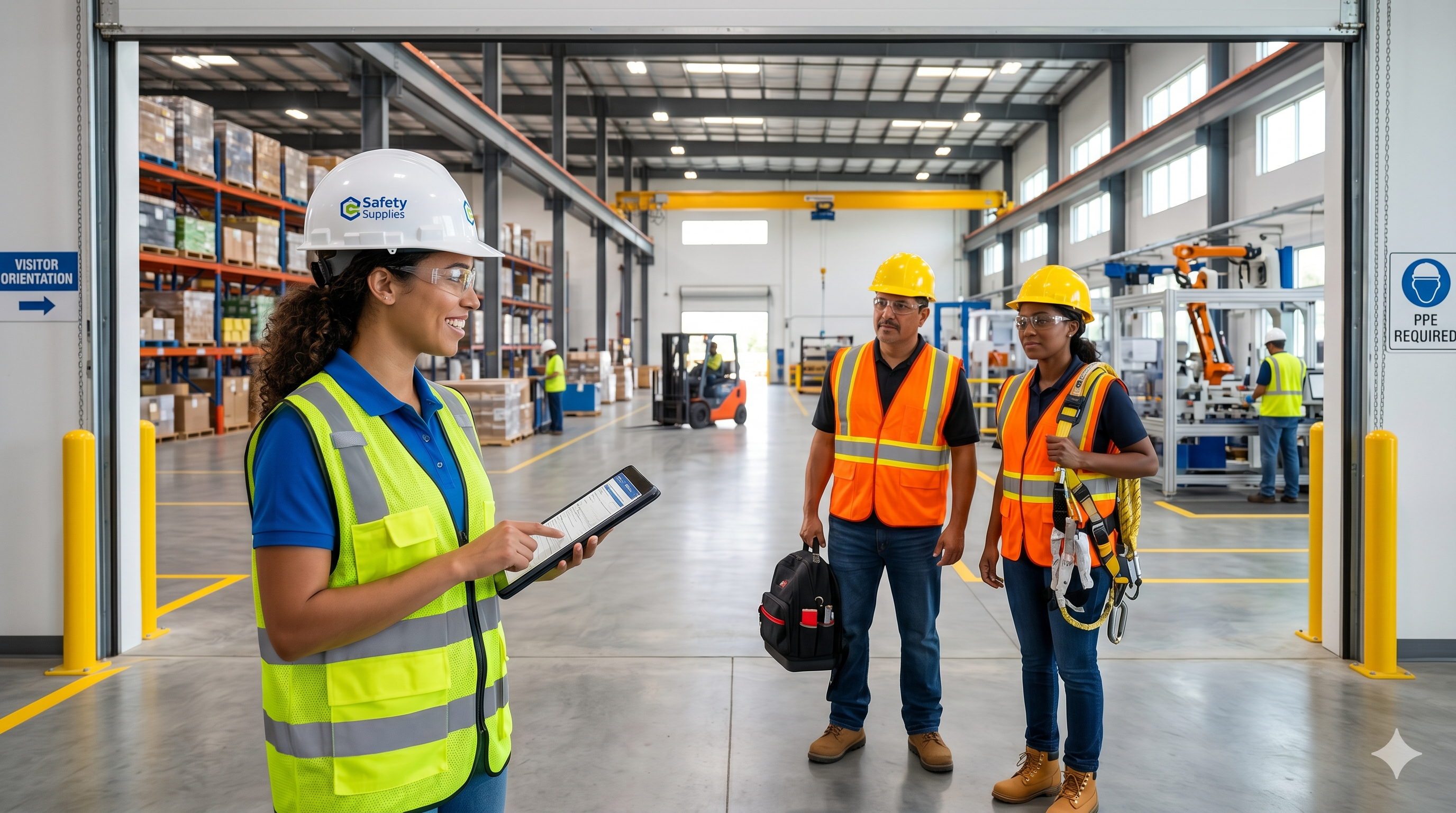
Managing an industrial facility or heavy job site becomes significantly more complex when third-party contractors, mechanical installers, and temporary warehouse workers join your daily operations. Bringing non-employee personnel into a high-velocity environment introduces immediate alignment challenges for your safety program.
Allowing gaps in equipment compliance across different teams is a primary driver of site liability and sudden enforcement actions. Under federal guidelines, including OSHA's Multi-Employer Citation Policy, host companies can be held directly accountable alongside sub-contractors if safety baselines are not strictly enforced across the shared workplace footprint.
This operational framework details the precise steps required to align personal protective equipment (PPE) mandates for temporary field forces, streamline your orientation processes, and build a unified shield of site compliance.
What Are the Core Requirements for Contractor PPE Standardization?
Establishing an airtight protective policy across diverse, multi-employer labor forces requires strict implementation of five core screening protocols during site entry:
- Unified High-Visibility Rules: Eliminating confusion by mandating specific performance garment tiers (such as ANSI Class 2 or Class 3) for all external personnel navigating operational corridors.
- Instant Color-Coded Zoning: Implementing unique vest colors or high-contrast hard hat marking schemes to clearly differentiate temporary staff from internal technical personnel at a glance.
- Footwear Standard Verification: Enforcing strict impact and compression guidelines (ASTM F2413-18) for all temporary material handling crews entering heavy staging lanes.
- Mandatory Pre-Entry Inspection Loops: Forcing an immediate inspection of all contractor-provided fall protection setups, electrical protective tools, and specialized face masks before workspace clearance is granted.
- Documented Legal Acknowledgments: Securing signed compliance waivers proving external vendor leadership groups received, reviewed, and agreed to match your facility's safety expectations.
Deep Dive: Structuring the Multi-Employer Orientation Workflow
To ensure your corporate safety parameters are completely understood by temporary logistics teams and field builders, compliance managers must integrate clear protective checkpoints directly into the vendor onboarding pipeline.
Step 1: Establishing the Baseline Apparel Standard
A major exposure point on shared industrial floors is the wide variation in safety gear provided by outside contractors. One visiting service vendor might equip their staff with premium reflective items, while another sends technicians in faded, non-compliant shirts.
To eliminate this variable, your orientation policy must clearly define the acceptable equipment baseline. If your internal teams rely on the rigorous metrics highlighted in our ANSI/ISEA 107-2020 High-Visibility Compliance Guide, visiting personnel must meet or exceed those exact same material rules before crossing the loading dock threshold.
Step 2: Leveraging Visual Color Coding for Faster Oversight
When dozens of external laborers are active on a crowded manufacturing floor, supervisors cannot halt operations to verify the credentials of every worker they encounter. Implementing an immediate visual zoning program solves this tracking bottleneck.
Many plants require internal team members to wear high-visibility lime-green vests, while all sub-contracted crews are assigned high-visibility fluorescent orange apparel. This basic color contrast allows safety marshals to spot unauthorized individuals in specialized technical spaces instantly from across the facility floor. To keep floor managers aligned on tracking color assignments during busy shifts, teams can distribute clear reference instructions found in standardized Safety Awareness Handbooks.
Step 3: Enforcing Footwear and Structural Guard Rules
Foot hazards are persistent in staging environments where heavy forklifts, automated pallet jacks, and raw structural materials are continuously shifted. Your onboarding checklist must explicitly require steel or composite protective footwear for all temporary material handlers.
Do not allow contractors to navigate active workspaces in standard athletic or thin leather shoes. If temporary support teams lack appropriate gear, providing accessible access to robust on-site safety resources protects them from injury while safeguarding your business from severe multi-employer regulatory penalties.
       +-------------------------------------------------------+
       |             CONTRACTOR ENTRY PPE CHECKLIST            |
       +-------------------------------------------------------+
       | Apparel    -> Meets Class 2/3 Biomotion Parameters    |
       | Headwear   -> ANSI Type I Hard Hat (Assigned Color)   |
       | Footwear   -> ASTM Rated Safety Shoes (Steel/Composite)|
       +-------------------------------------------------------+
Step 4: Integrating Daily Field Verification Routines
An effective safety onboarding process must extend past the initial orientation briefing. High-volume sorting yards and mechanical assembly bays undergo rapid changes during a typical production cycle.
Train your shift leaders to run quick equipment checks during morning tool-box talks. If an outside contractor's gear appears severely stained with grease, torn from heavy tool contact, or lacks proper reflective tape arrays, that worker must be paused until compliant replacement items are sourced from your staging inventory.
Strategic Actions for Operations and Procurement Leaders
Standardizing protection requirements across an active corporate footprint requires deploying reliable physical resources at every entry portal.
Establish Entry Guard Inventory Stations
Do not let your operations stall because a specialized contract technician arrived on-site missing a simple pair of approved safety glasses or a high-visibility vest. Establish fully stocked compliance lockers right at your visitor check-in windows. Maintaining a backup inventory of essential safety items ensures you can quickly outfit temporary specialists, keeping critical production timelines on track without opening your business up to site safety liabilities.
Deploy Clear On-Site Signage Directives
Ensure that your safety expectations are impossible to mistake by using strong, clear signage at every entrance, delivery door, and loading dock. If your yard requires specific hard hat or visibility ratings, state it clearly before visitors ever reach the plant floor. Utilizing heavy-duty, high-visibility Industrial Facility Safety Signs & Accessories gives incoming teams clear visual direction, keeping your facility organized and compliant under all operational conditions.
Consolidate Supply Chains with Enterprise Volume Accounts
When managing safety equipment requirements across a large network of local and temporary labor providers, processing separate, ad-hoc equipment orders degrades your margin control. By utilizing an enterprise-tier eSafety Supplies Bulk Procurement Account, safety directors can easily maintain a uniform pool of compliant gear for internal teams and contingent crews alike, all while hitting corporate cost-containment benchmarks.
Contractor Safety Orientation Frequently Asked Questions
Who is legally responsible for providing PPE to sub-contractors on a shared site?
Under OSHA's Multi-Employer Citation Policy, the secondary employer (sub-contractor) is primarily responsible for outfitting their team. However, the host or controlling employer can be cited if they fail to enforce mandatory site safety parameters across the collective footprint.
Can a host employer enforce stricter PPE rules than standard OSHA mandates?
Yes. Host employers possess full operational authority to institute site-specific policies that exceed federal baselines, such as requiring high-visibility Class 3 apparel or protective footwear in regions where OSHA only dictates basic coverages.
How should seasonal or contingent personnel verify equipment service integrity?
All temporary personnel must undergo an orientation check to verify their equipment is free from structural defects, severe staining, or faded reflective elements before being cleared to enter active production areas.
Why do industrial sites utilize contrasting safety vest colors for contractors?
Color-coding vests (such as orange for contractors and green for staff) creates instant visual zoning. This system allows supervisors to track personnel placement, recognize non-authorized staff in specialized areas, and streamline field oversight.
What document provides the best reference framework for temporary worker onboarding?
A formal Multi-Employer Safety Orientation Program manual or a dedicated company PPE alignment checklist provides the necessary legal baseline to standardize contractor safety expectations prior to field deployment.
About the Author
Mick Chan is a Senior EHS Compliance Specialist and Safety Content Strategist with over 15 years of boots-on-the-ground experience auditing industrial facilities, logistics hubs, and construction zones across the Western United States. Raised in the San Gabriel Valley, California, Mick holds a Bachelor of Science degree from California State University, Los Angeles (CSULA). He specializes in translating complex federal OSHA codes and National Electrical Codes (NEC) into practical, high-efficiency operational safety programs that shield companies from liability and protect industrial workforces.