
Quick Answer
A permit-required confined space entry checklist should confirm that the space is classified correctly, entry hazards are identified, atmospheric testing is completed before and during entry, ventilation is working, an attendant is assigned, communication is reliable, rescue is planned, and the right PPE and entry equipment are ready before anyone enters.
Who This Guide Is For
This guide is for safety managers, maintenance teams, facility managers, utilities, manufacturers, and contractors who need a practical pre-entry supply and readiness checklist. It is educational and does not replace OSHA requirements, state-plan rules, competent safety advice, site procedures, equipment instructions, or rescue-service evaluation.
Why Confined Space Entry Planning Matters
Confined spaces can expose workers to oxygen deficiency, flammable gases, toxic atmospheres, engulfment, mechanical hazards, heat, poor visibility, and limited rescue access. OSHA's permit-required confined space standard focuses on identifying those hazards before entry, controlling them during work, and making sure entrants, attendants, supervisors, and rescue services know their roles.
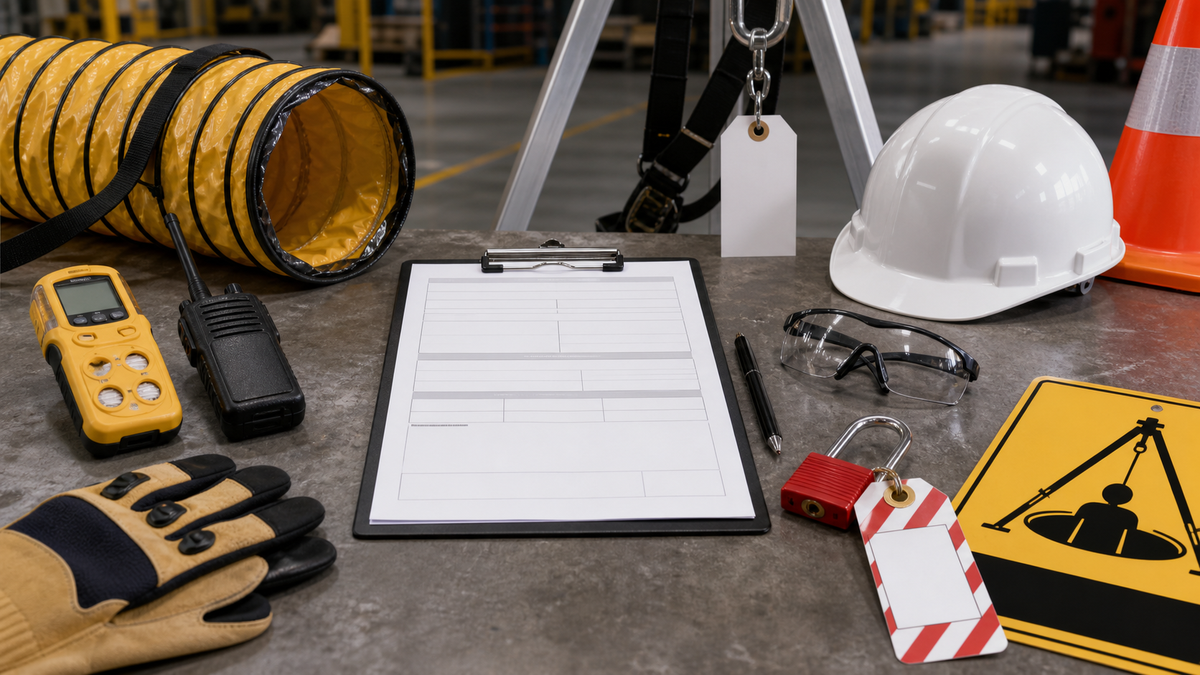
For purchasing, the key lesson is simple: do not buy only the visible PPE. A complete entry setup may also require gas detection, ventilation, communication, lockout/tagout, barricades, signs, lighting, retrieval equipment, and written permits.
Confined Space Entry Checklist
- Classify the space and decide whether it is permit-required before entry.
- Identify atmospheric, engulfment, mechanical, electrical, chemical, heat, and access hazards.
- Isolate hazardous energy and moving equipment before work begins.
- Test the atmosphere before entry for oxygen, flammable gases and vapors, then toxic gases and vapors.
- Continue monitoring as needed while workers are inside the space.
- Ventilate from a clean air source and keep ventilation running until entry is complete when required by the entry plan.
- Assign an attendant outside the space with no conflicting duties.
- Confirm two-way communication between entrants and the attendant.
- Post signs or barricades to keep unauthorized workers away.
- Confirm rescue and emergency services are evaluated, available, and reachable.
- Use retrieval systems when appropriate and when they do not increase entry risk.
- Keep the entry permit, test results, emergency contacts, and equipment list available at the job location.
Product Category Match Table
| Entry Need | ESS Category | What To Verify |
|---|---|---|
| Atmospheric testing | Gas monitors | Sensors match the expected hazard, the monitor is calibrated or bump-tested per instructions, and workers know alarm actions. |
| Respiratory exposure | Respiratory protection | Respirators match the exposure and are used only within a compliant respiratory protection program. |
| Head, eye, and hand hazards | Hard hats, safety glasses, and work gloves | PPE is compatible with the space, task, visibility, heat, and rescue plan. |
| Unauthorized access | Safety signs and cones | Signs and barricades are visible before workers approach the opening. |
| Hazardous energy | Accident prevention tags | Tags support the written isolation procedure and do not replace lockout/tagout controls. |
Common Mistakes
- Treating a space as safe because it was safe last time.
- Testing the atmosphere once and skipping monitoring during the job.
- Ventilating without confirming the air source is clean.
- Assigning an attendant who also has other work duties.
- Assuming a rescue plan exists because local emergency services can be called.
- Buying a gas monitor without matching sensors to the actual hazard profile.
- Entering before the permit, communication plan, and emergency contacts are complete.
FAQ
What should be checked before confined space entry?
Check the space classification, entry permit, hazard isolation, atmospheric test results, ventilation, communication, attendant assignment, rescue plan, PPE, lighting, access control, and emergency contacts before entry begins.
What gases should be tested first in a confined space?
OSHA's permit-required confined space standard says atmospheric testing for hazards should be performed in this order: oxygen first, then combustible gases and vapors, then toxic gases and vapors.
Does a gas monitor make a confined space safe?
No. A gas monitor helps detect atmospheric hazards, but it does not eliminate them. Entry still depends on hazard control, ventilation, communication, permits, attendants, rescue planning, and training.
Do confined space entries need rescue equipment?
Permit-required confined space planning must address rescue and emergency services. Non-entry retrieval systems are commonly part of the plan when they can be used without increasing overall risk.
Mick Chan Bio
Mick Chan is an eSafetySupplies safety content contributor focused on practical workplace safety supply planning, PPE selection, and compliance-oriented checklists for facility, warehouse, construction, and maintenance teams.
Final CTA
Use this checklist to build a confined space entry supply list by location and hazard type. Compare ESS gas monitors, respiratory protection, PPE, signs, cones, and tags, then review the final entry procedure with your site safety lead before work begins.