
Quick Answer
A combustible dust housekeeping checklist should identify where dust can accumulate, how often areas are inspected and cleaned, which equipment is safe for the dust and location, how ignition sources are controlled, and what PPE workers need for cleanup. Do not treat ordinary sweeping or compressed air as a default solution; verify hazards against OSHA guidance, safety data sheets, equipment instructions, and a qualified site assessment.
Who This Guide Is For
This guide is for EHS managers, facility managers, maintenance teams, production supervisors, warehouse leaders, and safety buyers at facilities that handle powders, wood dust, metal dust, food ingredients, plastics, paper dust, chemicals, or other combustible particulate solids. It is educational and does not replace OSHA requirements, NFPA standards, state-plan rules, manufacturer instructions, industrial hygiene review, or site-specific combustible dust analysis.
Why Combustible Dust Housekeeping Matters
Combustible dust can collect on floors, beams, shelves, equipment tops, ductwork, motors, lights, and hidden surfaces. If enough dust is dispersed into the air and an ignition source is present, a flash fire or explosion may occur. Housekeeping is one of the most visible controls, but it only works when the facility knows which dusts are present, where they collect, and how they must be cleaned.
OSHA identifies combustible dust as a serious hazard across many industries. A useful checklist should connect dust control, housekeeping frequency, ignition control, PPE, labeling, and training into one repeatable process.
Combustible Dust Housekeeping Checklist
- Identify dust-generating materials and review safety data sheets for combustible dust warnings.
- Map collection points, including elevated surfaces, rafters, ductwork, motors, lights, equipment tops, and concealed ledges.
- Set inspection frequency by process, dust volume, shift schedule, and past accumulation.
- Use cleaning equipment appropriate for the dust and classified location, as determined by qualified personnel.
- Avoid cleanup methods that disperse dust unless your site procedure specifically allows them.
- Control ignition sources before cleaning, including hot work, static, electrical equipment, open flames, and smoking.
- Keep dust containers closed, labeled, compatible with the material, and emptied on a defined schedule.
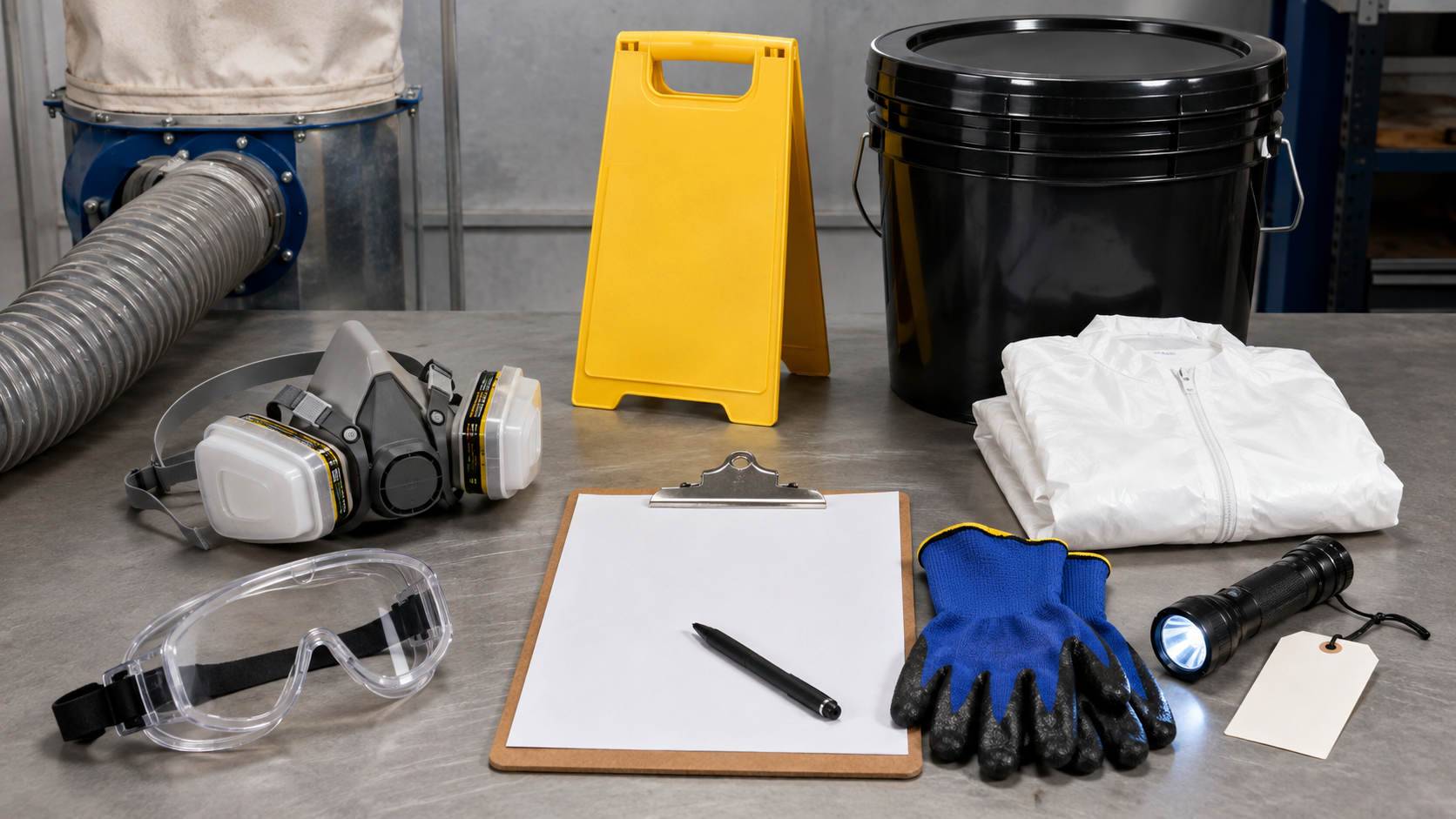
- Match PPE to the dust and cleanup method: eye protection, gloves, respiratory protection, and disposable apparel may be needed.
- Tag damaged vacuums, collection hoses, electrical cords, signs, or PPE storage stations out of service.
- Document inspections, cleanup actions, recurring buildup, and corrective actions.
Product Category Match Table
| Combustible Dust Need | ESS Category | What To Verify |
|---|---|---|
| Eye irritation and flying dust | Safety glasses and goggles | Impact protection, indirect venting if needed, fog control, and compatibility with respirators. |
| Hand protection | Work gloves | Cut, abrasion, chemical, heat, or contamination risks from the specific material. |
| Dust inhalation controls | Respiratory protection | Exposure assessment, filter type, fit testing, medical evaluation, and respiratory program rules. |
| Clothing contamination | Disposable apparel | Material compatibility, coverage, comfort, static concerns, and disposal procedure. |
| Hazard communication | Safety signs and labels | Message, location, language, durability, and whether labels match site hazard communication rules. |
| Damaged equipment control | Accident prevention tags | Clear out-of-service tagging for vacuums, hoses, cords, collection equipment, and PPE stations. |
Use-Case Recommendations
For woodworking and paper operations, inspect elevated ledges, dust collection systems, saw areas, sanding zones, and areas behind equipment. Dust may return quickly, so the schedule should be based on accumulation, not just the calendar.
For food, grain, and ingredient handling, focus on transfer points, bag dumping, conveyors, mixers, packaging areas, and storage rooms. Confirm cleanup equipment and PPE are compatible with the material and food-safety requirements.
For metal, plastic, or chemical dusts, treat compatibility as a critical buying step. Some materials create additional hazards when mixed, wetted, heated, or collected in the wrong equipment.
Common Mistakes
- Cleaning visible floors while ignoring overhead beams, lights, ducts, and equipment tops.
- Using compressed air or dry sweeping without verifying whether it can disperse combustible dust.
- Buying PPE without checking the safety data sheet, exposure assessment, and cleanup method.
- Letting unlabeled containers collect dust from unknown or mixed materials.
- Leaving ignition-source controls out of housekeeping procedures.
- Treating a one-time deep clean as a substitute for routine inspection.
- Failing to tag damaged cleanup equipment or PPE stations out of service.
Key Takeaways
- Combustible dust housekeeping starts with knowing the material, not just seeing dust.
- Hidden and elevated accumulations can matter as much as dust on the floor.
- Cleaning equipment must be suitable for the dust, process, and location.
- PPE should be selected from the exposure and cleanup method, not from a generic dust category.
- Inspection records help identify recurring buildup before it becomes normal.
FAQ
What makes dust combustible?
Dust may be combustible when fine particles can burn or explode under the right conditions. The material, particle size, concentration, oxygen, dispersion, confinement, and ignition source all matter, so facilities should review SDS information and qualified hazard assessments.
Can workers use compressed air to clean combustible dust?
Compressed air can disperse dust and may increase risk if it is not tightly controlled by site procedures. Do not use it as a default cleanup method; verify OSHA guidance, manufacturer instructions, and your combustible dust program first.
What PPE is needed for combustible dust cleanup?
PPE depends on the dust, exposure level, cleanup method, and facility procedure. Common categories include safety glasses or goggles, gloves, respiratory protection, and disposable clothing, but final selection should come from the hazard assessment and SDS.
How often should combustible dust areas be inspected?
Inspection frequency should reflect how quickly dust accumulates and how severe the hazard is. High-dust processes may need frequent checks during a shift, while lower-risk areas may fit a scheduled inspection plan.
Mick Chan Bio
Mick Chan is an eSafetySupplies safety content contributor focused on practical workplace safety supply planning, PPE selection, and compliance-oriented checklists for facility, warehouse, construction, and maintenance teams.
Final CTA
Use this checklist to review dust collection points, cleanup methods, PPE stations, labels, and out-of-service tags before combustible dust becomes routine background clutter. Compare ESS safety glasses, gloves, respiratory protection, disposable apparel, signs, and tags, then confirm the final procedure with your facility's qualified safety lead.
Sources
- OSHA Combustible Dust: https://www.osha.gov/combustible-dust
- OSHA Combustible Dust National Emphasis Program: https://www.osha.gov/enforcement/directives/cpl-03-00-008
- OSHA Hazard Communication: https://www.osha.gov/hazcom
- OSHA Respiratory Protection: https://www.osha.gov/respiratory-protection