
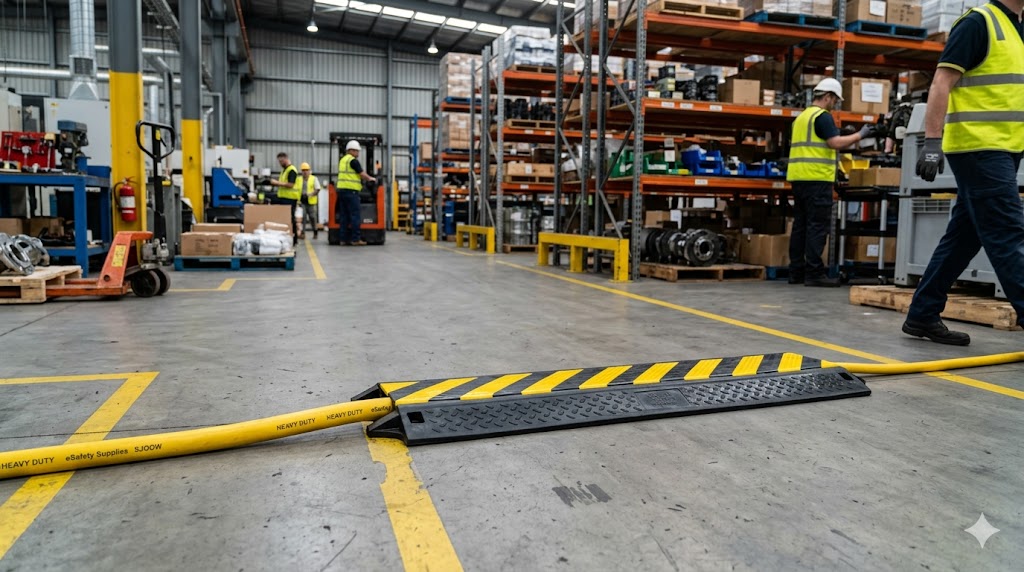
In high-velocity warehouse layouts, manufacturing floors, and temporary construction zones, flexible electrical cords are vital operational lifelines. They keep your power tools humming, your industrial fans moving, and your temporary workstations powered up. Yet, because they are so commonplace, extension cords are also one of the most frequently abused assets on the shop floor—making them a primary target for quick-acting OSHA compliance inspectors.
Electrical violations consistently rank among OSHA’s annual "Top 10" most cited workplace hazards. A single frayed jacket, a missing grounding pin, or an extension cord run through a drop-ceiling tile can trigger substantial "Serious Violation" fines and instantly damage your company's safety metrics during a surprise regional audit.
Balancing operational power needs with strict legal mandates requires knowing exactly where temporary power ends and structural violations begin. This comprehensive compliance guide breaks down the essential technical parameters of OSHA extension cord regulations, outlines strict daily inspection protocols, and delivers an audit-ready blueprint to keep your facility fully energized and accident-free.
What are the Official OSHA Rules for Extension Cords?
Under OSHA regulations 29 CFR 1910.305 and 1926.405, extension cords (referred to legally as flexible cords) **shall only be used for temporary power** during maintenance, remodeling, repair, or experimental work. OSHA strictly prohibits using extension cords as a **substitute for the fixed wiring** of a structure. Cords cannot be attached to building surfaces, run through holes in walls, ceilings, or floors, or be concealed behind walls or structural panels. Additionally, all workplace extension cords **must be heavy-duty or extra-heavy-duty**, three-wire grounded, and protected by a Ground Fault Circuit Interrupter (GFCI) in construction or damp environments.
The OSHA Electrical Cord Compliance Matrix
Federal electrical codes outline clear boundaries for cord design, length, and environmental deployment. Utilizing basic residential-grade power strips or unrated hardware in a commercial setting will result in an immediate inspection write-up.
| Compliance Parameter | OSHA / NEC Standard Requirement | Operational Safety Purpose |
|---|---|---|
| Time Limits (Temporary Use) | Maximum 90 days for festivals/events; restricted to active project duration for construction. | Prevents insulation degradation from long-term environmental exposure. |
| Grounding Configuration | Must be a 3-prong grounded cord assembly (unless tools are certified Double-Insulated). | Provides a safe path for fault current, preventing severe user shock. |
| Jacket Rating Code | Must feature hard-service or extra-hard-service markings (e.g., S, ST, SO, SOW). | Guarantees resistance to crushing, abrasion, oils, and structural punctures. |
| GFCI Protection | Mandatory for all construction sites and wet/damp industrial spaces. | Instantly cuts power if a current leak to ground is detected, saving lives. |
| Strain Relief | Must be perfectly intact at the plug and socket joints; no exposed copper conductors. | Prevents physical pulling forces from disconnecting wires internally and causing arcs. |
1. The "Temporary Power" Mandate: Stopping the Permanent Substitute Trap
The most common citation involving flexible cords is the "permanent installation trap." When a new piece of warehouse machinery or a packaging workstation is deployed far from an existing wall outlet, crews frequently run a heavy-duty extension cord along the floor or zip-tie it to structural steel joists to bridge the gap indefinitely.
OSHA considers this a direct violation of fixed-wiring standards. If an asset requires constant, everyday electrical access to execute a standard production shift, you must hire a licensed electrician to drop permanent conduit and install a hardwired junction box or wall receptacle. Extension Cords are legally intended to move from zone to zone within a shift or project window—not to serve as structural infrastructure.
2. Cable Protection, Concealment, and Physical Hazards
Because flexible cords lack the robust protective shielding of metallic conduit, where and how you route them determines your level of compliance risk. Concealing a cord to make a work zone look neat often creates hidden structural fire hazards.
- The Concealment Ban: Cords must never be run through holes in drywall, dropped through suspended acoustic ceiling tiles, or routed under heavy rugs or industrial floor mats. Trapping a cord traps the radiant heat generated by electrical resistance, melting the insulation polymer and igniting surrounding building materials.
- Physical Damage Defenses: If a temporary cord must cross an active walking path or forklift lane, it cannot lie unprotected on the concrete. It must be enclosed inside a high-visibility, heavy-duty rubber cord ramp to prevent wheels and boots from crushing the copper strands inside.
3. The Assured Equipment Grounding Conductor Program (AEGCP)
On construction job sites, OSHA mandates a comprehensive defensive system against electrical shocks. Employers must implement either a universal GFCI deployment protocol or a strict Assured Equipment Grounding Conductor Program (AEGCP). This program requires a dedicated safety coordinator to maintain an audit log of physical continuity tests:
- Daily Visual Inspections: Drivers, operators, and field hands must visually check their cords before every single shift for deformed pins, cracked jackets, or internal loose connections.
- Periodic Continuity Testing: All equipment grounding conductors must be physically tested with a multimeter for electrical continuity at intervals not exceeding 3 months. These tests must be logged, often indicated by color-coded vinyl tape wrapped near the male plug end to prove compliance status to field inspectors.
Frequently Asked Questions About OSHA Cord Rules
1. Can you repair a damaged extension cord with electrical tape?
No. OSHA explicitly prohibits patching deep cuts, punctures, or jacket separations on extension cords using standard electrical tape. If the outer jacket is compromised to where the inner colored insulation is visible, the cord must be taken out of service immediately. The only legal repair method is cutting out the damaged segment and installing an OSHA-approved replacement male or female cord cap terminal, provided the remaining cord length maintains its structural integrity.
2. Is "daisy-chaining" extension cords an automatic OSHA violation?
Yes. Plugging one extension cord into another—technically known as "daisy-chaining"—violates National Electrical Code (NEC) standards and OSHA 1910.303(b)(2). Connecting multiple cords increases total electrical resistance, causing the assembly to heat up excessively and dramatically dropping the voltage delivered to the power tool, which can burn out equipment motors or start a fire.
3. How do I read the markings on an OSHA-compliant cord?
Look at the outer jacket stamp. Compliant industrial cords feature specific letters indicating structural durability. "S" stands for Service (heavy-duty); "O" means Oil-resistant; and "W" designates Weather-resistant (outdoor rated). An "SOOW" cord represents the gold standard for industrial environments, proving it can withstand rugged oils, moisture, and rough mechanical handling.
4. Are two-prong extension cords legal in a commercial warehouse?
Only under extremely narrow circumstances. A two-prong extension cord is only permissible if it is powering a certified, factory-labeled **Double-Insulated** power tool or appliance. However, because warehouses are highly dynamic environments where any driver or worker might plug in a standard grounded tool by mistake, most safety directors ban two-prong cords entirely from their facilities to ensure foolproof safety.
5. What is the maximum legal length for an industrial extension cord?
OSHA regulations do not specify a hard maximum physical length. However, the National Electrical Code and electrical engineering guidelines warn against excessive voltage drop. Running a standard 16-gauge cord out past 100 feet drops voltage significantly under load. For longer runs, safety managers must upgrade to thicker 12-gauge or 10-gauge heavy conductor assemblies to ensure safe transmission.
Actionable Next Steps: Eliminate Electrical Hazards Today
Allowing worn out, unrated, or permanently installed extension cords to clutter your facility floor is a dangerous gamble with worker safety and corporate liability. Protect your production crew and secure your operational uptime by conducting a comprehensive site-wide electrical cord sweep across your facility lines this week.
Are your temporary power lines fully protected by heavy-duty rubber ramps? Are your cords stamped with the correct industrial service codes? Equip your teams with structural power assets built to withstand heavy operations.
Procure Industrial OSHA-Compliant Electrical Safety Gear Today
Explore eSafety Supplies’ professional electrical safety inventory to secure premium, ultra-rugged SOOW industrial extension cords, heavy-duty commercial cord protectors, and field-ready inline GFCI adapters engineered to keep your facility 100% compliant and fully powered.
Shop OSHA Compliant Electrical Equipment
Managing an enterprise network or multi-state facility portfolio? Contact our dedicated B2B commercial accounts specialist team for high-volume contract pricing.
About the Author
Mick Chan is a Senior EHS Compliance Specialist and Safety Content Strategist with over 15 years of boots-on-the-ground experience auditing industrial facilities, logistics hubs, and construction zones across the Western United States. Raised in the San Gabriel Valley, California, Mick holds a Bachelor of Science degree from California State University, Los Angeles (CSULA). He specializes in translating complex federal OSHA codes and National Electrical Codes (NEC) into practical, high-efficiency operational safety programs that shield companies from liability and protect industrial workforces.