Quick Answer
Nitrile can be a useful glove material for cleaning, but “nitrile” alone does not tell you whether a glove resists the cleaner or disinfectant in your hand. Read the product label and safety data sheet, then check the exact glove manufacturer's chemical-resistance information for the concentration and contact time. Choose cuff length, grip, and a disposable or reusable design for the actual cleaning task.
Who This Guide Is For
This guide is for teams buying gloves for routine facility cleaning and chemical preparation. It is educational, not a universal chemical-compatibility chart. Follow the cleaner's instructions, the safety data sheet, site hazard assessment, and the glove maker's current test data. Healthcare and other regulated settings may have additional infection-control procedures.
Start With the Bottle, Not the Glove Box
“We use nitrile gloves” sounds like a complete PPE policy until the supply room adds a new degreaser or concentrated disinfectant. The gloves on the shelf may be thin disposable exam gloves; the new task may involve repeated wet contact, splashing, or a longer exposure. Even within one material, glove formulation and thickness differ.
List each cleaning product and how workers use it. Is it ready to use or diluted on site? Do workers spray and wipe, immerse a cloth, pour concentrate, or clean a large spill? Note the chemical, concentration, duration, and likely splash path. The product's safety data sheet and label may specify gloves, eye protection, ventilation, and other controls. OSHA's hand-protection rule directs employers to select gloves based on the task, conditions, duration, and identified hazards.
This is not about finding the thickest glove in a catalog. OSHA's PPE selection appendix warns that no glove protects against every chemical. For mixtures, the component that breaks through a glove fastest can drive the selection. Ask the glove maker for data on the exact product and chemical where available.
Disposable or Reusable?
Thin disposable nitrile gloves can make sense for short, low-exposure tasks when the chemical data supports them and the worker changes them as required. They can also be practical when cross-contamination is a concern. But a disposable glove is easy to overuse: a worker may rinse it, keep it on through several products, or overlook a small tear.
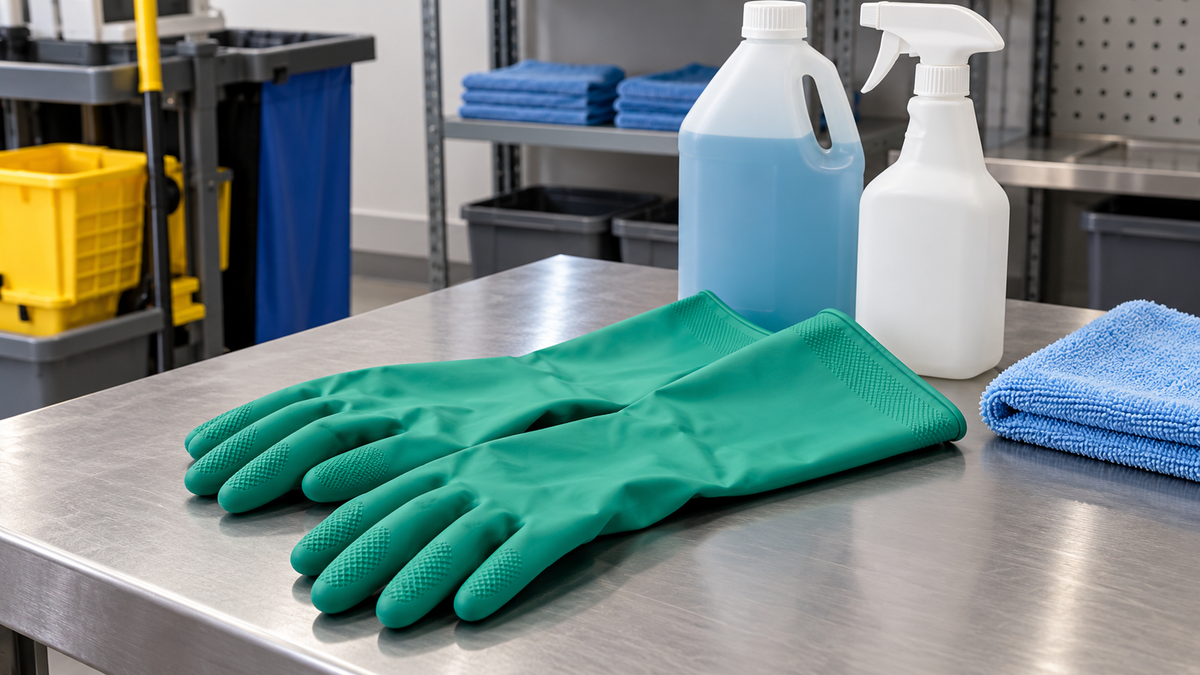
Longer reusable chemical-resistant nitrile gloves can offer a longer cuff and a sturdier grip for some wet tasks. They still need documented chemical suitability, a cleaning and storage procedure, and inspection before reuse. A long cuff can help with splash coverage, but it is not proof of resistance to a particular disinfectant or solvent.
CDC's healthcare cleaning guidance offers a useful distinction: it calls for chemical-resistant gloves when preparing cleaning chemicals and points staff to the SDS for PPE selection. It also describes reusable rubber gloves for certain cleaning tasks. Those healthcare examples do not automatically define the right glove for every workplace; they illustrate why task and exposure matter more than a broad material name.
Five Checks at the Supply Shelf
- Chemical match. Read the cleaner's current SDS and the glove manufacturer's resistance or breakthrough information. Check the actual dilution, not only the concentrate's name.
- Exposure time. A quick wipe is different from repeated immersion. Set a change interval based on the task, test data, and glove instructions.
- Cuff and splash path. Consider whether liquid can run into the glove when hands are raised or submerged. Coordinate glove cuffs with sleeves or an apron.
- Grip and fit. Test the glove on wet bottles, mop handles, and other real tools. A loose glove may snag; one that is too tight may split at the fingertips.
- Reuse and disposal. Decide who inspects, cleans, stores, and replaces reusable pairs. Discard contaminated disposable gloves as required by the workplace procedure.
Do not mix cleaning products unless the product instructions and workplace procedure specifically permit it. OSHA's cleaning-chemical guidance warns that combinations such as bleach and ammonia can release dangerous gases. Gloves are not a solution to an unsafe mixture.
What to Buy First
For a site with several cleaners, make a short glove-to-task matrix. Each row should name the cleaner, concentration, application method, required glove model, allowed use time, and replacement trigger. Keep it near the dispensing station and revise it when products change. This prevents a new concentrate from quietly inheriting the glove choice made for a mild ready-to-use spray.
The ESS chemical-resistant nitrile glove collection includes longer-cuff and other reusable designs; the disposable nitrile collection covers a different set of tasks. Neither collection is a compatibility chart. Verify each model against the cleaner before buying, and use the chemical-resistant glove guide for the broader material-selection process.
Frequently Asked Questions
Are nitrile gloves safe for bleach?
It depends on the exact bleach product, concentration, contact time, and glove model. Read the label and SDS, then check the glove manufacturer's chemical-resistance data. Do not infer suitability from the word “nitrile.”
Should cleaning crews wear disposable or reusable gloves?
Both can have a place. Select for the exposure, task length, contamination risk, and maintenance procedure. A reusable pair needs inspection and cleaning; a disposable pair needs timely changes and proper disposal.
Does a thicker nitrile glove always protect longer?
Not necessarily. Thickness is one factor, but formulation and chemical-specific permeation data matter. Compare exact glove models, not only mil numbers.
Final CTA
Compare ESS chemical-resistant nitrile gloves with the cleaners your team actually uses. Bring the product label, SDS, and expected contact time to the selection so the final order solves the real task.
About Mick Chan: Mick Chan contributes safety supply guidance for eSafetySupplies content, with a focus on practical PPE selection, workplace readiness, and helping teams connect safety requirements to the right supplies. His review perspective is included to keep recommendations grounded in real purchasing and jobsite use.