
For commercial property managers, asphalt paving contractors, and business owners across the United States, managing a parking lot isn't just about smooth blacktop and fresh paint. It is a highly litigated regulatory landscape. Among all the compliance frameworks you must maintain, ADA parking sign requirements are the most scrutinized.
A single accessible parking space missing the correct penalty language, striped incorrectly, or mounted even two inches below federal mandates is a direct invitation for a failed municipal inspection or an expensive Americans with Disabilities Act Title III civil lawsuit. Understanding the intersection of the Department of Justice (DOJ) ADA Standards for Accessible Design and the Manual on Uniform Traffic Control Devices (MUTCD) can save your operation thousands of dollars in penalties. This guide provides an inspection-ready blueprint detailing exact mounting heights, sign layouts, and stall configurations to keep your facility accessible, lawful, and 100% compliant.
What is the Legal Mounting Height for ADA Parking Signs?
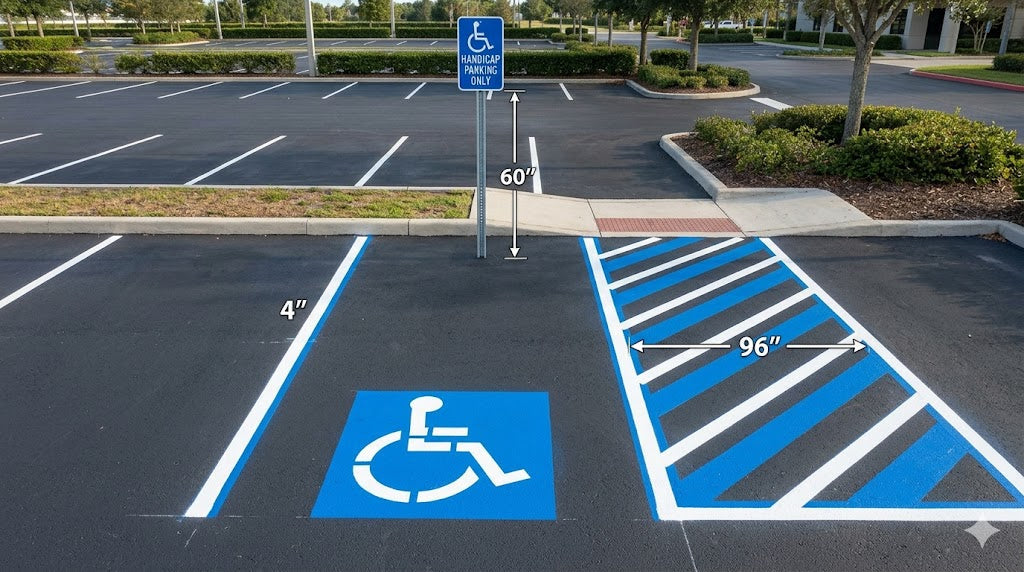
Under federal ADA Standards Section 502.6, all parking space identification signs must be mounted on a permanent post or wall with the bottom edge of the lowest sign at least 60 inches (5 feet) above the ground surface, measured directly from the pavement or sidewalk to the bottom of the sign. This exact height requirement ensures that the International Symbol of Accessibility (ISA) remains completely visible to oncoming traffic and security enforcement even when a large high-roof van or SUV is parked directly in the stall.
The Master Compliance Matrix: Federal Sizing and Height Rules
Federal civil codes establish the absolute floor for accessibility compliance, not the ceiling. If your municipal or state guidelines are stricter, the law requires you to follow the stricter parameter. Below is the baseline physical breakdown for a standard accessible stall.
| Compliance Element | Federal Specification | Technical Purpose |
|---|---|---|
| Minimum Mounting Height | 60 inches (5 feet) from ground to bottom edge | Preserves sign visibility over parked vehicles |
| Standard Sign Dimensions | 12 inches wide x 18 inches tall (MUTCD) | Ensures maximum legibility from driving aisles |
| Reflective Sheeting | Engineering Grade or High Intensity Prismatic | Guarantees nighttime illumination via headlights |
| Standard Stall Width | Minimum 96 inches (8 feet) wide | Provides adequate room for standard vehicle egress |
| Van-Accessible Stall Width | 132 inches (11 feet) or 96 inches with 96-inch aisle | Accommodates side-loading wheelchair mechanical lifts |
1. The 60-Inch Mounting Rule: Common Measurement Failures
The single most common violation caught during a facility safety audit is an improperly mounted sign. Many maintenance crews mistakenly mount signs at "eye level" (approximately 48 to 54 inches) or measure from the wrong surface baseline.
When stacking two signs on a single post (e.g., the Blue ISA Wheelchair Sign on top, and a "Minimum Fine $250" or "Van Accessible" plaque below), the 60-inch measurement MUST be taken from the ground to the bottom edge of the LOWEST plaque.
Actionable Installation Protocols:
- Measure from the Grade: Always measure the 60 inches from the exact pavement or sidewalk surface directly beneath the post—never from an adjacent sloped road or lower drainage curb.
- Deploy Permanent Posts: Ensure the post is anchored firmly in concrete or utilizing an approved breakaway system according to local traffic engineering guidelines to resist heavy wind loads and minor bumper impacts.
2. Van-Accessible Signage and Quantity Allocations
You cannot simply designate every accessible stall with a standard wheelchair sign. The federal government requires a specific ratio of your spaces to be explicitly engineered for lift-equipped vans.
- The 1-in-6 Allocation Rule: For every six accessible parking spaces in a lot, at least one must be a van-accessible space. If your lot contains only one total accessible space, that single space must be configured as van-accessible.
- The Double-Sign Mandate: Van-accessible spaces require an additional, distinct plaque stating "Van Accessible" mounted directly below the International Symbol of Accessibility.
- Vertical Clearance: Van spaces, along with their adjacent access aisles and the incoming vehicular route, must maintain at least 98 inches of clear vertical clearance to protect raised-roof vans from striking structural overhangs or low-hanging trees.
3. High-Traffic Engineering: Reflectivity and Materials
The MUTCD mandates that all parking identification signs within a public or commercial parking lot be constructed with retroreflective sheeting. Non-reflective, painted steel or plastic retail signs have zero legal standing in a commercial environment.
Material Specifications for Passing Inspections:
- Rust-Free Aluminum Blocks: Utilize heavy-duty, .080-gauge rust-free aluminum sign blanks. This industrial grade prevents the sign from warping, bending, or scaling over years of extreme ultraviolet (UV) or winter weather exposure.
- Reflective Film Grades: Ensure the face utilizes high-intensity prismatic sheeting. This ensures that when a vehicle turns into the parking lane at night, its headlights immediately illuminate the blue and white boundary symbol, preventing accidental illegal parking.
4. Ground Markings and Access Aisle Coordination
Vertical post-mounted signs are only one half of the compliance equation. They must align perfectly with your ground paint pavement striping.
- The No-Decal Trap: While painting a 36-inch tall blue and white wheelchair icon on the asphalt is an excellent best practice, surface decals cannot replace vertical signage. Under federal law, the post-mounted sign is what legally establishes the space.
- Cross-Hatched Access Aisles: Adjacent to your accessible spaces must be a cross-hatched access aisle (minimum 60 inches wide for standard cars, 96 inches for vans) painted with durable traffic paint to discourage other motorists from parking directly next to a wheelchair unloading zone.
Frequently Asked Questions About ADA Parking Signs
1. Can I mount an ADA parking sign directly to a building wall?
Yes, you can mount an ADA sign directly to a structural exterior wall, but only if the building wall sits directly at the head of the designated parking stall. You must still adhere strictly to the 60-inch minimum height rule from the walkway pavement to the bottom edge of the frame. If a sidewalk runs between the wall and the car, a post-mounted installation is required to keep the sign at the front of the space.
2. What happens if federal ADA rules conflict with my state's parking sign rules?
When federal and state rules overlap, the strictest standard always wins. For example, California Title 24 requires a minimum fine notification sign ($250) and a tow-away warning plaque, which federal guidelines don't explicitly require. If you operate in California, omitting those state-mandated elements will result in a compliance failure, even if your post sits exactly at 60 inches.
3. Are private or gated business parking lots exempt from ADA signage rules?
No. Title III of the ADA covers all places of "public accommodation," which includes private commercial facilities, retail stores, warehouses, office complexes, and multi-family residential housing properties. If employees, clients, tenants, or delivery couriers have vehicular access to the property, the lot must feature legally compliant accessible stalls.
4. What is the standard physical size of a commercial handicap parking sign?
The standard industrial size recommended by the MUTCD and utilized by municipal inspectors is 12 inches wide by 18 inches tall for the primary accessibility marker, and 12 inches wide by 6 inches tall for secondary modifier plaques (like "Van Accessible" or fine warnings).
5. Can a business be fined if an ADA parking sign is faded or weathered?
Yes. Under asset maintenance provisions, if a sign becomes severely faded, spray-painted by vandals, or damaged by an impact to the point where the retroreflective properties or the International Symbol of Accessibility are no longer clearly legible at night, it loses its legal standing and can trigger code violations during an audit.
Actionable Next Steps: Audit Your Property Layout This Week
An unvetted parking lot is an open target for structural compliance failures and predatory public lawsuits. Protect your business infrastructure, minimize your organizational liability, and provide a welcoming, accessible environment for all visitors by running an absolute physical audit on your property lines this week.
Are your sign posts sitting at a true 60 inches? Are your van allocations legally structured?
Upgrade Your Commercial Property Layout Today
Explore eSafety Supplies’ comprehensive inventory of commercial-grade regulatory assets, including rust-free aluminum ADA parking signs, high-durability breakaway u-channel posts, and premium industrial traffic paints engineered to keep your facility safe, visible, and 100% compliant.
Shop Compliant Regulatory Traffic Signs
Seeking custom penal code language modifications or bulk volume asset pricing? Contact our dedicated industrial support team today.
About the Author
Mick Chan is a Senior EHS Compliance Specialist and Safety Content Strategist with over 15 years of boots-on-the-ground experience auditing industrial facilities, logistics hubs, and commercial assets across the Western United States. Raised in the San Gabriel Valley, California, Mick holds a Bachelor of Science degree from California State University, Los Angeles (CSULA). He specializes in translating dense, overlapping federal codes into high-efficiency operational assets that shield businesses from liability and keep public spaces safe.